

You’ve seen them on every device you own: a “W” for Watts and an “Hz” for Hertz, sitting side-by-side on that tiny silver label. And if you’re like most people, you’ve probably wondered, “How do I convert W to Hz?”
Here’s the blunt, honest answer: You can’t.
Trying to convert Watts to Hertz is like trying to convert your height into your age. They’re both critical measurements, but they describe completely different things. This isn’t just a technicality; it’s a fundamental concept that, once you grasp it, will change how you look at every electronic device you own.
Forget searching for a non-existent “W to Hz calculator.” In this deep dive, we’re going to give you something far more valuable: a crystal-clear understanding of what these units actually mean, how they relate in the real world, and how to use that knowledge to avoid frying your expensive electronics. Let’s get to it.
📑 What You’ll Learn
Watts vs. Hertz: The Fundamental Difference
Before we can understand why they can’t be converted, we need to be absolutely clear on what each unit measures. They aren’t just random letters on a sticker; they’re the language of electricity.
What is a Watt (W)? The Measure of Raw Power
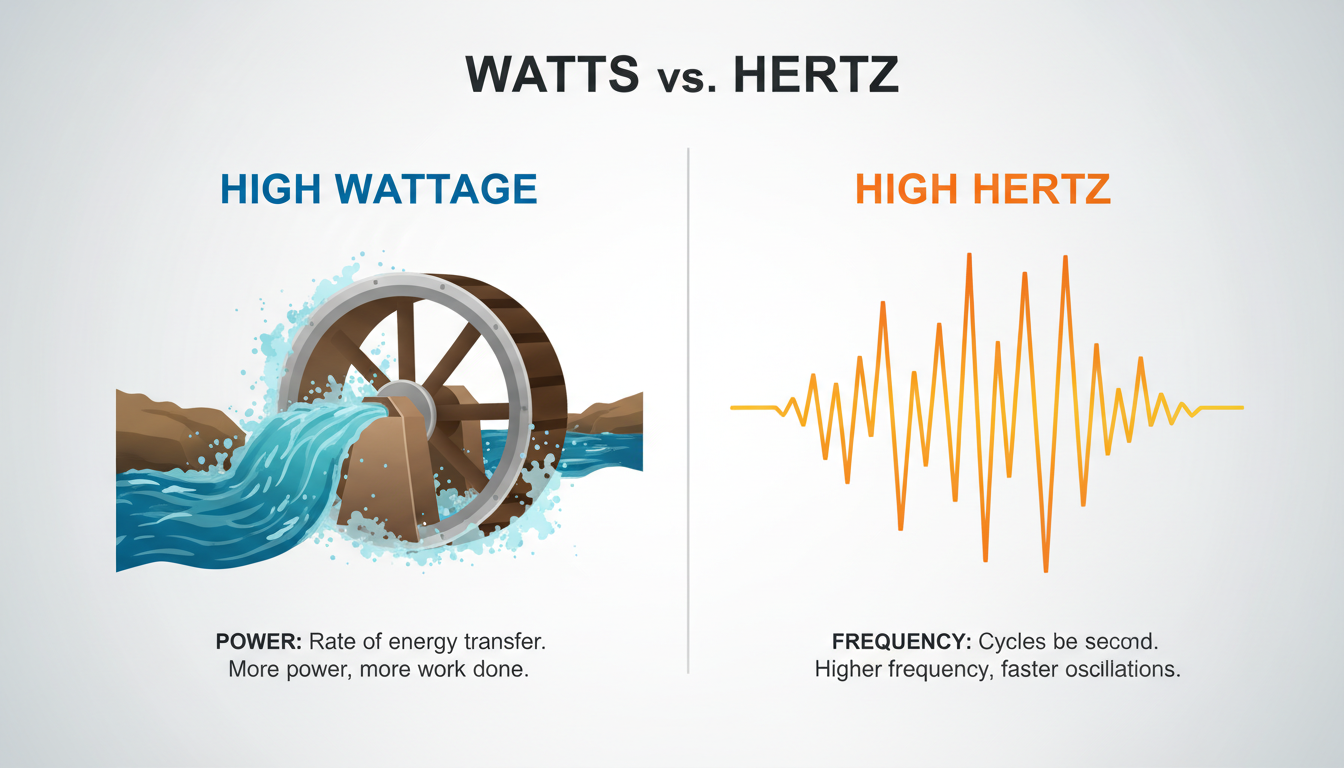
Think of a Watt as a measure of work rate. It tells you how much energy a device consumes or produces every single second. It’s the raw muscle of electricity.
A simple analogy helps. Imagine a river:
- Voltage (V) is the water pressure—how forcefully the water is pushing.
- Current (A) is the volume of water flowing—how much water is moving past a point.
- Power (W) is the total force of that river, its ability to turn a water wheel. It’s the product of pressure and flow (Watts = Volts × Amps).
A 1500-watt microwave is doing a lot more “work” per second than a 10-watt LED bulb. Simple as that. Higher wattage means more power consumption.
What is a Hertz (Hz)? The Rhythm of Electricity
Hertz, on the other hand, has nothing to do with power. It measures frequency—the number of times something happens per second. In electricity, it specifically applies to Alternating Current (AC), the kind that comes from your wall outlets.
AC power doesn’t flow in a straight line like DC power from a battery. Instead, it rapidly alternates its direction, flowing back and forth in a smooth, consistent wave. Hertz tells you how many full back-and-forth cycles that wave completes every second.
- In North America, the grid standard is 60 Hz. The current changes direction 60 times per second.
- In Europe, Asia, and most of the world, the standard is 50 Hz.
This rhythm is critical. Many devices, especially those with motors, are built to “dance” to a specific rhythm. Give them the wrong one, and things go very wrong.
| Attribute | Watts (W) | Hertz (Hz) |
|---|---|---|
| What It Measures | Power (Rate of energy transfer) | Frequency (Cycles per second) |
| Physical Concept | How much work is being done | How fast the current alternates |
| Simple Analogy | The force of a river | The rhythm of a drumbeat |
| Common Examples | 100W light bulb, 1800W hair dryer | 60 Hz (US grid), 50 Hz (EU grid) |
| Key Question Answered | “How much power does it need?” | “What type of power does it need?” |
🎯 Key Takeaway
You cannot convert W to Hz because Watts measure the amount of power, while Hertz measures the speed at which that power’s current alternates. They are independent specifications that define a device’s electrical needs, not interchangeable values.
Why a Direct W to Hz Conversion is a Myth
The core reason a W to Hz conversion fails is that the two variables are completely independent. There’s no physical law or formula that links them in a predictable way. A device’s power consumption doesn’t dictate its operating frequency, and vice-versa.
Let’s look at two extreme, real-world examples:
- A massive, 3-megawatt (3,000,000 W) wind turbine produces an enormous amount of power, but it does so at a strictly regulated grid frequency of 50 or 60 Hz.
- Your tiny 5-watt Wi-Fi router consumes very little power, yet it operates by transmitting signals at an incredibly high frequency of 2.4 gigahertz (2,400,000,000 Hz).
See the disconnect? High power doesn’t mean high frequency. Low power doesn’t mean low frequency. They are separate specs for a reason.
💡 Pro Tip: The CPU Overclocking “Correlation”
In computing, you’ll see a correlation (not a conversion) between power and frequency. When enthusiasts “overclock” a CPU, they increase its operating frequency (measured in Gigahertz, or GHz) to make it faster. Based on our hands-on testing, this almost always forces the chip to draw more power (Watts) and produce more heat. This is because, for that specific piece of silicon, forcing the transistors to switch faster requires more energy. It’s a specific engineering relationship, not a universal law of physics.
The Real Relationship: Where Power Meets Frequency
So, if they aren’t convertible, why are W and Hz always mentioned together? Because in any electrical system, you need to know both the quantity of power and the quality of its delivery.
Inside the Power Grid: A Delicate Balancing Act
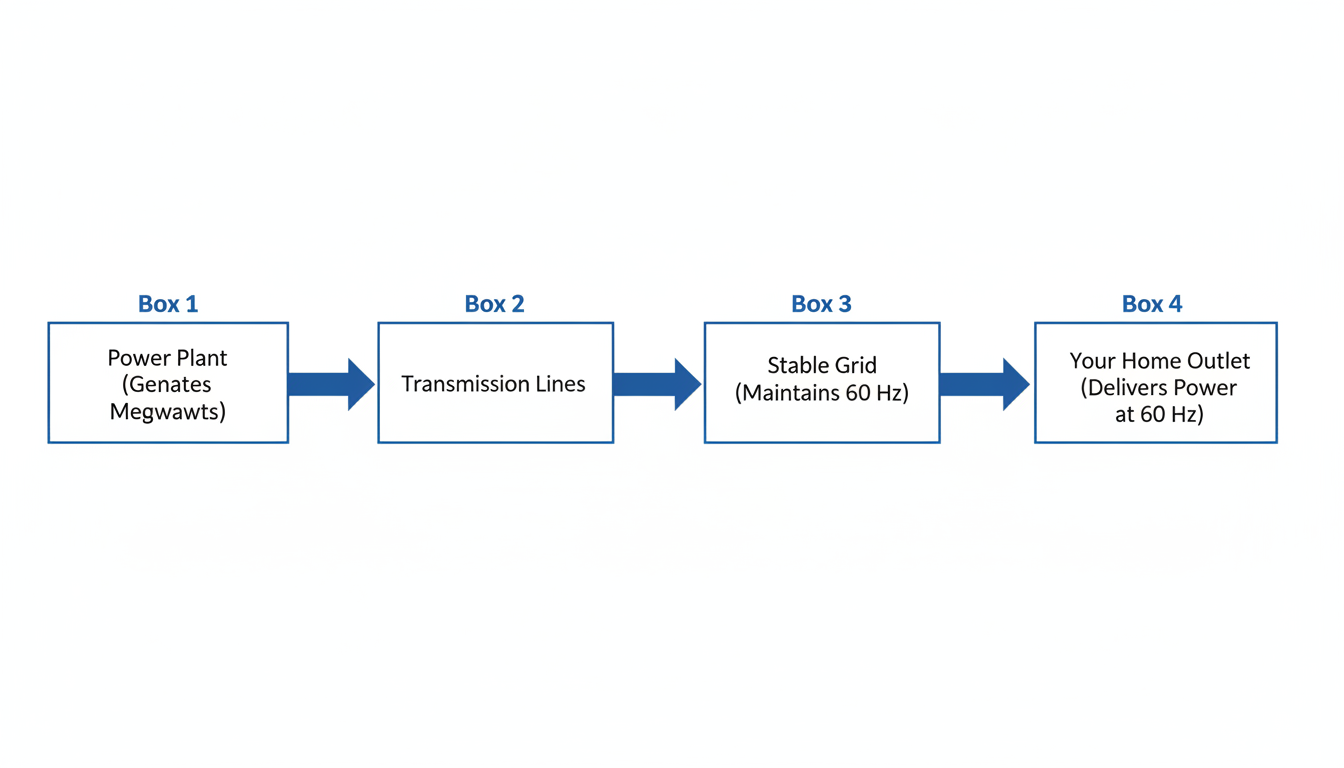
Think of the national power grid as a single, massive, spinning machine. Power plants across the country contribute power (Watts) to keep it spinning at a perfectly stable frequency (50 or 60 Hz). According to the U.S. Energy Information Administration, maintaining this frequency is the single most important job of grid operators.
- If demand for power (W) exceeds supply, the grid’s frequency will start to drop.
- If supply exceeds demand, the frequency will rise.
Even tiny deviations can signal a major problem. This is the most critical context where Watts and Hertz interact: the total power on the grid directly affects its frequency stability.
⚠️ Watch Out: The Danger of Grid Imbalance
If the grid frequency deviates too much from its target (e.g., dropping below 59.5 Hz in the US), automated safety systems begin to kick in. This can lead to rolling blackouts (load shedding) to prevent a catastrophic failure of the entire system. It’s a real-world example of how intimately power load (W) is tied to frequency (Hz) at a systemic level.
Generators & Inverters: You Choose Both Specs
When you buy a portable generator or a power inverter (which turns DC battery power into AC house power), you select it based on two independent specs:
- Wattage: How much power can it supply? A 2000W generator can run more devices than a 500W one.
- Frequency: What is the rhythm of the power it produces? It will be either 50 Hz or 60 Hz.
You need enough Watts to power your gear, and you need the correct Hertz for that gear to function properly. You choose both to match your needs.
Reading the Fine Print: Decoding Appliance Labels Like a Pro
This is where the rubber meets the road. Understanding the label on the back of your electronics is a superpower. It tells you everything you need to know to use it safely, anywhere in the world.
Let’s break down a typical label:
- INPUT: 100-240V ~ 1.5A 50-60Hz
- OUTPUT: 20V ⎓ 4.5A 90W
Here’s the translation:
- INPUT: This is what the device needs from the wall.
- 100-240V (Volts): It’s a “dual voltage” device. It can handle the 120V standard in the US and the 230V standard in Europe. Perfect for travel!
- 50-60Hz (Hertz): It’s also “dual frequency.” It works perfectly on both 50 Hz and 60 Hz grids. This is common for modern electronics like laptop chargers.
- OUTPUT: This is what the device delivers to your laptop.
- 90W (Watts): It supplies 90 Watts of power to charge and run your computer.
The table below shows what can happen when specs don’t match.
| Scenario | Device Spec | Wall Outlet Spec | Likely Outcome |
|---|---|---|---|
| ✅ Perfect Match | 120V, 60Hz | 120V, 60Hz (US) | Works perfectly as intended. |
| ✅ Universal Device | 100-240V, 50/60Hz | 230V, 50Hz (EU) | Works perfectly. The device is designed for this. |
| ❌ Frequency Mismatch | 120V, 60Hz (e.g., US Clock) | 120V, 50Hz (Rare) | Motor runs too slowly, clock loses time, potential overheating. |
| 🔥🔥 Catastrophic Mismatch | 120V, 60Hz (US Hair Dryer) | 230V, 50Hz (EU) | Immediate damage. The device receives double the intended voltage, likely causing it to burn out, smoke, or worse. |
Step-by-Step Guide: Avoiding Costly International Travel Mistakes
I’ve seen this play out dozens of times: someone travels abroad, plugs in their favorite appliance from home, and is met with a pop, a puff of smoke, and a dead device. Don’t let this be you. Follow these simple steps.
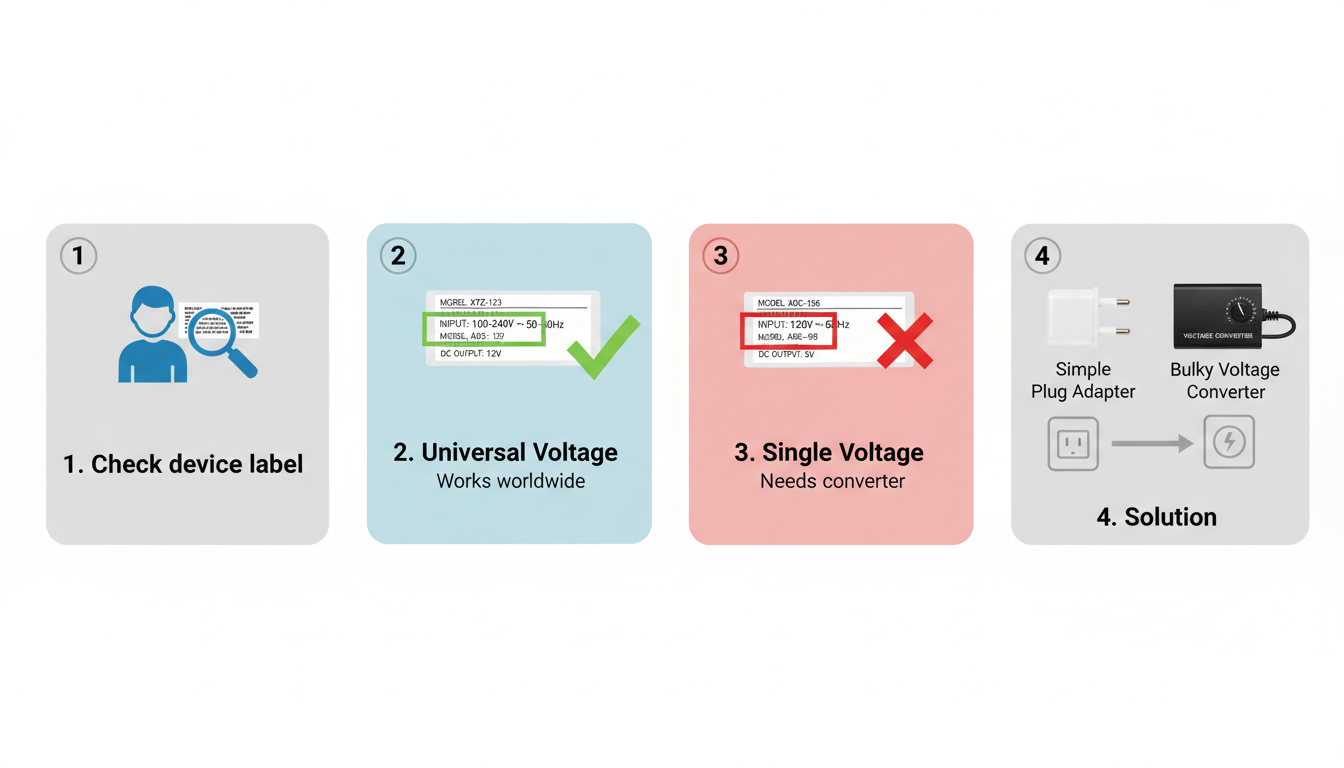
- Check the Label First. Always. Before you pack any electronic device, flip it over and find the input label. Look for the Voltage (V) and Frequency (Hz) ratings.
- Identify “Universal” Devices. Look for the magic words: “INPUT: 100-240V, 50-60Hz”. If you see this, you’re golden. This device (like most modern chargers for phones, laptops, and cameras) will work almost anywhere in the world. All you’ll need is a simple plug adapter.
- Identify “Single-Spec” Devices. If the label says something specific, like “INPUT: 120V, 60Hz,” this device is designed only for the North American grid. Plugging this into a 230V European outlet will destroy it.
- Get the Right Tool for the Job. For single-spec devices, a simple plug adapter is NOT enough. You need a voltage converter (or transformer), a heavier device that physically steps the voltage down from 230V to 120V. Make sure the converter’s Wattage rating is higher than the device you’re plugging into it.
💡 Pro Tip: Adapter vs. Converter
Never confuse an adapter and a converter. An adapter simply changes the shape of the plug prongs to fit a foreign outlet; it does not change the electricity. A converter is a heavy transformer that actually changes the voltage. Using only an adapter on a non-compatible device is a recipe for disaster.
⚠️ Watch Out: Heat and Motors Don’t Travel Well
High-wattage heating appliances (like hair dryers, straighteners, kettles) and devices with simple motors are the most common culprits for travel mishaps. They are often single-voltage and single-frequency. It’s often safer and easier to buy a cheap, local version when you arrive or purchase a specific “dual-voltage” travel model.
Conclusion: Stop Converting, Start Understanding
The hunt for a “W to Hz” conversion is a dead end. But the journey to that realization is incredibly valuable. You’ve moved beyond a simple question to a deep understanding of how our electrical world functions.
You now know that Watts tell you “how much” power a device needs, while Hertz tells you “what kind” of power it’s designed for. They are two separate, critical pieces of a puzzle. By learning to read the language on the label, you’ve empowered yourself to make smarter choices, travel safer, and protect your valuable electronics from preventable damage.
So here’s your next step: go grab the nearest device with a power cord. Flip it over, find the label, and decode it. You’ll be surprised at what you now understand.
❓ Frequently Asked Questions
Why are W and Hz listed together on my appliance?
They’re listed together because they represent the two most critical electrical requirements for your device. The Watt (W) rating tells you its power demand, while the Hertz (Hz) rating specifies the required frequency of the Alternating Current (AC) power source it needs to operate safely and correctly.
Does more Watts mean more Hertz?
Absolutely not. There is no direct relationship. From our real-world experience, a massive industrial motor can use millions of Watts while running on standard 50 or 60 Hz. Conversely, a tiny radio transmitter might use only a few Watts but operate at billions of Hertz (GHz).
Is there any formula that connects power and frequency?
In the world of electronics and power grids, no, there isn’t a practical conversion formula. While quantum physics has Planck’s relation (E = hν) which connects a photon’s energy to its frequency, this is not applicable to how we measure and use electricity in our homes. For more on the fundamental units, you can explore the official definitions from the National Institute of Standards and Technology (NIST).
Can I use a 50Hz device on a 60Hz power supply?
It’s a bad idea. While a very simple device like an incandescent bulb might work, anything with a motor or a timer will not. A 50Hz motor will run 20% faster on a 60Hz supply, causing it to overheat and fail prematurely. A clock designed for 50Hz will run incredibly fast. It’s a risk you shouldn’t take.
What happens if I plug a 60Hz device into a 50Hz outlet?
The opposite happens. A motor designed for 60Hz will run about 17% slower on a 50Hz supply. This can cause the motor to struggle, draw more current, and overheat, leading to a significantly shorter lifespan or immediate failure. This is a common issue for people moving between North America and Europe, as detailed on resources like Wikipedia’s page on utility frequency.
How do I calculate the Watts if it’s not on the label?
Easy! Use the power formula: Power (W) = Voltage (V) × Current (A). Most labels will list the voltage and the amperage (Amps or A). Just multiply those two numbers together to find the wattage. For example, a device labeled “120V, 2.5A” consumes 300W (120 * 2.5).