Your Username Is Taken. Again. Here’s How to Fix It for Good.
Let’s be honest. You’ve been there. You have the perfect idea for a new YouTube channel, a killer Gamertag, or a professional Instagram handle. You type it in, hold your breath, and… “Username unavailable.”
So you try again. You add your birth year. Taken. You add an underscore. Taken. You mash the keyboard in frustration and end up with something like `AwesomeCreator_87_YT`. It’s available, sure, but it feels… deflating. It lacks personality, it’s hard to remember, and it certainly doesn’t scream “professional brand.”
For over 20 years, I’ve built and optimized digital brands, and I’ve seen firsthand how a weak username can cripple a project before it even starts. It’s the very first piece of your digital identity people see, and a bad one is like showing up to a job interview in sweatpants. It sends the wrong message.
This is where most people give up and settle. But you’re not going to. Why? Because you’re about to learn how to use a username generator not as a random name picker, but as a strategic partner in crafting a powerful digital identity. Forget generic advice. We’re going deep on the psychology of memorable names, the framework for getting perfect results, and the common mistakes that sabotage 90% of people.
Why Your Username Is Your Most Underrated Brand Asset
Before we even touch a tool, we need a mental shift. A username isn’t just a login credential; it’s a tiny, powerful piece of marketing real estate. It’s your digital handshake, your calling card, and your brand’s first impression, all rolled into one.
Think about it. On platforms like Twitter, TikTok, or Twitch, your username is often seen even before your profile picture or bio. It sets the tone for every interaction. A name like `CryptoKing` tells a very different story than `JohnSmith_CPA`.
This isn’t just fluff; it’s backed by psychology:
- Cognitive Fluency: Our brains are wired to prefer things that are easy to process. A study published in the journal Consciousness and Cognition found that names that are easy to pronounce and spell are perceived more positively. A simple, catchy username like `ProGuides` is easier for the brain to handle than `xX_Pr0_Gamerz_Xx`, making it feel more familiar and trustworthy.
- The Halo Effect: This is a cognitive bias where our impression of one quality (like a professional username) influences our feelings about other qualities. A clean, relevant username can make your content, products, or opinions seem more credible before anyone has even engaged with them.
- Brand Recall: How easily can someone find you again after hearing your name once? According to branding research, consistency and simplicity are key. Using a consistent handle across platforms can boost brand recognition by over 20%. A username generator helps you find a unique name you can actually secure everywhere.
The ‘Username Taken’ Wall: Why Manual Brainstorming Fails
So, why is finding a good name so ridiculously hard? It’s a simple game of numbers, and the odds are stacked against you. Instagram has over 2 billion users. TikTok has over 1.5 billion. Every single one of them has a unique username.
All the good, short, single-word names are long gone. The clever combinations you think of have likely been thought of by thousands of others. This leads to the dreaded cycle:
- You brainstorm a cool name.
- It’s taken.
- You add a number or symbol, diluting the brand.
- You get frustrated and settle for something mediocre.
A username generator breaks this cycle. It’s not about replacing your creativity; it’s about augmenting it. It can process thousands of linguistic combinations in a second—alliteration, portmanteaus, niche keywords, prefixes, suffixes—ideas your brain might take hours to stumble upon. It’s your tireless brainstorming partner that never runs out of coffee or ideas.
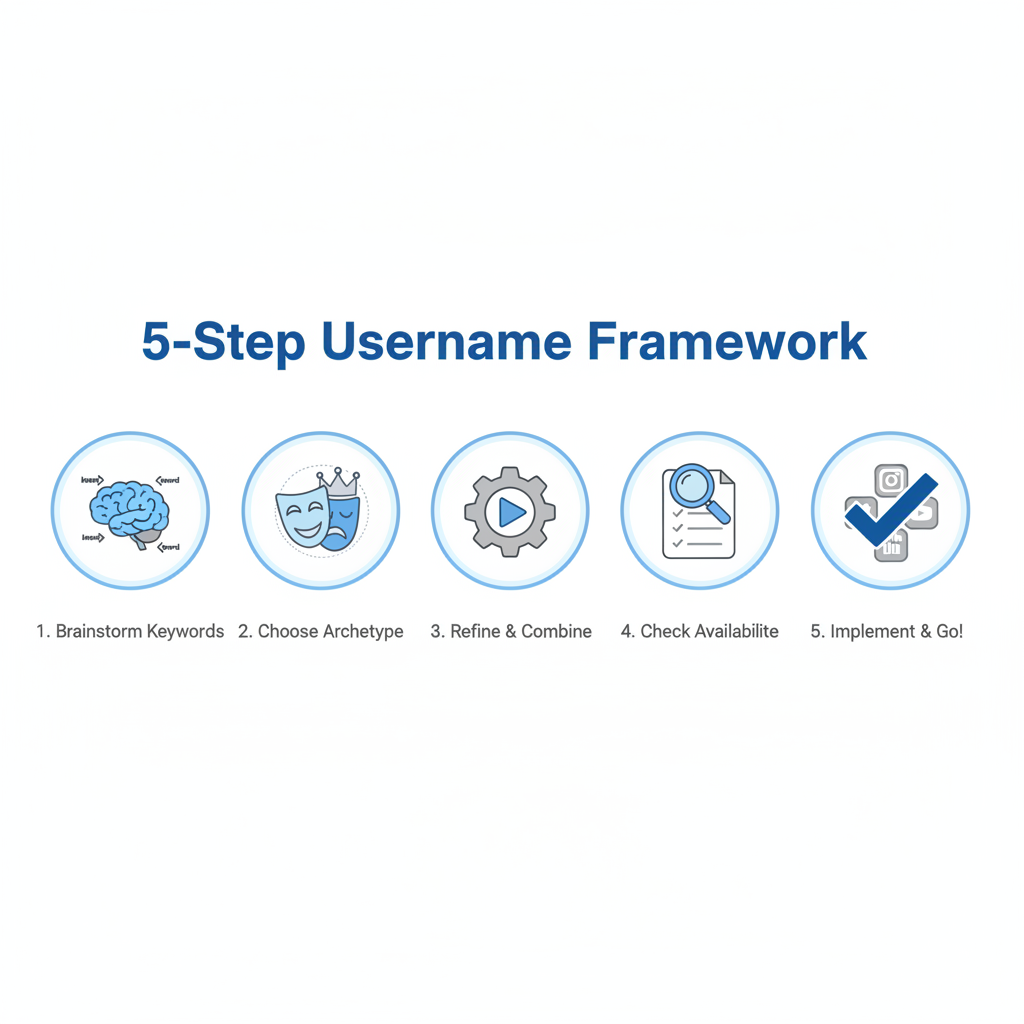
How to Strategically Use a Username Generator (My 5-Step Framework)
Simply typing one keyword into a generator and hoping for magic is a rookie mistake. Garbage in, garbage out. To get truly exceptional results, you need to provide smart inputs. Here’s the exact framework I use to craft brand-ready handles.
Step 1: Define Your Core Identity Keywords (The ‘Seed’ Words)
Start with a list of 5-10 words that are the DNA of your brand. Don’t just think literally. Think about the feeling you want to evoke. Ask yourself:
- Who am I? (e.g., developer, artist, coach, gamer)
- What do I do? (e.g., code, paint, train, explore)
- What is my niche? (e.g., Python, watercolor, keto, retro)
- What is my vibe? (e.g., calm, energetic, funny, minimalist, techy)
Example for a fitness coach: train, fit, strong, pulse, kinetic, ally, coach, gains, flex.
Step 2: Choose Your Archetype
Who are you trying to be online? This will guide the style of the name.
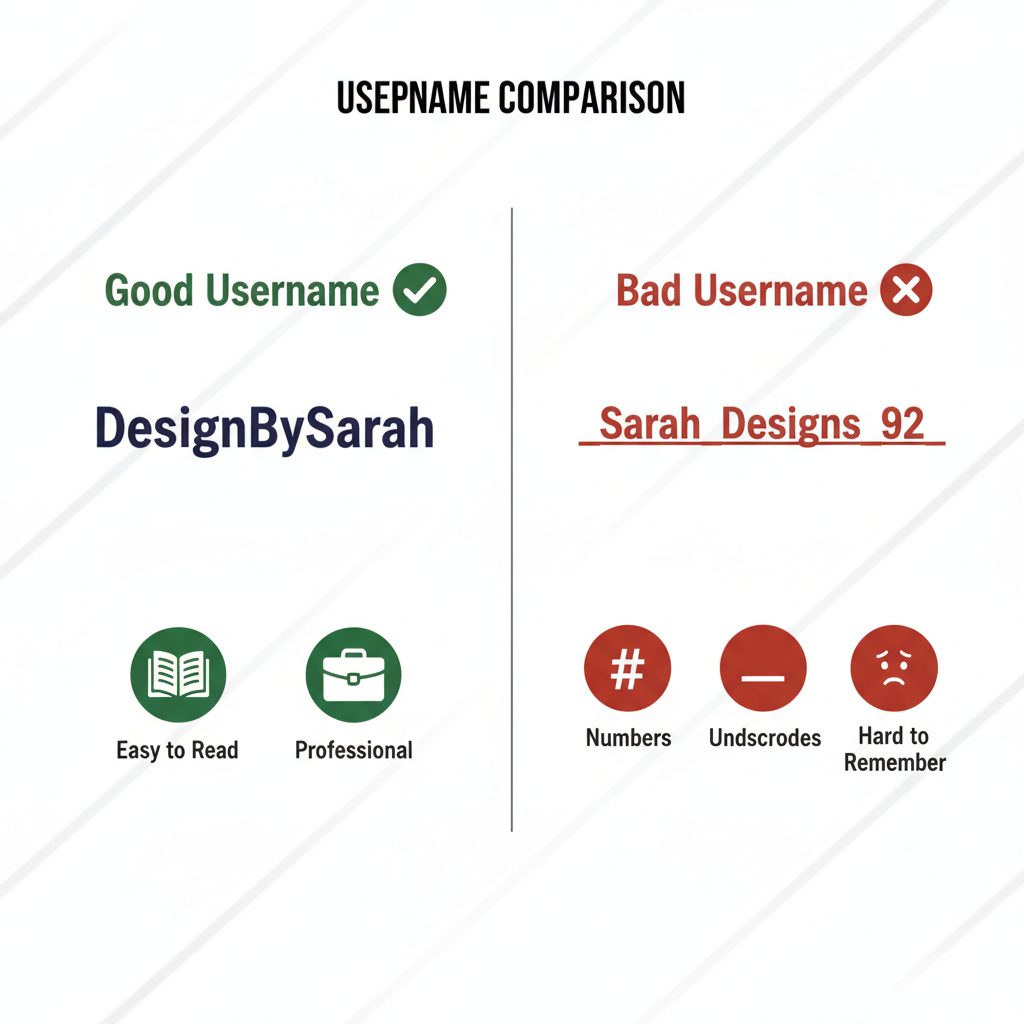
- The Professional: Combines your name or profession. (e.g., `DesignBySarah`, `DevMike`)
- The Creator: Catchy, brandable, and often abstract. (e.g., `MrBeast`, `PewDiePie`)
- The Gamer: Can be edgy, funny, or powerful. (e.g., `Ninja`, `Shroud`, `Pokimane`)
- The Anonymous: Random or abstract to protect privacy. (e.g., `PixelStorm`, `EchoSphere`)
Step 3: Provide Smart Inputs to the Generator
Now, feed your seed words into the username generator. But don’t stop there. Use the advanced options most good tools offer:
- Combine Keywords: Mix your primary keyword (e.g., “Fit”) with your vibe words (e.g., “Kinetic”). A generator might suggest `KineticFit` or `FitKinetic`.
- Add Prefixes/Suffixes: Look for options to add words like `HQ`, `Labs`, `Co`, `Pro`, `TV`, `Real`. This can instantly make a taken name available (`FitCoachHQ`).
- Set Character Limits: Shorter is almost always better. Aim for under 15 characters if possible.
- Use Rhyming or Alliteration: Some tools have features to find names that sound good, like `FitnessFlex` or `CoachClutch`.
Step 4: Curate and Refine the Output
The generator will give you a long list. Most of it will be junk. Your job is to be the curator. Scroll through and look for gems that meet the “S.M.A.R.T.” criteria:
- S – Simple: Is it easy to spell and type?
- M – Memorable: Does it stick in your head?
- A – Available: Is it free on your target platforms?
- R – Relevant: Does it align with your brand or niche?
- T – Timeless: Will it still sound good in 5 years? Avoid trends.
Step 5: The Cross-Platform Availability Check
This is the final, non-negotiable step. Just because a generator says a name is available doesn’t mean it is everywhere. Manually check your top 2-3 choices on every single platform you plan to use, even ones you might use in the future:
- Instagram, TikTok, YouTube, Twitter/X
- Twitch, Discord
- Pinterest, LinkedIn
- Domain name (.com, .co, etc.)
Finding a name that’s available across the board is the holy grail of digital branding. It creates a seamless, professional identity for your audience.
Beyond Availability: 7 Advanced Benefits of a Username Generator
A good username generator does more than just find an open slot. It’s a strategic tool that elevates your entire digital presence.
- Achieve Flawless Brand Consistency: A unified handle like `BrandName` across all platforms is far more powerful than `BrandName` on Twitter, `Brand_Name` on IG, and `BrandNameOfficial` on YouTube. A generator helps you find that one, perfect, universally available name.
- Enhance Your Security & Privacy: Using your real name or common details (like `JohnDoe1992`) makes you an easy target for doxxing or social engineering. A generator can create abstract, random usernames (`AetherByte`, `CrimsonPeak`) that contain no personally identifiable information (PII), protecting your privacy on forums, gaming platforms, or anonymous accounts. This is a critical first step in digital security, just as important as using a strong Password Generator.
- Bake In Memorability: The best generators use linguistic tricks to create “sticky” names. They suggest alliteration (`GamingGuru`), rhymes (`FitHit`), or portmanteaus (blending two words, like `Vlogumentary`). These names are scientifically easier for the human brain to remember.
- Get Niche-Specific Suggestions: A sophisticated username generator can tailor results to a specific vibe. Inputting keywords like “crypto” and “tech” will yield different results than “baking” and “cute.” This ensures your name resonates with your target audience from the first glance.
- Future-Proof Your Digital Identity: The biggest mistake I see is choosing a name you’ll outgrow. `TeenGamer2024` sounds great now, but it will be a liability when you’re 25 and want to take your channel seriously. A generator helps you brainstorm more timeless, mature concepts.
- Discover Hidden SEO Opportunities: If your username includes a relevant keyword, it can help you rank in platform-specific searches. Someone searching for “keto coach” on Instagram is more likely to discover a profile named `TheKetoCoach` than one named `AllyB_Fit`. A generator can help you weave these keywords in naturally.
- Obliterate Creative Block: Sometimes, you just get stuck. Staring at a blank screen is paralyzing. A username generator acts as a creative catalyst, providing a stream of ideas that can spark the perfect concept, even if you don’t use the exact name it suggests.
The Username Litmus Test: 5 Mistakes That Wreck Your Digital First Impression
Even with a great tool, it’s easy to make a wrong turn. Before you commit to a name, run it through this checklist. If it fails any of these tests, go back to the drawing board.
- Mistake #1: The Number Graveyard. Adding numbers, especially long strings or birth years (`Creator92`), is the fastest way to look unprofessional or like a bot account. The only exception is if the number is part of the brand itself (e.g., `37signals`).
- Mistake #2: The Underscore Overload. One underscore (`_`) or period (`.`) can be a necessary evil to separate words (`first.last`). But multiple symbols (`_my_cool_name_`) look messy, are hard to type, and can be difficult to communicate verbally.
- Mistake #3: The Spelling Bee Nightmare. Intentionally misspelling words (`Kreator`) or using complex, hard-to-spell names is a huge mistake. If people can’t spell your name, they can’t search for you, tag you, or recommend you.
- Mistake #4: The “Trendy Today, Cringey Tomorrow” Trap. Remember when everyone added “-preneur” to their name? Or used words like “hustle” or “guru”? Trends fade. Stick to classic, timeless concepts that will age well.
- Mistake #5: The Accidental Offense. Before finalizing, Google your chosen username. Does it mean something inappropriate or offensive in another language or subculture? A quick search can save you from a massive branding blunder down the road.
Your Username and SEO: The Surprising Connection
Most people don’t think about SEO when choosing a username, but it absolutely plays a role. While it’s not as powerful as a page title or a backlink, it’s a contributing factor that’s foolish to ignore.
Here’s how it works:
- Platform Search: On sites like YouTube, Instagram, and Twitter, the search algorithm heavily weighs usernames. If you’re a vegan chef and your handle is `VeganChefPro`, you have a much higher chance of appearing when someone searches for “vegan chef.”
- Google Search: Google indexes social media profiles. When someone searches for your brand name or related keywords, your profile is more likely to appear if the username is relevant. According to Moz, keyword presence in the URL—which often includes your username on social platforms—is a known ranking signal.
- Anchor Text: When others link to your social profile, they often just use your handle as the anchor text. A keyword-rich handle can provide a small SEO boost from these natural links.
A username generator can help you brainstorm handles that naturally incorporate your primary keywords without sounding forced or spammy. And when you’re managing bios and descriptions across these platforms, using a tool like a Text Difference Checker can ensure your branding and SEO keywords are perfectly consistent everywhere.
The Final Word: Stop Settling and Start Building
Your digital identity starts with your name. For too long, we’ve treated it as a frustrating hurdle, settling for whatever was left over. But that approach is a disservice to the brand, the channel, or the community you’re trying to build.
Using a username generator isn’t a shortcut or a cheat. It’s a strategic decision to use a powerful tool to overcome a saturated market and a creative block. It allows you to move past the frustration of the “username taken” wall and focus on what really matters: creating amazing content and connecting with your audience.
So, take the framework, use the tools, and find a name that isn’t just available, but one that is memorable, professional, and truly represents you. Your future brand will thank you for it.