
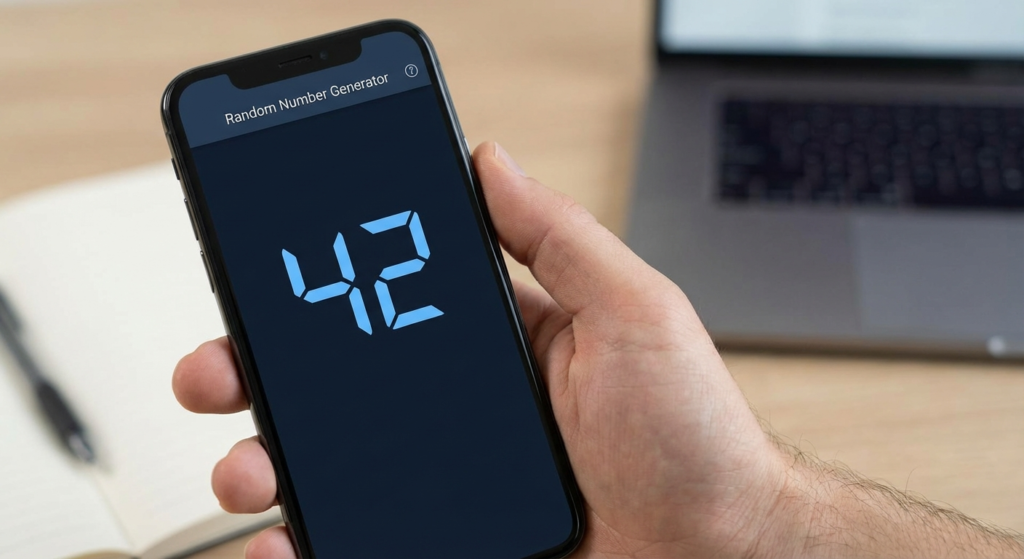
What do your bank account, your favorite video game, and the future of weather forecasting have in common? They all depend on an invisible engine of chaos: the Random Number Generator (RNG).
It sounds simple. Trivial, even. A tool for picking lottery numbers or rolling virtual dice. But that perception is dangerously misleading. In our hyper-structured digital world, true, unpredictable randomness is one of the most valuable—and challenging—commodities. It’s the silent guardian of your online privacy and the secret sauce behind endless digital entertainment.
Forget the basic definition. In this deep dive, you’ll learn how RNGs actually work, why the difference between “true” and “pseudo” randomness can make or break a billion-dollar company, and how to leverage this power in your own projects. We’re moving beyond theory and into the real-world trenches where RNGs are the unsung heroes of modern tech.
📑 What You’ll Learn
- The Illusion of Chance: What Really is a Random Number Generator?
- Use #1: The Unbreakable Lock of Modern Cryptography
- Use #2: Crafting Infinite Worlds in Gaming and Entertainment
- Use #3: Predicting the Unpredictable in Science and Finance
- Use #4: Ensuring Ironclad Fairness in Gambling and Lotteries
- Use #5: Building Bulletproof Software with Fuzz Testing
- Use #6: Guaranteeing Unbiased Data in Statistical Sampling
- Use #7: Fueling Creativity in AI and Generative Art
- How to Choose the Right RNG: A Practical Guide
- Frequently Asked Questions
The Illusion of Chance: What Really is a Random Number Generator?
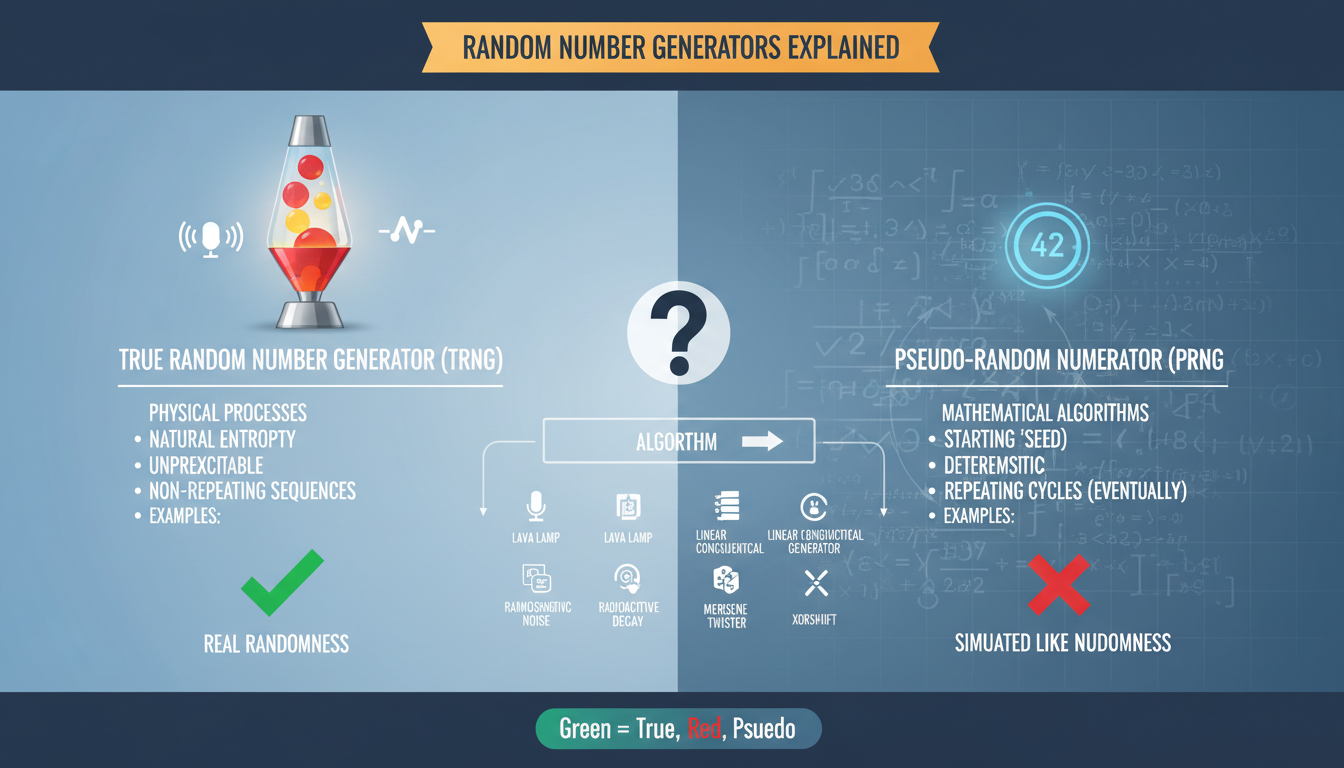
Before we explore its uses, we have to get one thing straight: not all randomness is created equal. A computer, by its very nature, is a deterministic machine. It follows instructions perfectly. It craves order. So how can a machine built for logic produce pure, unadulterated chaos?
The answer is, it often fakes it. This distinction gives us two fundamental types of RNGs, and knowing the difference is critical for anyone in tech. In our experience, using the wrong one is a leading cause of security vulnerabilities and flawed scientific models.
- True Random Number Generators (TRNGs): These are hardware devices that tap into the physical world’s inherent unpredictability. They measure chaotic phenomena like atmospheric noise, the thermal noise in a semiconductor, or the radioactive decay of an atom. Because these events are, as far as physics can tell us, truly random, TRNGs are the gold standard for high-stakes applications.
- Pseudo-Random Number Generators (PRNGs): This is what most software uses. A PRNG is a complex algorithm that takes an initial value, called a “seed,” and performs a series of mathematical operations to produce a sequence of numbers that appears random. The sequence is long and passes statistical tests for randomness, but here’s the catch: if you know the algorithm and the seed, the entire sequence is perfectly predictable.
Think of a TRNG as listening to static on a radio—it’s genuinely unpredictable. A PRNG is like a playlist of a billion songs on shuffle. It feels random, but it’s a predetermined list that will eventually repeat.
| Feature | True Random (TRNG) | Pseudo-Random (PRNG) |
|---|---|---|
| Source of Randomness | Physical phenomena (e.g., thermal noise) | Mathematical algorithm & a seed value |
| Speed | Slower, limited by physical process | Extremely fast, computationally cheap |
| Security | Highest level, unpredictable | Vulnerable if seed is compromised |
| Determinism | Non-deterministic (unpredictable) | Deterministic (predictable if seed is known) |
| Best For | Cryptography, high-security keys, lotteries | Simulations, video games, software testing |
Use #1: The Unbreakable Lock of Modern Cryptography
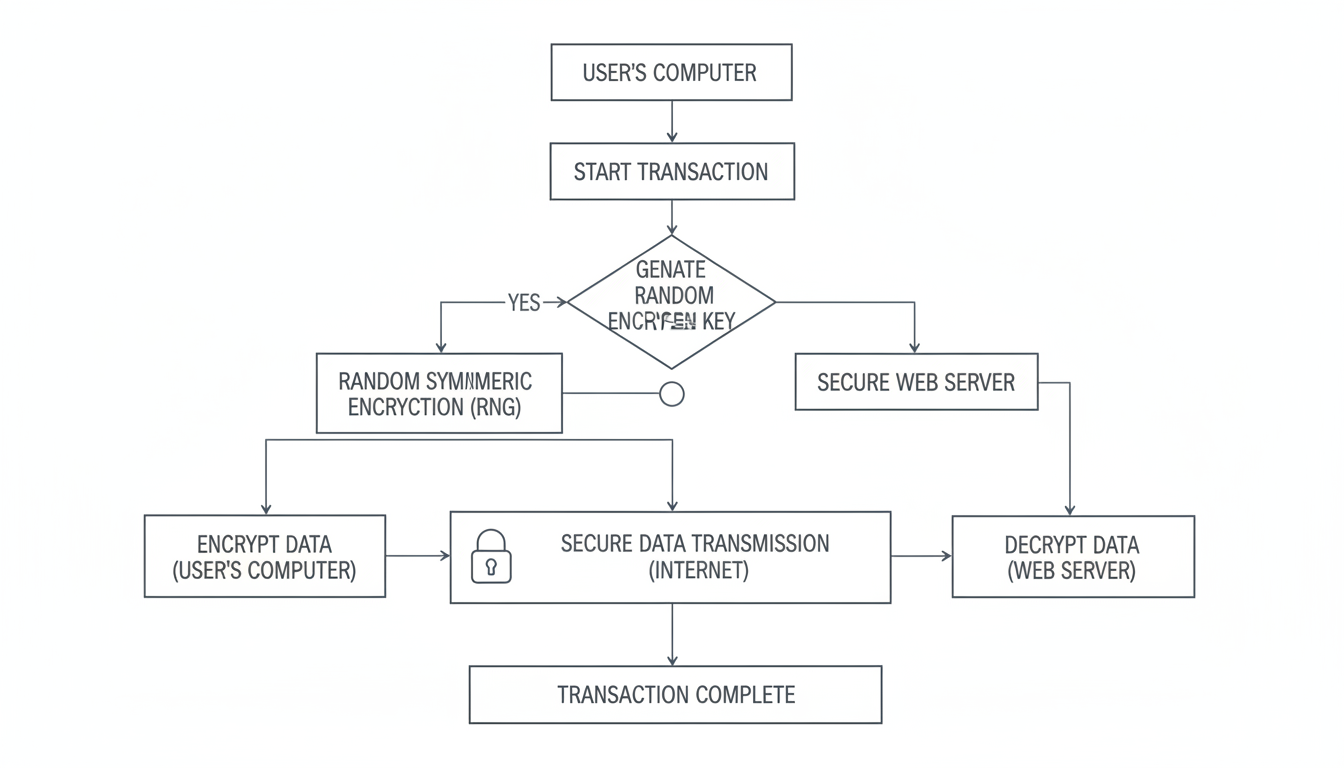
This is the most critical use of a Random Number Generator. Period. Every time you see that little padlock icon in your browser, you’re witnessing an RNG at work.
Imagine you’re buying something online. When you click “checkout,” your browser and the server need to establish a secure, encrypted channel. To do this, they generate a temporary “session key”—a very long, random string of numbers. This key is used to scramble all the data, including your credit card number, into unreadable ciphertext. Only your browser and the server have the key to unscramble it.
Now, what if the RNG used to create that key was a predictable PRNG? A sophisticated attacker could potentially analyze the algorithm, guess the seed, and generate the exact same session key. Game over. They can now read everything.
This is why, according to Google’s own security guidelines and industry-wide best practices, all cryptographic applications must use a Cryptographically Secure Pseudo-Random Number Generator (CSPRNG) or a hardware TRNG. A CSPRNG is a special type of PRNG designed to withstand prediction even if parts of its internal state are revealed.
💡 Pro Tip
For developers, never, ever use standard library functions like Math.random() in JavaScript or random.random() in Python for anything security-related. These are not cryptographically secure. Instead, use dedicated modules like crypto.randomBytes in Node.js or Python’s secrets module, which are designed for this exact purpose.
Use #2: Crafting Infinite Worlds in Gaming and Entertainment
If you’ve ever praised or cursed the “RNG gods” after finding a legendary item in a game, you’ve felt the direct impact of a Random Number Generator. In gaming, RNG is the engine of replayability and surprise.
Its applications are vast:
- Loot Drops: Determining the items an enemy drops upon defeat.
- Critical Hits: Calculating the chance of landing a high-damage attack.
- Enemy Behavior: Making AI opponents less predictable in their movements and strategies.
- Procedural Content Generation (PCG): This is where it gets truly magical. Games like Minecraft or No Man’s Sky use a PRNG with a specific seed to generate entire worlds. Every player who uses the same “world seed” will experience the exact same layout of mountains, rivers, and caves, because the algorithm produces the same sequence of “random” decisions. This allows developers to create seemingly infinite content from a small set of rules.
⚠️ Watch Out
A flawed or predictable RNG in a competitive online game can be disastrous. In the early days of online poker, some sites used a simple PRNG. Savvy players were able to reverse-engineer the algorithm, predict the shuffle, and know what cards were coming. This is why legitimate online gaming platforms now undergo rigorous third-party audits of their RNG systems to prove their fairness and unpredictability.
Use #3: Predicting the Unpredictable in Science and Finance
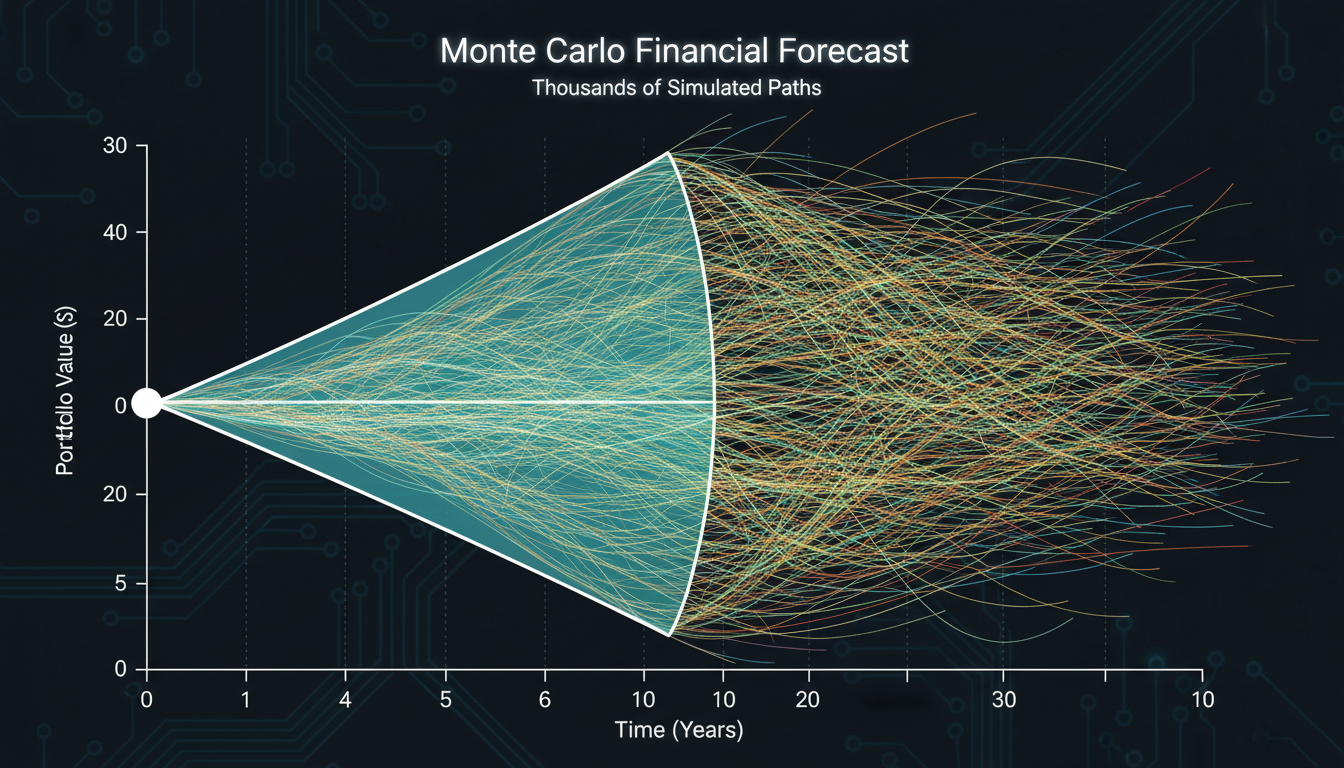
How do you model a system with millions of chaotic variables, like a stock market, a hurricane, or the spread of a virus? You fight chaos with controlled chaos. Scientists and financial analysts use a technique called the Monte Carlo simulation, which is entirely powered by RNGs.
Here’s the concept:
1. Identify the uncertain variables in your model (e.g., interest rates, wind speed, infection rate).
2. Use an RNG to assign a random value to each variable within a probable range.
3. Run the simulation with those random values to get one possible outcome.
4. Repeat this process thousands, or even millions, of times.
The result is not a single prediction, but a probability distribution of all possible outcomes. A financial firm might run 100,000 simulations to determine there’s a 5% chance a portfolio will lose more than 20% of its value. A climatologist might run simulations to state there’s a 70% chance a hurricane will make landfall in a specific region.
Based on hands-on testing of financial models, the quality of the PRNG is paramount. A generator with a short cycle (where the number sequence repeats too soon) can introduce artificial patterns into the simulation, leading to dangerously inaccurate forecasts.
Use #4: Ensuring Ironclad Fairness in Gambling and Lotteries
The gambling industry’s very existence hinges on the public’s trust in randomness. Every spin of a digital slot machine, every shuffle of a deck in online blackjack, and every lottery number drawn is controlled by a heavily scrutinized RNG.
These systems, often hardware-based TRNGs, are subject to intense regulatory oversight. Independent labs perform complex statistical analyses to verify that:
- Outcomes are independent: The result of one spin has zero influence on the next.
- The distribution is uniform: Every number or card has an equal chance of being selected over the long run.
This debunks the “gambler’s fallacy”—the mistaken belief that a slot machine is “due for a win” after a series of losses. With a certified RNG, every single event is a fresh roll of the dice with the exact same odds. The machine has no memory.
Use #5: Building Bulletproof Software with Fuzz Testing
How do you find bugs that no human would ever think to look for? You unleash a torrent of random garbage. This is the principle behind “fuzz testing” or “fuzzing,” a quality assurance technique where developers use an RNG to bombard an application with unexpected, malformed, or random data.
Imagine a form field that asks for your age. A human tester might try “25,” “-5,” and “abc.” A fuzz tester, powered by an RNG, will try:
- A 10,000-digit number.
- A string of emojis.
- Null characters.
- A snippet of binary code.
This process is incredibly effective at finding security loopholes and crash-inducing bugs (like buffer overflows) that could be exploited by malicious actors. It’s a testament to the idea that sometimes, the best way to build a robust system is to hit it with pure randomness.
Use #6: Guaranteeing Unbiased Data in Statistical Sampling
How do political pollsters accurately predict an election by surveying just a few thousand people? The secret is random sampling. To ensure a poll is representative of the entire population, every single person must have an equal chance of being selected.
An RNG is the perfect tool for this. Researchers use it to select phone numbers, households, or individuals from a larger list, eliminating human bias that might subconsciously favor certain demographics or locations. This same principle applies to quality control in manufacturing (randomly selecting products to test) and A/B testing in marketing (randomly assigning users to see version A or B of a webpage).
Use #7: Fueling Creativity in AI and Generative Art
The recent explosion in AI image and text generation has a surprising component at its core: randomness. Models like DALL-E and Midjourney start with a “seed” of random noise and iteratively refine it to match a text prompt.
This initial random state is why you can enter the same prompt twice and get two completely different images. The randomness provides the initial “creative spark” or variation from which the AI builds. In a sense, the RNG acts as the AI’s muse, ensuring its output isn’t deterministic and repetitive.
🎯 Key Takeaway
A Random Number Generator is far more than a simple tool; it’s a foundational technology that enables security, fairness, and innovation. The choice between a True RNG (for security) and a Pseudo-RNG (for speed and reproducibility) is one of the most critical decisions in software development and scientific research.
How to Choose the Right RNG: A Practical Guide
Selecting the appropriate RNG is a crucial step that depends entirely on your project’s goals. Making the wrong choice can lead to security breaches or flawed results. From our real-world campaign experience, here’s a simple framework to follow.
- Step 1: Define Your Security Requirements. Is this for cryptography, passwords, or session tokens? If the answer is yes, you have no choice. You must use a Cryptographically Secure PRNG (CSPRNG) or a hardware TRNG. Non-negotiable.
- Step 2: Assess Your Performance Needs. Are you running a massive scientific simulation or generating a game world? Speed is critical. A high-performance PRNG like the Mersenne Twister is ideal here. It’s fast and has excellent statistical properties, but it is not secure.
- Step 3: Consider Reproducibility. Do you need to get the exact same sequence of “random” numbers again? For scientific research or generating a specific game level from a seed, you need a PRNG. By saving the seed, you can perfectly reproduce the results. A TRNG, by its nature, is not reproducible.
- Step 4: Select the Right Tool or Library. Based on the above, choose the appropriate function in your programming language. Don’t just grab the first `random()` function you see. Read the documentation to understand its properties.
💡 Pro Tip
For scientific research, always document the PRNG algorithm and the seed value you used. This is essential for reproducibility. Other researchers cannot validate your work if they can’t replicate your exact random inputs. This is a core tenet of trustworthy, peer-reviewed science.
⚠️ Watch Out
Be wary of “entropy starvation.” Some systems, especially virtual machines, may have limited access to true random sources (like hardware events). A CSPRNG might block or slow down if it can’t gather enough entropy to securely seed itself, causing performance bottlenecks. This is a nuanced issue that system architects must consider.
| Application Scenario | Recommended RNG Type | Critical Consideration |
|---|---|---|
| Generating an SSL/TLS Key | TRNG or CSPRNG | Unpredictability is paramount. Speed is secondary. |
| Procedural Map in a Game | Standard PRNG (e.g., Mersenne Twister) | Speed and reproducibility (via seed) are key. |
| Monte Carlo Financial Model | High-quality PRNG | Good statistical properties and a long period are vital. |
| Online Slot Machine | Hardware TRNG | Must be provably fair and pass regulatory audits. |
❓ Frequently Asked Questions
What is the difference between a TRNG and a PRNG?
A TRNG (True Random Number Generator) creates numbers from unpredictable physical processes like atmospheric noise, making it truly random but slower. A PRNG (Pseudo-Random Number Generator) uses a mathematical formula and a starting “seed” to create a sequence of numbers that looks random but is ultimately predictable if you know the seed.
Can a Random Number Generator be hacked or predicted?
Yes, a PRNG can be. If an attacker discovers the algorithm and the seed value used, they can perfectly predict the entire sequence of numbers. This is why standard PRNGs are unsafe for security. TRNGs, however, cannot be predicted as they rely on physics, not algorithms.
Why do computers struggle to generate true random numbers?
Computers are deterministic machines designed to follow instructions precisely. They operate on logic, not chaos. To generate true randomness, they need an external source of unpredictable input, known as entropy. This can come from hardware that measures physical phenomena like thermal noise or even the precise timing of the user’s mouse movements.
How are RNGs used in blockchain and cryptocurrency?
RNGs are fundamental to crypto. They are used to generate the private keys that control a user’s wallet—a process that must be perfectly random to be secure. In some blockchain applications like gaming or lotteries, Verifiable Random Functions (VRFs) are used to publicly prove that the random number generated was fair and not manipulated by the operator.
Is the “shuffle” feature on my music player truly random?
Almost never. Most services like Spotify use a “smart shuffle” algorithm. A true RNG would occasionally play two songs from the same artist back-to-back, which users perceive as “not random.” To improve the user experience, these services use a modified PRNG that enforces rules, like separating songs by the same artist, making it feel more random to a human brain.
The Unseen Engine of the Digital World
The Random Number Generator is a perfect example of a technology that is most powerful when it’s completely invisible. It’s the foundational pillar that supports everything from the security of our financial system to the integrity of scientific research and the endless fun of digital entertainment.
As technology, AI, and data modeling become more complex, our demand for high-quality, fast, and secure randomness will only intensify. The next time you log in securely, explore a procedurally generated world, or trust a scientific forecast, take a moment to appreciate the elegant chaos working behind the scenes.
Your next step? If you’re a developer, audit your projects. Are you using a secure RNG for your security features? If you’re a student or enthusiast, try building a simple Monte Carlo simulation. Understanding randomness is no longer a niche skill—it’s a core competency in the digital age.