
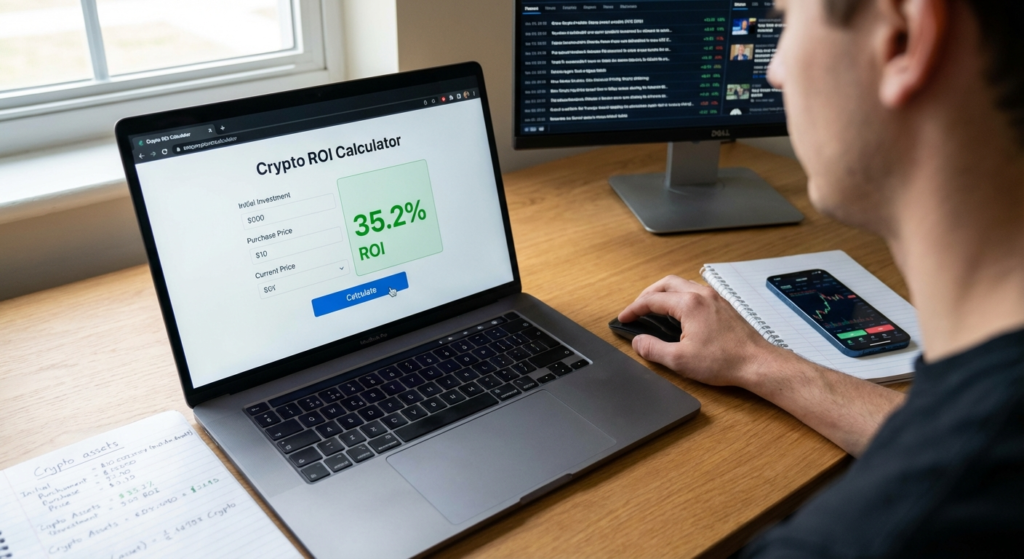
In the volatile world of cryptocurrency, guessing your profits is a dangerous game. Whether you are a day trader scalping small movements or a long-term holder (“HODLer”) waiting for the next bull run, understanding your exact Return on Investment (ROI) is crucial. This is where the Crypto ROI Calculator becomes your most valuable tool. It transforms complex trading data into clear, actionable insights, allowing you to make decisions based on math rather than emotion.
Many beginners overlook the hidden costs of trading—gas fees, exchange commissions, and spread—which can eat into perceived profits. A robust Crypto ROI Calculator accounts for these variables, giving you a transparent view of your portfolio’s performance. In this comprehensive guide, we will explore how to leverage this tool to optimize your strategy, minimize risk, and ultimately grow your digital wealth.
What is a Crypto ROI Calculator and Why Does it Matter?
At its core, a Crypto ROI Calculator is a specialized tool designed to measure the profitability of an investment relative to its cost. While the basic formula for ROI ((Current Value – Cost of Investment) / Cost of Investment * 100) seems simple, applying it to cryptocurrency is often more complex due to the fractional nature of coins and varying entry points.
Unlike traditional stock markets, crypto markets operate 24/7 with extreme volatility. A Crypto ROI Calculator helps investors standardize their performance metrics. It allows you to answer the fundamental question: “Is the return I am getting worth the risk I am taking?” By inputting your buy price, sell price, and associated fees, the calculator provides a percentage that represents your efficiency as an investor.
Precision Tracking
Eliminates the guesswork by calculating gains down to the decimal, accounting for fractional token ownership.
Fee Management
Helps you understand how much exchange fees and gas costs are impacting your final net profit.
Strategy Testing
Allows you to simulate different exit prices to define your take-profit targets before you even enter a trade.
The Importance of Using a Crypto ROI Calculator for Risk Management
Risk management is the survival kit of any trader. Using a Crypto ROI Calculator is not just about counting winnings; it is about protecting capital. By calculating potential ROI against potential losses (Risk/Reward Ratio), traders can determine if a trade setup is statistically profitable in the long run.
For instance, if your calculator shows a potential 5% ROI on a trade but the downside risk is 10%, the trade is mathematically unsound. Professional traders use these calculators to ensure they only take trades where the upside significantly outweighs the downside. According to Investopedia, understanding ROI is fundamental to portfolio management across all asset classes, but it is doubly important in crypto where 20% swings in a single day are common.
Analyzing Historical Data with a Crypto ROI Calculator
One of the most powerful features of a comprehensive Crypto ROI Calculator is the ability to backtest strategies. By inputting historical entry and exit points, you can see how a specific strategy would have performed over time. This retrospective analysis helps in refining your approach, ensuring that you are not repeating past mistakes.
Step-by-Step: How to Use a Crypto ROI Calculator Effectively
Using these tools might seem straightforward, but missing a single variable can lead to incorrect data. Here is a systematic approach to getting the most accurate results.
- Determine Your Initial Investment: This is the total amount of fiat currency (USD, EUR, etc.) you used to purchase the crypto. If you swapped one coin for another, you must calculate the fiat value of the original coin at the time of the swap.
- Input the Buy Price: Enter the price per coin at the moment of purchase.
- Input the Sell Price (or Current Price): Enter the price you sold at, or the current market price if you are calculating unrealized gains.
- Include Transaction Fees: This is the step most people miss. Include trading fees (maker/taker fees) and withdrawal fees. If you are trading on a DEX (Decentralized Exchange), gas fees must be added to the cost basis.
- Calculate: Hit the button to see your percentage return and net profit/loss.
If you are dealing with multiple currencies or need to convert your profits back to your local currency to understand your real-world purchasing power, tools like a currency convertor are essential companions to your ROI analysis.
Common Mistakes When Using a Crypto ROI Calculator
Even with the best tools, human error can skew results. One frequent mistake is ignoring the “Dollar Cost Averaging” (DCA) effect. If you bought Bitcoin at $30k, again at $40k, and again at $20k, you cannot simply plug in one buy price. You need to calculate your average entry price before using the Crypto ROI Calculator.
Another error is failing to account for inflation or the opportunity cost. While a 10% gain sounds good, if inflation is at 7%, your real return is significantly lower. Furthermore, traders often confuse profit margin with ROI. If you run an online business accepting crypto, you might want to compare your trading returns against traditional business metrics using a profit margin calculator to see where your time is best spent.
Ignoring Gas Fees
On networks like Ethereum, gas fees can sometimes exceed the profit on small trades. Always subtract these from gross profit.
Confusing Unrealized vs. Realized
Remember, ROI is theoretical until you sell. A calculator shows you what you could make, not what you have banked until you exit.
Overlooking Taxes
Short-term capital gains tax can take a huge chunk of your ROI. Use the calculator to estimate post-tax returns.
Advanced Strategies: Compound Growth and the Crypto ROI Calculator
Albert Einstein famously called compound interest the “eighth wonder of the world.” In crypto, staking and yield farming allow you to earn interest on your holdings. A standard Crypto ROI Calculator might only look at price appreciation, but advanced versions or manual calculations should include staking rewards.
Projecting Long-Term Wealth with a Crypto ROI Calculator
When you reinvest your staking rewards, your ROI grows exponentially rather than linearly. By using a Crypto ROI Calculator to project these compounded gains over 1, 5, or 10 years, you can visualize the massive potential of holding assets that generate yield. This perspective often helps investors hold through bear markets, knowing that the quantity of their assets is increasing even if the USD value temporarily drops.
For accurate long-term projections, always cross-reference token data with reliable sources like CoinGecko to ensure you are using correct historical price points and supply metrics.
Conclusion
The cryptocurrency market offers unparalleled opportunities for wealth generation, but it punishes those who rely on intuition alone. The Crypto ROI Calculator is more than just a convenience; it is a fundamental instrument for navigation in the digital asset space. By accurately tracking your entry and exit points, factoring in fees, and understanding the difference between realized and unrealized gains, you transform from a gambler into a strategic investor.
Start using a calculator today to audit your past trades and plan your future moves. Whether you are looking to convert your gains using a currency tool or comparing your crypto yields against traditional business margins, the data provided by an ROI calculator is the bedrock of financial success in the blockchain era.
FAQs
While the formula is the same, Crypto ROI is often calculated over much shorter timeframes due to high volatility. Additionally, Crypto ROI often involves factoring in staking rewards (APY) and network gas fees, which are not present in traditional stock trading.
Most basic calculators do not automatically deduct taxes because tax laws vary wildly by country. However, you can use the calculator to find your Gross Profit and then manually deduct your local capital gains tax percentage to find your Net ROI.
Yes, but you must first calculate your “Average Buy Price.” Total the cost of all your purchases and divide it by the total number of coins acquired. Use this average figure as the “Initial Investment Cost” in the calculator.
This is subjective and depends on risk tolerance. In traditional finance, 10% annually is excellent. In crypto, investors often aim higher due to higher risk, but a “good” ROI is any positive return that outpaces inflation and justifies the fees paid.
Discrepancies usually occur due to ignored fees. Ensure you have subtracted exchange trading fees (0.1% to 0.5%) and withdrawal fees from your final amount. Also, check if you are calculating ROI based on the total portfolio value or just the profit portion.