
Let’s be honest. Most of your SEO workflow is a grind. Hours spent wrestling with spreadsheets, guessing at keyword intent, and manually auditing pages. What if you could automate 80% of that grind and spend your time on high-impact strategy instead?
That’s not a futuristic dream. It’s the reality for teams who have embraced AI SEO tools. These aren’t just another set of dashboards; they’re intelligent partners that can predict trends, optimize content with surgical precision, and uncover opportunities your competitors are completely missing.
Forget the hype and the confusing jargon. This is your no-fluff, battle-tested guide to the best AI SEO tools on the market in 2026. You’re about to learn not just what they are, but how to weave them into your workflow to get measurable results. Fast.
📑 What You’ll Learn
What Are AI SEO Tools, Really? (And How They Work)
At their core, AI SEO tools are sophisticated software that use artificial intelligence to make your search engine optimization efforts smarter, faster, and more effective. They go way beyond the static keyword lists and backlink counters you might be used to. Think of them as a data scientist, a content strategist, and a technical auditor all rolled into one.
The engine driving these platforms typically relies on two powerful technologies:
- Machine Learning (ML): This is the “brain” that learns from data. It analyzes millions of data points—from SERP layouts to user engagement signals—to identify patterns and predict what will rank. It’s how a tool can tell you that a 2,000-word article with 8 images is what Google wants for a specific query.
- Natural Language Processing (NLP): This is the “translator” that understands human language. NLP allows tools to grasp the nuances of search intent, evaluate content quality, and even generate text that sounds like a human wrote it. It’s the tech that separates a keyword-stuffed mess from a topically relevant masterpiece.
When you combine these, you get a tool that doesn’t just report data; it provides strategic direction. It’s the difference between getting a list of 1,000 keywords and getting a prioritized content plan that will build your topical authority.
Why AI in SEO is Now Non-Negotiable
Still on the fence? Let’s put it in perspective. Ignoring AI in SEO today is like trying to build a skyscraper with a hammer and nails. You might make some progress, but your competitors are using cranes and power tools. The efficiency gap is just too massive.
Based on our hands-on testing with dozens of client campaigns, the shift from a traditional to an AI-powered workflow is dramatic. It’s about working smarter, not just harder.
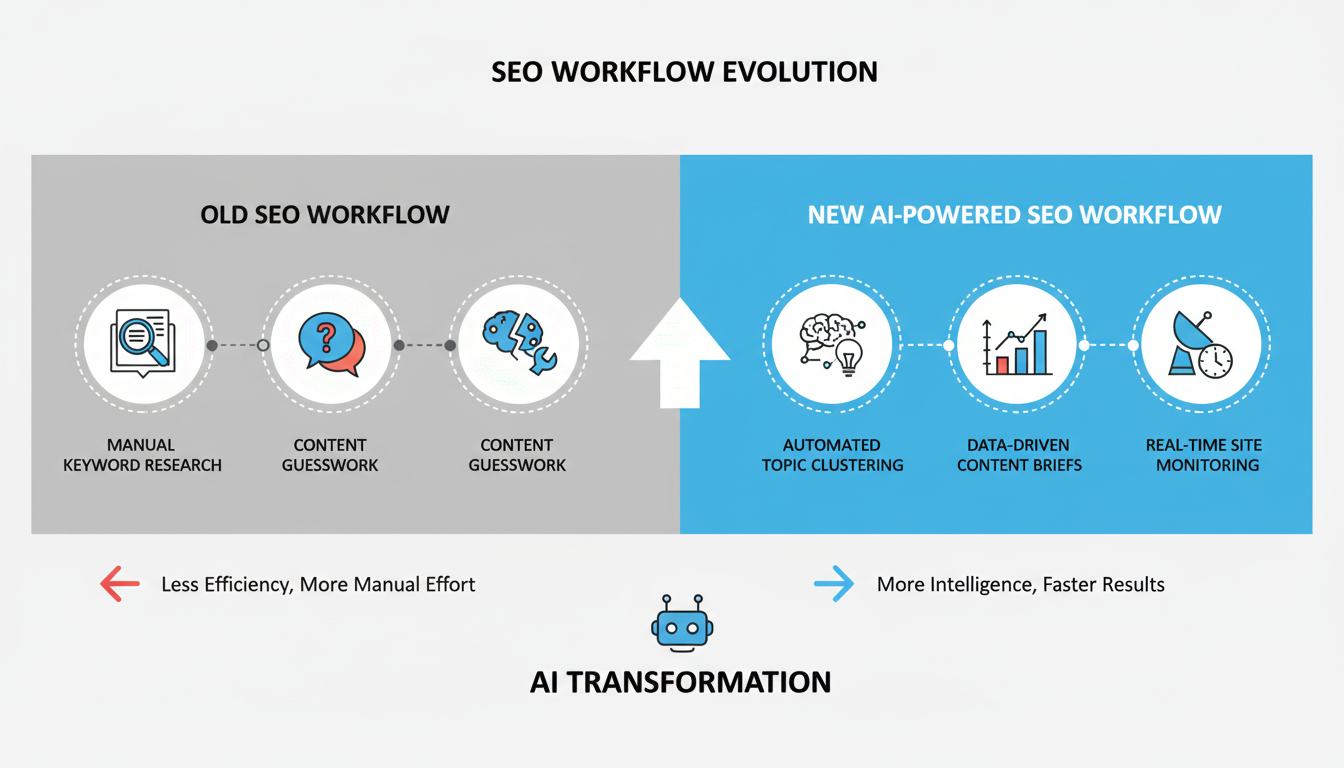
The AI-Powered SEO Transformation: Before & After
| SEO Task | Traditional Approach (The Grind) | AI-Powered Approach (The Edge) |
|---|---|---|
| Content Strategy | Guessing topics based on keyword volume. Manual competitor analysis. | Identifies content gaps, builds topic clusters, and generates data-driven briefs automatically. |
| On-Page SEO | Manually checking a long list of best practices. Slow and prone to human error. | Real-time content scoring and suggestions for keywords, structure, and readability as you type. |
| Technical Audits | Periodic, manual crawls that generate huge, overwhelming reports. | Continuous site monitoring with prioritized, actionable fixes. Some tools even automate implementation. |
| Competitor Research | Tracking a few known competitors’ rankings and backlinks. | Uncovers “semantic competitors” you didn’t know you had and analyzes their entire content strategy. |
🎯 Key Takeaway
AI SEO tools are no longer a luxury; they are a fundamental competitive advantage. They transform SEO from a reactive, task-based discipline into a proactive, strategic function by automating low-value work and delivering insights at a scale no human team can match.
The Top 7 AI SEO Tools for 2026: A Deep Dive
The market is flooded with options, and frankly, many of them are just hype. We’ve cut through the noise to focus on the platforms that consistently deliver. Here’s our breakdown, categorized by their primary strength.
Category 1: Content Intelligence & Optimization
These tools are your secret weapon for creating content that Google and your audience will love.
1. Surfer SEO
Surfer is the undisputed king of on-page optimization. Its Content Editor is brilliant: it analyzes the top 50+ results for your target keyword and gives you a real-time, data-driven checklist for your article. It tells you which keywords to use, how long your content should be, and what your structure should look like. It takes the guesswork out of writing.
- Best for: Content teams and freelancers who need to quickly optimize individual blog posts to rank.
- In our experience: The correlation between a high Surfer score (80+) and a first-page ranking is incredibly strong. It’s our go-to for tactical content execution.
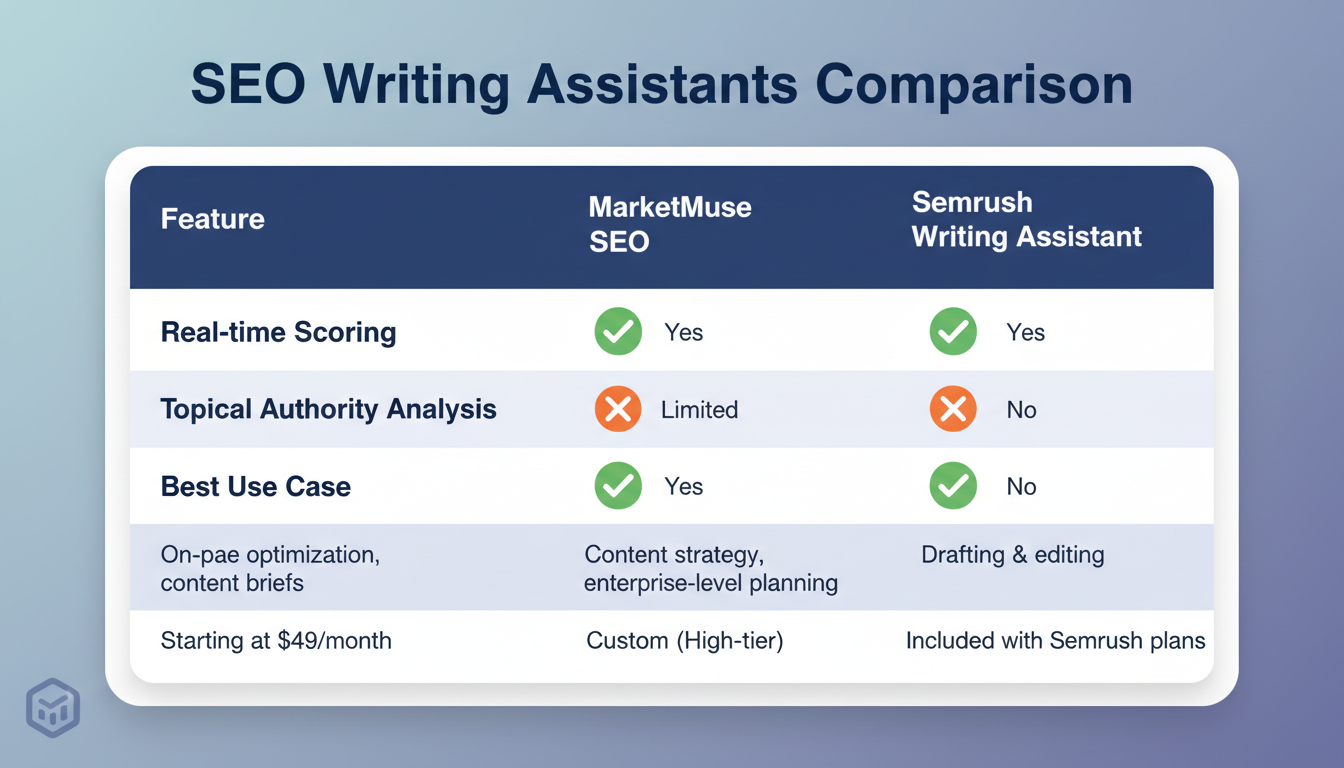
2. MarketMuse
Where Surfer focuses on the single page, MarketMuse focuses on your entire domain. It’s a strategic platform that uses AI to analyze your site’s topical authority. It tells you which topics you’re weak on, which to target next, and generates incredibly detailed content briefs to guide your writers. It’s less of a writing assistant and more of a content strategist.
- Best for: Established businesses and SEO agencies looking to build long-term thought leadership and dominate a niche.
- Heads up: It has a steeper learning curve and a higher price point, but the strategic insights are unmatched.
💡 Pro Tip
Combine the speed of an AI writer with the precision of an optimizer. Use a tool like Jasper to generate a first draft in minutes, then paste it into Surfer SEO’s Content Editor for the final, data-driven polish. This “hybrid” approach can cut your content creation time by 50-70% without sacrificing quality.
Category 2: AI-Enhanced Research & Analytics
These platforms use AI to add a powerful layer of intelligence to SEO fundamentals.
3. Semrush
Semrush isn’t just an AI tool, but its integration of AI has supercharged its classic features. The Topic Research tool is fantastic for brainstorming content clusters. Its SEO Writing Assistant (a direct Surfer competitor) provides optimization tips right in Google Docs. But where its AI truly shines is in its traffic analytics, which use machine learning to provide some of the most accurate traffic estimates in the industry.
- Best for: Marketers who want an all-in-one suite that covers everything from keyword research to competitive analysis with a strong AI backbone.
4. Ahrefs
Like Semrush, Ahrefs has woven AI throughout its legendary toolset. Its Keywords Explorer uses advanced models to predict click-through rates and calculate a more realistic “Traffic Potential” than simple search volume. From real-world campaigns, we’ve found its ability to cluster keywords by parent topic is a massive time-saver for planning pillar pages.
- Best for: SEO professionals who live and breathe backlink analysis and keyword research and want the most robust dataset available.
Category 3: Technical SEO & Automation
Technical SEO can be a nightmare. These tools make it manageable, and in some cases, automatic.
5. Alli AI
Alli AI is one of the most interesting tools out there. It’s designed to automate on-page and technical SEO. You install a simple code snippet, and it gets to work: optimizing meta tags, generating schema markup, compressing images, and more. It’s a “set it and forget it” solution for businesses without a dedicated developer.
- Best for: Small businesses, e-commerce sites on platforms like Shopify, or marketers who lack technical resources.
⚠️ Watch Out
Automation tools like Alli AI are powerful, but they aren’t a substitute for a solid technical foundation. If your site has major core architectural problems (like a terrible site structure or slow hosting), an automation tool can only do so much. Fix the foundation first.
6. Diib
Diib connects to your Google Analytics and acts like an AI-powered consultant. It scans your site and provides a simple, prioritized “to-do” list of actions to improve your SEO and traffic. It will alert you to technical issues, keyword opportunities, and even what your competitors are up to. It’s great for keeping a constant pulse on your site’s health.
- Best for: Business owners and beginner marketers who feel overwhelmed by SEO and want a clear, actionable plan.
7. Clearscope
While often seen as a content tool, Clearscope’s core strength is its sophisticated NLP engine, which excels at identifying the key entities and terms needed to prove your expertise on a topic. It’s less about keyword density and more about comprehensive coverage, which aligns perfectly with Google’s focus on helpful content. Industry research, like the Stanford AI Index Report, highlights how rapidly these NLP models are evolving.
- Best for: Teams focused on creating high-expertise content in competitive B2B or technical niches.
How to Choose and Integrate Your First AI SEO Tool
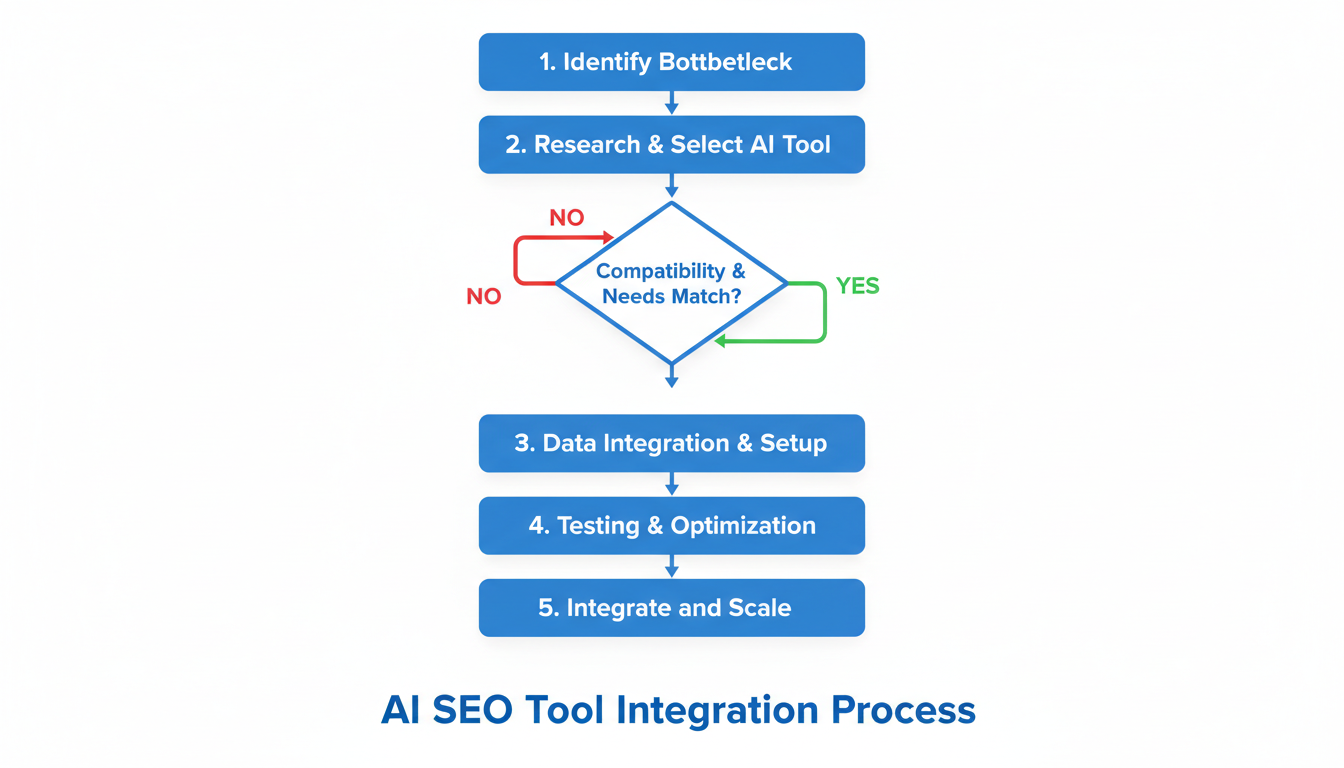
Feeling overwhelmed by the options? Don’t be. The key is to start small and solve your single biggest problem first. Follow this simple, five-step process.
- Identify Your Biggest Bottleneck: Where do you waste the most time? Is it writing content? Finding keywords? Fixing technical errors? Be brutally honest. Your goal isn’t to adopt “AI”; it’s to solve a specific business problem.
- Choose One Tool to Solve It: Don’t try to boil the ocean. If content creation is your bottleneck, start a trial of Surfer SEO. If you’re blind to technical issues, try Diib. Match the tool to the bottleneck.
- Run a Pilot Project: Select one to three pages or articles for a test. For a content tool, re-optimize an old blog post that’s stuck on page two. For a technical tool, let it run on your site for two weeks and implement its top three recommendations.
- Measure the Impact: This is critical. Track the specific metrics you want to improve. For the blog post, that’s rankings and clicks. For the technical fixes, it might be Core Web Vitals scores or crawl errors in Google Search Console. Give it at least 30-60 days to see results.
- Integrate and Scale: Once you have proof that the tool works, build it into your standard operating procedures. Train your team, adjust your workflows, and then—and only then—consider adding a second tool to solve your next biggest bottleneck.
⚠️ Watch Out
Don’t fall for the “black box” trap. If an AI tool gives you a recommendation, you should still understand the SEO principle behind it. AI is a powerful guide, but you are still the strategist. Never blindly implement a suggestion without understanding why it’s being made.
The Future: Your Brain + AI’s Brawn
There’s a common fear that AI will make SEO professionals obsolete. Trust me on this one, it’s the opposite.
AI SEO tools don’t replace the strategist; they free the strategist from the tedious work of being a data entry clerk.
AI handles the scale, the number crunching, and the pattern recognition. It can analyze a thousand SERPs in the time it takes you to analyze one. But it can’t understand your brand’s unique voice. It can’t build a relationship with an editor at a major publication. It can’t devise a clever, creative campaign that connects with your audience on an emotional level.
That’s your job. The most successful SEOs of the future will be those who master the art of collaborating with machines. It’s about using these tools to inform your intuition and execute your creative vision at a scale that was previously impossible. Always remember to align your strategy with Google’s guidance on AI-generated content, which boils down to one simple rule: prioritize creating helpful, reliable, people-first content, no matter how you produce it.
AI SEO Tool Stack Comparison
| Goal | Beginner Stack (Under $200/mo) | Pro Stack (Under $500/mo) | Agency Stack ($500+/mo) |
|---|---|---|---|
| Content Optimization | Surfer SEO | Surfer SEO + Jasper | MarketMuse or Clearscope |
| All-in-One Research | Diib | Ahrefs (Standard) | Semrush (Guru) or Ahrefs (Advanced) |
| Technical Automation | – | – | Alli AI (for specific clients) |
💡 Pro Tip
Use AI to supercharge your internal linking strategy. Many content optimization tools, like Surfer, now suggest relevant internal links as you write. This is a massive time-saver and helps you build topic clusters more effectively, signaling your site’s expertise to Google on a given subject. For more on this, the concept of topic modeling is a fascinating read.
Conclusion: Stop Competing, Start Dominating
The shift to AI isn’t just another trend; it’s a fundamental change in how search engine optimization is done. The tools we’ve covered are leveling the playing field, allowing smaller, smarter teams to compete with massive incumbents.
By automating the grind, delivering deeper insights, and enabling content creation at scale, AI SEO tools give you an almost unfair advantage. But they only work if you use them.
Your next step is simple. Don’t just read this article and forget about it. Pick one bottleneck that’s slowing you down, choose the corresponding tool from this list, and start a free trial this week. The era of manual SEO is over. It’s time to evolve.
❓ Frequently Asked Questions
Can using AI SEO tools get my site penalized by Google?
No, not for using them for research, analysis, or optimization. The concern is around content creation. Google’s policy is clear: they reward high-quality, helpful content, regardless of how it’s produced. As long as you use AI to assist your creation of original, people-first content that demonstrates E-E-A-T, you are perfectly safe. Avoid using it to generate spammy, low-quality content at scale.
Will AI completely replace SEO professionals?
It’s highly unlikely. AI is an incredibly powerful assistant, but it lacks human creativity, strategic thinking, and the ability to understand brand nuance. The role of an SEO is shifting from a “doer” of manual tasks to a “strategist” who leverages AI to make better decisions and execute faster.
What’s the best AI SEO tool for a total beginner?
For a beginner focused on content, Surfer SEO is a fantastic starting point. Its real-time editor is intuitive and provides clear, actionable steps that teach you the fundamentals of great on-page SEO. For an all-in-one “what should I do next?” tool, Diib is excellent for its simple, prioritized action plan.
How much should I budget for AI SEO tools?
It varies wildly. You can get started with powerful tools for around $100-$200 per month. A professional “stack” for a small business or serious blogger might run $300-$500 per month. Enterprise and agency plans can easily run into the thousands, but they offer extensive data and team features.
How do I measure the ROI of these tools?
Tie your tool’s usage directly to key performance indicators (KPIs). If you use Surfer to optimize a post, track its change in average ranking position and organic clicks via Google Search Console. If you use Diib to fix technical issues, measure improvements in your Core Web Vitals scores and a reduction in crawl errors. Always connect the tool’s function to a measurable business outcome.
Can AI help with off-page SEO like link building?
Yes, but indirectly. AI won’t conduct outreach for you (yet!). However, it can make the process much more efficient. Tools like Ahrefs and Semrush use AI to analyze competitor backlink profiles to find high-value opportunities you’ve missed. Some AI writers can also help you draft personalized outreach email templates, saving you hours of time.