
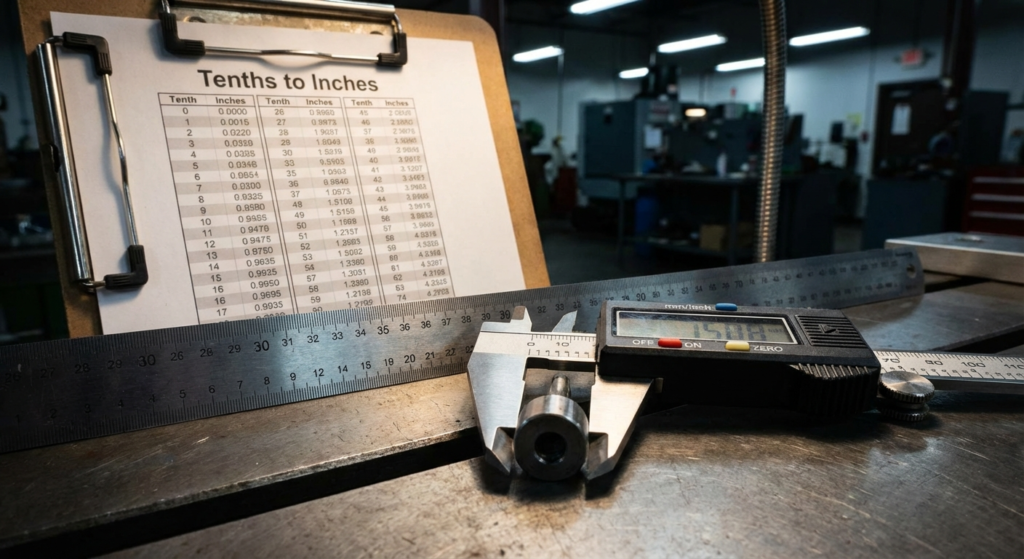
I once watched a site foreman scream into his hard hat because a drainage pipe was installed an inch too high. The culprit? A simple miscommunication between the surveyor’s blueprints and the plumber’s tape measure. The plans called for a grade change of “0.5 feet.” The plumber, thinking quickly but incorrectly, measured down 5 inches.
But 0.5 feet isn’t 5 inches. It’s 6 inches.
That single inch of difference meant water pooled instead of draining, costing the project thousands of dollars in rework. If you work in construction, civil engineering, or excavation in 2026, you cannot afford to be “close enough.” You need to be exact. The disconnect between the engineer’s decimal foot (tenths) and the carpenter’s fractional foot (inches) is the most common source of errors on job sites today.
In this guide, I’m going to walk you through exactly how to convert tenths to inches without breaking a sweat. We’ll cover the mental math, the cheat sheets you should tape to your clipboard, and the tools that keep your project on the level.
📑 What You’ll Learn
The Language Barrier: Surveyors vs. Carpenters
Here is the thing: the construction world speaks two different dialects of the same language. If you don’t speak both, you’re going to have a bad time.
On one side, you have Civil Engineers and Surveyors. They live in a base-10 world. For them, a foot is divided into 10 tenths, and each tenth is divided into 100 hundredths. Why? Because adding 10.52 + 4.25 is infinitely easier on a calculator than adding 10′ 6-1/4″ + 4′ 3″. It streamlines the massive data sets involved in grading land and plotting coordinates.
On the other side, you have Carpenters, Architects, and Masons. They live in a base-12 world. A foot is 12 inches. An inch is divided into halves, quarters, eighths, and sixteenths. This system is fantastic for physical divisibility—you can divide 12 by 2, 3, 4, and 6 cleanly—but it’s a nightmare for quick mental addition.
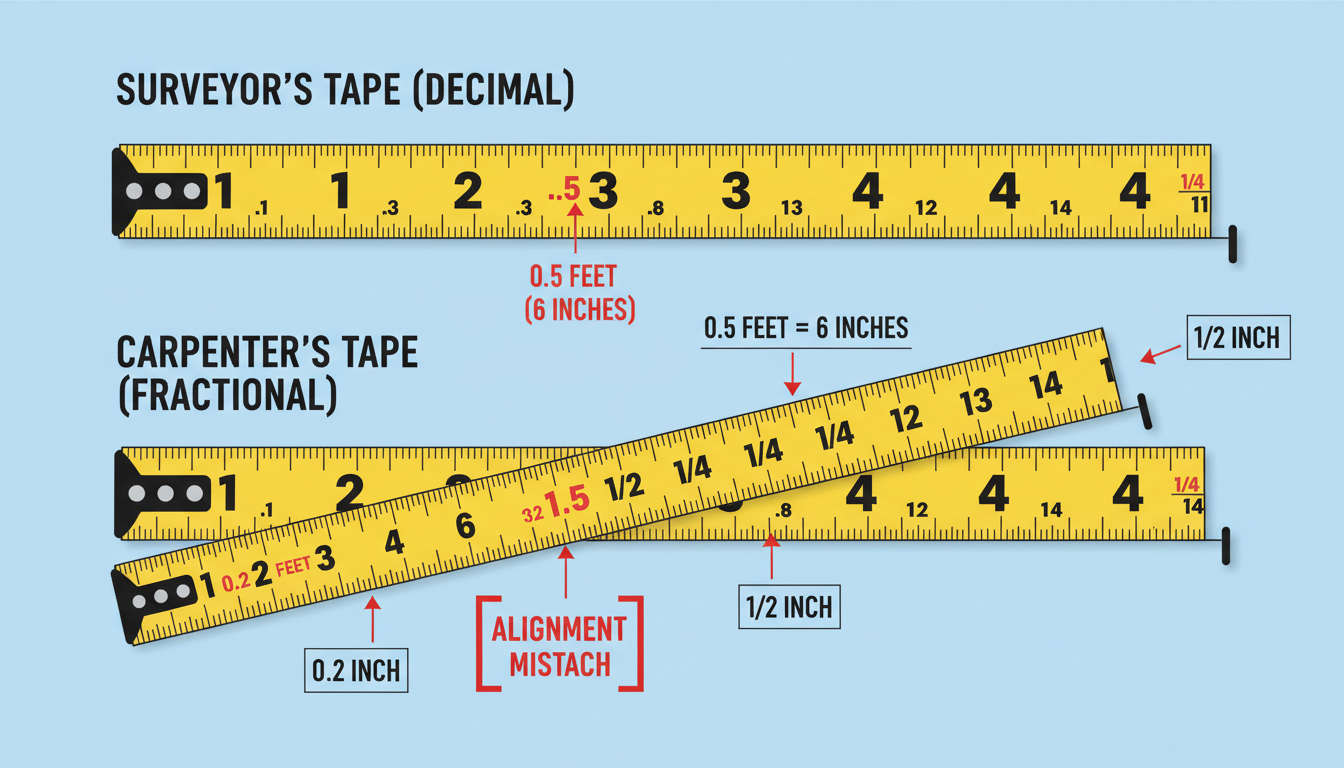
The friction happens when these two worlds collide. A grade stake says “Cut 0.25.” A carpenter pulls out a standard tape measure. If they don’t know that 0.25 feet is 3 inches, they might guess 2.5 inches. And just like that, the foundation is out of whack.
🎯 Key Takeaway
Never assume a decimal on a site plan equals inches. In the decimal foot system, 1 foot = 10 tenths. In the standard system, 1 foot = 12 inches. The “Golden Ratio” for conversion is 1.2 inches per tenth.
The Math: How to Convert Tenths to Inches
You don’t need a degree in mathematics to master this. You just need to remember one simple relationship: The Rule of 12.
Since there are 12 inches in a foot, any decimal portion of a foot is just that percentage of 12.
The Core Formula
To convert tenths to inches, simply multiply your decimal value by 12.
Decimal Feet × 12 = Inches
Let’s look at a real-world example. You see a stake marked 0.40′.
- Take the 0.40.
- Multiply by 12.
- 0.40 × 12 = 4.8.
- Result: 4.8 inches.
Now, you have 4.8 inches. But your tape measure doesn’t have a mark for “.8”. It has 16ths. So, we need to go one step deeper.
💡 Pro Tip
To convert the decimal remainder (like the .8 in 4.8 inches) to 16ths of an inch, multiply that remainder by 16.
Example: 0.8 × 16 = 12.8. Round it to 13.
Final Measurement: 4 and 13/16 inches.
Essential Conversion Tables (Cheat Sheets)
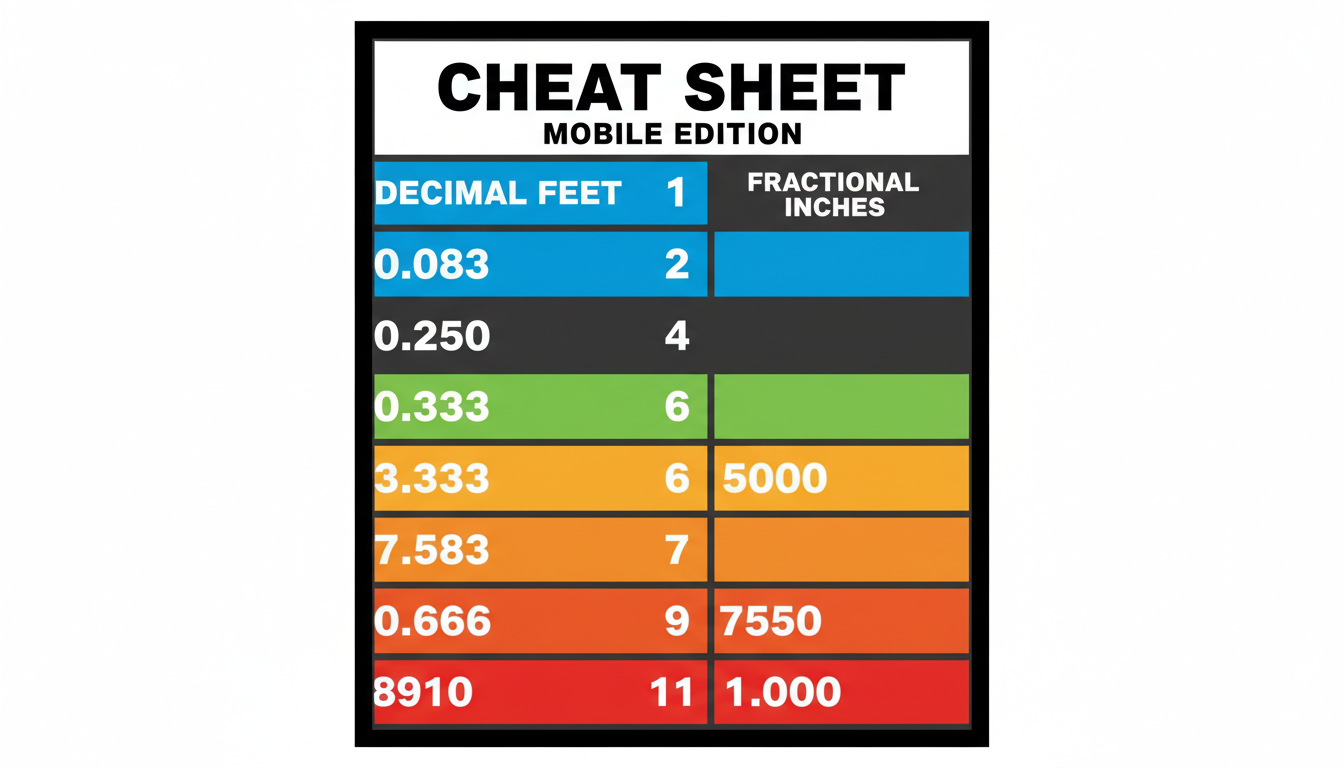
In my experience running job sites, doing math in the mud while it’s raining is a recipe for disaster. It is always safer to rely on a hard copy. Below are two tables you should bookmark or print out.
Quick Reference: The “Big Numbers”
This table covers the primary tenths. Memorize these, and you’ll be right 90% of the time.
| Decimal Feet (Tenths) | Exact Inches | Fractional Approximation | Common Mental Shortcut |
|---|---|---|---|
| 0.10′ | 1.2″ | 1-3/16″ | Just over an inch |
| 0.20′ | 2.4″ | 2-3/8″ | Almost 2.5 inches |
| 0.25′ | 3.0″ | 3″ | Quarter foot = 3 inches |
| 0.30′ | 3.6″ | 3-5/8″ | 3 and a half-ish |
| 0.40′ | 4.8″ | 4-13/16″ | Almost 5 inches |
| 0.50′ | 6.0″ | 6″ | Half foot = 6 inches |
| 0.60′ | 7.2″ | 7-3/16″ | Just over 7 inches |
| 0.75′ | 9.0″ | 9″ | Three-quarter foot = 9 inches |
| 0.80′ | 9.6″ | 9-5/8″ | 9 and a half-ish |
| 0.90′ | 10.8″ | 10-13/16″ | Almost 11 inches |
| 1.00′ | 12.0″ | 12″ | One full foot |
Detailed Precision: Handling Hundredths
Sometimes “close enough” isn’t good enough. If you are setting anchor bolts for steel columns, you need precision. Here is how the hundredths break down.
| Decimal Foot (Hundredths) | Inches (Decimal) | Nearest 1/8th Inch |
|---|---|---|
| 0.01′ | 0.12″ | 1/8″ |
| 0.02′ | 0.24″ | 1/4″ |
| 0.03′ | 0.36″ | 3/8″ |
| 0.04′ | 0.48″ | 1/2″ |
| 0.05′ | 0.60″ | 5/8″ |
| 0.06′ | 0.72″ | 3/4″ |
| 0.07′ | 0.84″ | 7/8″ |
| 0.08′ | 0.96″ | 1″ |
⚠️ Watch Out
The “0.08” Trap: Many people assume 0.10 feet is one inch. It is not. 0.08 feet is approximately one inch (0.96″). 0.10 feet is actually 1.2 inches. That 0.2-inch difference adds up over a 100-foot run!
Step-by-Step: Reading the Rod
Let’s walk through a scenario. You are holding a grade rod or looking at a laser detector, and you need to communicate a cut to an excavator operator who is thinking in inches.
- Read the Decimal: Your laser receiver beeps solid at 3.67 feet.
- Separate the Feet: You have 3 whole feet. Set that aside. You are left with 0.67 feet.
- Calculate the Inches: Multiply 0.67 × 12.
- Calculation: 0.67 × 12 = 8.04.
- So, you have 8 inches.
- Handle the Remainder: You have a tiny remainder of 0.04 inches.
- In rough grading, you ignore this.
- In finish carpentry, 0.04 inches is about 1/32 of an inch.
- Final Call: You tell the operator the grade is 3 feet, 8 inches.
According to the National Institute of Standards and Technology (NIST), maintaining consistent unit conversion protocols is critical for structural integrity. When in doubt, write it down. Don’t rely on mental math for complex decimals.
Tools of the Trade in 2026
We are living in the future, so why are you still doing long division on a piece of scrap wood? While knowing the math is vital for verification, modern tools speed up the process.
1. The Engineer’s Folding Rule
This is the “old reliable.” It’s a fiberglass or wood ruler. One side has standard inches (1/16ths). Flip it over, and the other side has decimal feet (1/10ths). You don’t have to calculate anything; you just find the measurement on one side and flip the ruler to see the equivalent. It’s analog, battery-free, and fail-safe.
2. Dual-Unit Tape Measures
Several manufacturers now produce tape measures with “Engineer’s Scale” on the top blade and “Standard Scale” on the bottom blade. If you are doing site layout regularly, buy one of these. It eliminates the mental load entirely.
3. Construction Calculator Apps
In 2026, your smartphone is your most powerful tool. Apps like “Construction Master Pro” allow you to input 5.45 Feet and hit Convert to Inch to get 5' 5-3/8" instantly. These are essential for checking your work before pouring concrete.

Common Pitfalls to Avoid
I’ve audited enough job sites to see the same mistakes happen over and over. Here is how to protect your project.
The “Half-Foot” Confusion
This is the classic error I mentioned in the introduction.
The Mistake: Seeing 0.5′ and cutting 5 inches.
The Reality: 0.5′ is half of 12, which is 6 inches.
The Fix: Remember that the decimal system is a percentage. 50% of a foot is 6 inches.
The Rounding Error Compound
If you round 0.12 feet to 1.5 inches (it’s actually 1.44 inches), you are off by a hair. No big deal, right? But if you do that 20 times over a 500-foot pipe run, you could end up inches off grade. Always keep your decimals precise until the very last step of the calculation.
⚠️ Watch Out
Don’t Mix Your Tapes! If you are shouting measurements to a partner, verify what tape they are holding. If you yell “Six point five!” (6.5 feet) and they have a standard tape, they might mark 6 feet 5 inches. You meant 6 feet 6 inches. Always clarify units: “Six point five decimal feet!”
Why This Matters: The “So What?”
You might be thinking, “Is it really that big of a deal?” Yes. In the civil engineering world, water flows downhill. If your conversion is wrong, water might flow into a basement instead of away from it.
Consider ADA (Americans with Disabilities Act) ramps. The code is strict: a 1:12 slope. If you miscalculate the rise by even a few tenths of an inch because of a bad conversion, a building inspector can—and will—make you tear out the concrete and pour it again. That is a mistake that costs thousands. Precision isn’t just about math; it’s about profitability.
Conclusion
Converting tenths to inches is a fundamental literacy test for anyone in the trades. It bridges the gap between the theoretical design of the engineer and the physical reality of the builder. By mastering the “Times 12” rule, keeping a cheat sheet in your pocket, and using the right tools, you can eliminate the guesswork.
Don’t be the guy who cuts the pipe at 5 inches when it should have been 6. Take the time to double-check your math. Your reputation (and your wallet) will thank you.
Ready to upgrade your site skills? Start by downloading a conversion chart to your phone today, or pick up an engineer’s folding rule for your tool belt.
❓ Frequently Asked Questions
What is 1 tenth of a foot in inches?
One tenth (0.10) of a foot is equal to exactly 1.2 inches. In practical construction terms, this is usually rounded to 1-3/16 inches or loosely referred to as “an inch and a heavy eighth.”
How do I convert tenths to inches on a standard calculator?
Type in the decimal part of the foot (e.g., .45) and multiply it by 12. The result is your inches. If you have a decimal remainder in the answer (e.g., 5.4 inches), multiply that .4 by 16 to get the 16ths of an inch.
Why do surveyors use tenths instead of inches?
Surveyors use decimal feet (tenths) because it makes adding, subtracting, and calculating slopes much easier. It eliminates the need to convert fractions like 5/8ths or 1/16ths when processing large amounts of elevation data.
Is 0.5 feet the same as 5 inches?
No! This is the most common mistake. 0.5 feet is 50% of a foot. Since a foot has 12 inches, 50% of 12 is 6 inches.
Where can I find official standards for measurement units?
For official definitions and conversion factors, you can reference resources from the educational math resources or government standards bodies like NIST.