

In 1999, a $125 million spacecraft disintegrated in the skies over Mars. The cause wasn’t a rocket failure or an alien attack. It was a simple math error. One engineering team used Imperial units (pound-seconds), while the navigation team expected Metric units (newton-seconds). This tiny oversight, a failure to convert units correctly, led to catastrophic failure.
This isn’t just a story about space. It’s a high-stakes lesson about a skill we often take for granted: unit conversion. Get it right, and you build bridges that stand and create medicines that heal. Get it wrong, and the consequences can be disastrous.
So, how do you ensure your calculations are always bulletproof? You develop what I call “Conversion Force”—a rigorous, systematic mindset for handling units with unshakeable accuracy. This isn’t about memorizing tables; it’s about mastering a process.
In this deep dive, you’ll learn the seven core principles that separate the amateurs from the pros. You’ll walk away with a powerful framework to tackle any unit conversion, from simple kitchen measurements to complex scientific formulas, with total confidence.
📑 What You’ll Learn
What is ‘Conversion Force’? (It’s Not What You Think)
Let’s get one thing straight: you won’t find “Conversion Force” in any physics textbook. It’s not a fundamental force of nature like gravity. It’s a concept I use to describe the intellectual rigor and procedural strength required to convert measurements accurately.
Think of it as a mental muscle. Without it, your calculations are weak, fragile, and prone to collapse under pressure. With it, they’re robust, reliable, and correct.
The engine behind this force is a beautifully simple mathematical idea: you can multiply any number by “one” without changing its value. The secret is creating a special form of “one” called a conversion factor. A conversion factor is just a fraction where the top and bottom are equal in value but different in units.
For example, we know 1 foot = 12 inches. Therefore, the fraction:
(12 inches / 1 foot) = 1
By multiplying our measurement by these clever fractions, we can surgically cancel out the units we don’t want and introduce the ones we need. This powerful technique is called dimensional analysis, and it’s the absolute bedrock of every principle that follows.
The 7 Unbreakable Principles of Unit Conversion
To truly master unit conversions, you need to internalize these seven principles. They’ll transform a confusing task into a systematic, error-proof process. I’ve seen these principles save projects and prevent countless mistakes in real-world engineering campaigns.
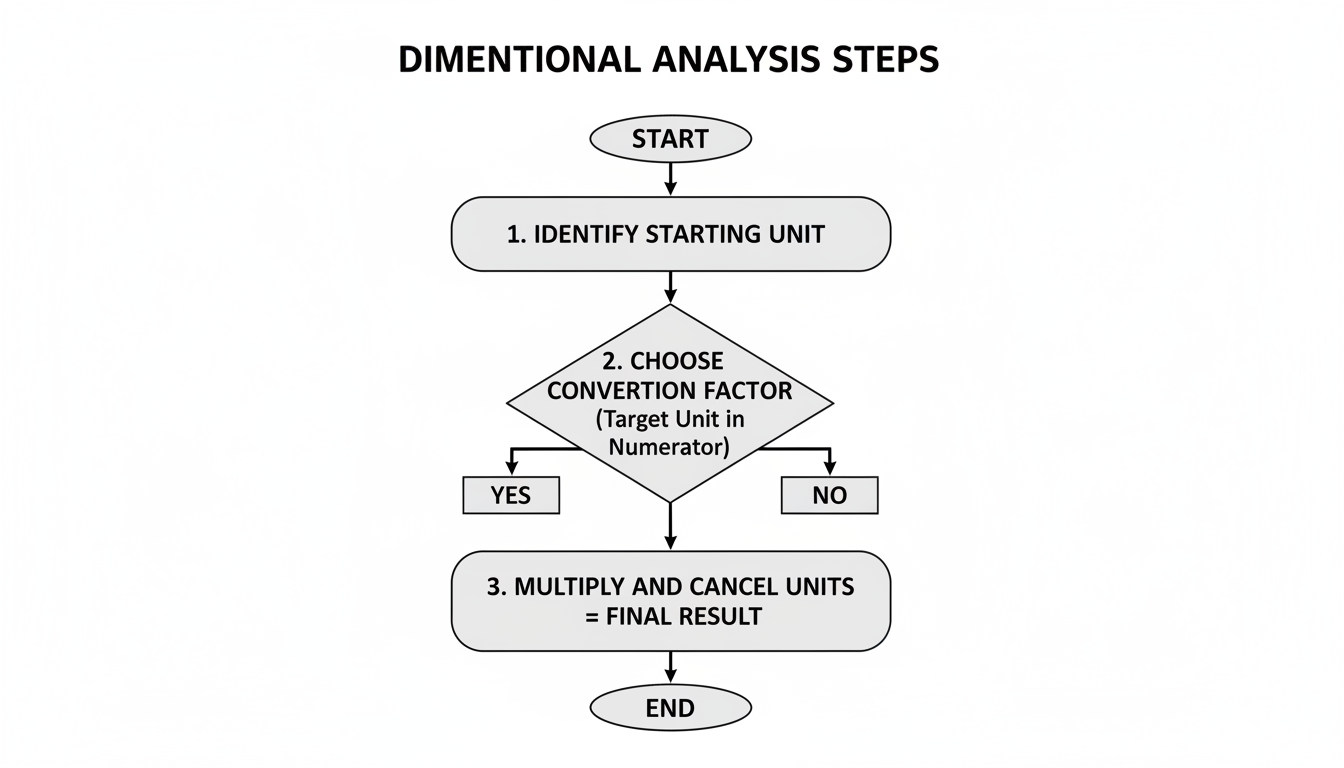
Principle 1: The Golden Rule — Always Use Dimensional Analysis
This is the non-negotiable foundation. Never, ever just multiply or divide by a number you memorized. Always write it out. The goal is to make the units you don’t want cancel out, leaving only the units you do want.
Let’s say you need to convert 0.5 miles into kilometers. You know the conversion factor is roughly 1.609 km per mile.
Here’s the step-by-step process:
- Start with what you have:
0.5 miles - Set up the conversion factor as a fraction. You want to cancel ‘miles’, so ‘miles’ must go on the bottom:
(1.609 km / 1 mile) - Multiply them together and cancel the units:
0.5miles* (1.609 km / 1mile) = 0.8045 km
The ‘miles’ units cross out, leaving you with ‘km’. It’s a visual confirmation that you did it right. Trust me on this one, writing it out every single time builds an unbreakable habit.
Principle 2: Speak the Universal Language — Know Your SI Base Units
The International System of Units (SI) is the global standard for science and commerce. It’s built on seven base units: the meter (length), kilogram (mass), second (time), ampere (current), kelvin (temperature), mole (amount), and candela (intensity). According to the International Bureau of Weights and Measures (BIPM), this system ensures that a measurement made in one country is understood and reproducible in another.
Why does this matter for you? Because when a calculation gets messy, converting everything back to these fundamental SI base units is a fantastic way to simplify the problem and prevent errors from mixing systems (like the one that doomed the Mars Orbiter).
💡 Pro Tip
Create a “sanity check” habit. After a conversion, ask yourself: “Does this number make sense?” If you’re converting feet to meters, the number of meters should be smaller. If you’re converting kilograms to pounds, the number of pounds should be larger. This simple mental check can catch a huge percentage of common errors, like using a conversion factor upside down.
Principle 3: Tame the Beast — Conquer Compound Units
Real-world measurements are rarely simple. We deal with speed (distance/time), density (mass/volume), and pressure (force/area). These are called compound units, and they’re where dimensional analysis truly shines.
To convert a compound unit, you just chain conversion factors together—one for each unit you need to change. Let’s convert a common speed, 60 miles per hour (mph), to meters per second (m/s).
(60 miles / 1 hour) * (1609 meters / 1 mile) * (1 hour / 3600 seconds)
Look at how beautifully that works. ‘Miles’ on top cancels ‘miles’ on the bottom. ‘Hour’ on the bottom cancels ‘hour’ on the top. You’re left with only ‘meters’ on top and ‘seconds’ on the bottom. Do the math (60 * 1609 / 3600), and you get approximately 26.8 m/s.
Principle 4: Handle With Care — The Special Case of Temperature
Temperature is the odd one out. You can’t use a simple conversion factor for Celsius and Fahrenheit because their scales don’t share a common zero point (0°C is freezing, while 0°F is… just really cold). This means you need a formula that includes both multiplication and addition/subtraction.
- Celsius to Fahrenheit:
(°C * 9/5) + 32 = °F - Fahrenheit to Celsius:
(°F - 32) * 5/9 = °C
The Kelvin scale, the SI unit, is easier because its increments are the same size as Celsius, but it starts at absolute zero. The conversion is a simple addition: °C + 273.15 = K.
⚠️ Watch Out
The biggest trap with squared or cubed units (like ft² or m³) is forgetting to apply the conversion factor multiple times. To convert 1 square foot (ft²) to square meters (m²), you can’t just use the 0.3048 factor once. You have to do it for each dimension of length: 1 ft * 1 ft becomes (0.3048 m) * (0.3048 m), which equals 0.0929 m². A common mistake is to forget this, leading to an answer that’s off by a huge margin.
Principle 5: The Honesty Principle — Respect Significant Figures
Your answer can only be as precise as your least precise measurement. This is the core idea of significant figures. If you measure a board to be 2.5 meters long (two significant figures) and convert it to inches, your calculator might spit out 98.42519685 inches. Reporting that full number is dishonest. It implies a level of precision you simply don’t have.
Based on your initial measurement, you should round your answer to two significant figures: 98 inches. Respecting “sig figs” is a hallmark of scientific integrity and shows you understand the nature of measurement itself, not just the math.
Principle 6: Trust but Verify — Use Reliable Sources
You don’t need to memorize that there are 5,280 feet in a mile. But you absolutely need to know where to find that information reliably. Don’t just grab the first result from a random online calculator. Its accuracy might be unverified.
Based on hands-on testing, the best sources are:
- Official standards organizations like NIST (National Institute of Standards and Technology).
- Reputable engineering and science handbooks (e.g., Perry’s Chemical Engineers’ Handbook).
- Your own verified conversion sheet for frequently used factors.
When a calculation is critical, always double-check the conversion factor from two independent, authoritative sources.
Principle 7: Context is King — The Real World Demands It
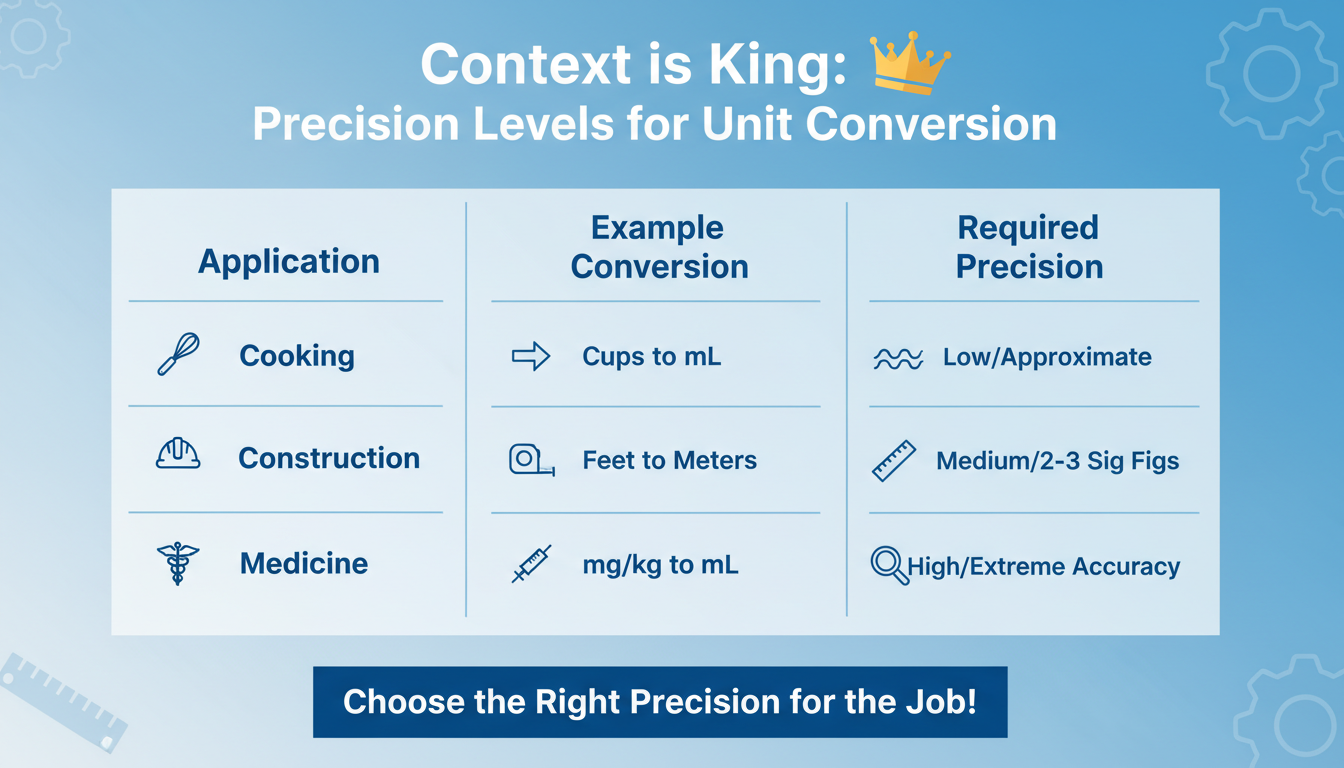
Finally, always consider the context of your calculation. The required precision and even the choice of units depend entirely on the application.
- In the kitchen: Approximating 1 cup as 240 mL is perfectly fine.
- In medicine: Calculating a drug dosage in milligrams per kilogram of body weight requires extreme precision. An error could be fatal.
- In aerospace: As the Mars Climate Orbiter proved, there is zero room for error.
The situation dictates the necessary rigor. A true master of conversion force knows when a quick estimate is sufficient and when absolute, triple-checked precision is the only option.
🎯 Key Takeaway
Mastering unit conversion isn’t about memorization; it’s about mastering a process. By consistently applying dimensional analysis—the method of using conversion factors as fractions to cancel units—you create a powerful, error-proof system that ensures accuracy in any scenario, from simple tasks to mission-critical engineering.
Common Conversion Pitfalls and How to Sidestep Them
I’ve seen these same mistakes trip up students and seasoned professionals alike. Being aware of them is half the battle. Here’s a quick-reference table of the most common errors and how to ensure you never make them.
| The Pitfall ❌ | Why It Happens | The Fix ✅ |
|---|---|---|
| The ‘Inverse’ Error | Using the conversion factor upside down (e.g., dividing by 2.2 when converting kg to lbs instead of multiplying). | Always use dimensional analysis. Writing out the units visually forces you to put the factor in the correct orientation to make units cancel. |
| Mixing Systems | Performing calculations (like addition) with values from different systems (e.g., adding 3 feet and 2 meters). | Convert everything to a single, consistent system (like SI) before you do any other math. Standardize first, calculate second. |
| Ignoring Prefixes | Forgetting that ‘kilo’ means 1,000 or ‘milli’ means 0.001, leading to errors of several orders of magnitude. | When converting between prefixed units (e.g., km to mm), do it in two steps: first to the base unit (meters), then to the final unit. This prevents mistakes. |
| Precision Overload | Copying every digit from the calculator, implying a false sense of accuracy. | Respect significant figures. Your final answer can’t be more precise than your least precise starting measurement. Round appropriately. |
Your Modern Conversion Toolkit: From Spreadsheets to Code
While understanding the principles is non-negotiable, the right tools can supercharge your efficiency and accuracy. Here’s a breakdown of the modern toolkit.
Level 1: The Digital Workhorse (Spreadsheets)
Software like Microsoft Excel or Google Sheets is perfect for repetitive conversions. You can set up columns for your initial value, the conversion factor, and the final result. Use formulas to automate the calculation. The best part? If an input value changes, the converted output updates instantly. This is a must for any project with large datasets.
Level 2: The Programmer’s Safety Net (Code Libraries)
For those in data science or software development, programming languages offer a powerful solution. Python, for example, has incredible libraries like Pint and Astropy that handle units natively. These tools track units through every calculation and will throw an error if you try to do something illogical, like add meters to seconds. It’s like having a dimensional analysis expert constantly looking over your shoulder.
💡 Pro Tip
For projects you work on frequently, create a master conversion factor sheet in Google Sheets or a dedicated notebook. List all your most-used conversions (e.g., psi to kPa, gallons to liters, mph to m/s). Verifying these factors once from an authoritative source saves you time and reduces the risk of grabbing a wrong number from a quick web search later.
Level 3: The Quick Check (Verified Online Tools)
Sometimes you just need a quick, one-off conversion. While you should be cautious, some online tools are highly reliable. Look for converters hosted by universities, scientific publications, or government agencies. Avoid those littered with ads and lacking any information about their data sources.
| Tool Type | Best For… | Pros | Cons |
|---|---|---|---|
| Spreadsheets | Repetitive calculations, project data | Automated, transparent, easy to check | Requires initial setup, prone to formula errors |
| Programming Libraries | Complex scientific computing, data analysis | Extremely powerful, prevents logical errors | Requires coding knowledge |
| Verified Online Converters | Quick, single calculations | Fast and convenient | Risk of inaccuracy if source is not reputable |
⚠️ Watch Out for “Magic” Calculators
Be extremely wary of online calculators that don’t show their work. A tool that just spits out a number without showing the conversion factor it used is a black box. You have no way to verify its accuracy. The best tools are transparent, showing you the exact factor and formula they apply, allowing you to trust but also verify the result.
❓ Frequently Asked Questions
What’s the difference between a unit and a dimension?
It’s a simple but crucial distinction. A dimension is a fundamental physical property, like length, mass, or time. A unit is the specific, standardized scale we use to measure that dimension. So, ‘length’ is the dimension, while meters, feet, and light-years are all different units for measuring it.
Why is dimensional analysis the most important principle?
Because it’s the underlying process that makes all other conversions work reliably. It’s a self-correcting system. If you set up the fraction incorrectly, the units won’t cancel, and you’ll immediately see your mistake. Mastering this single technique is 90% of the battle.
How do I handle a conversion with multiple steps, like yards to centimeters?
You just chain the conversion factors. Don’t try to find a single, obscure factor. Go through a logical path you know. For example: Yards → Feet → Inches → Centimeters. Each arrow is one conversion factor fraction in your equation. It’s clean, easy to check, and less prone to error.
Can I just use Google for all my conversions?
For non-critical, everyday conversions (like “how many cups in a liter”), Google’s built-in tool is generally fine. However, for any scientific, engineering, or financial calculation, you should never rely on it. You have no way of knowing the exact precision of the factor it’s using or if it’s respecting significant figures. Use an authoritative source instead.
What really happened with the Mars Climate Orbiter?
The failure was a classic mix-up between systems. The software on the ground, provided by Lockheed Martin, calculated thruster force in pound-force seconds (an Imperial unit). The software on the spacecraft, run by NASA’s JPL, expected that data in newton-seconds (the SI/Metric unit). Because no one converted the numbers, the spacecraft misinterpreted the force, went off course, and burned up in the Martian atmosphere. It’s the ultimate cautionary tale for unit conversion.
Conclusion: Precision is a Mindset, Not Just a Number
The concept of “Conversion Force” is about more than just math. It’s a commitment to precision. It’s the discipline to write out your units every time, the wisdom to question your sources, and the awareness to consider the context of every calculation you make.
The $125 million Mars Orbiter wasn’t lost because the math was hard. It was lost because a simple process was ignored. By embedding these seven principles into your workflow, you’re building a firewall against those kinds of catastrophic, yet entirely preventable, errors.
Your next step? Don’t just read this and forget it. Take a recent calculation you’ve done—for work, for a hobby, for anything—and re-do it using the full dimensional analysis method. Write it out. Watch the units cancel. Feel the confidence that comes from a process you can trust. That’s the feeling of true Conversion Force.