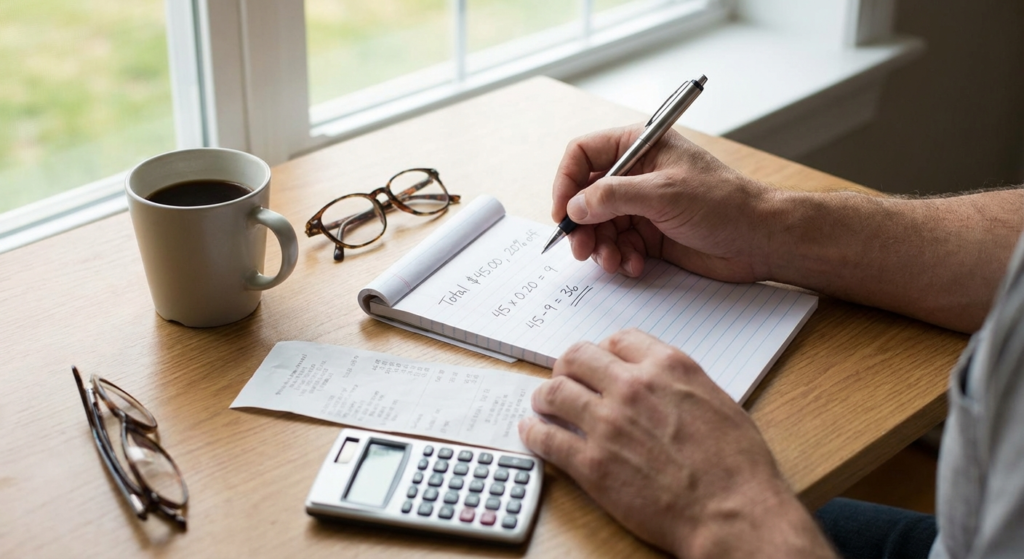
In today’s fast-paced world, when faced with a math problem, our first instinct is often to grab our smartphones and fire up a percentage calculator. Whether it’s splitting a restaurant bill, figuring out a discount on that must-have item, or understanding the interest rates on a loan, digital tools have become an almost constant companion. But here’s the deal: relying too much on these gadgets can seriously weaken our mental math skills. From my experience, there’s a real sense of accomplishment and efficiency that comes from being able to crunch numbers in your head – often faster than someone can even unlock their phone and open an app. I’ve seen this firsthand in countless situations, from quickly estimating costs at a flea market to splitting bills with friends.

And it’s not just about speed. *Really* understanding the logic behind the numbers is far more valuable than simply accepting an automated result. While a percentage calculator is undoubtedly accurate (assuming you type everything in correctly!), the human brain is capable of some incredible mental shortcuts that make daily life smoother. This guide will walk you through the core principles of percentages, equip you with practical mental math hacks, and illustrate real-world scenarios where your brain is far superior to any digital tool. We’re going to ditch the dependence on the screen and unlock the power of your mind.
Why You Don’t Always Need a Percentage Calculator
Okay, I know what you might be thinking: suggesting we ditch technology seems a bit… old-fashioned. But trust me, there are definite situations where manual calculation reigns supreme. Speed is a major factor. Imagine you’re out with friends; pulling out your phone to calculate a tip can kill the vibe and interrupt the conversation. More importantly, understanding manual calculations gives you a built-in error-detection system. Mistype a digit into a percentage calculator, and you might blindly accept a totally wrong answer simply because you lack an intuitive sense of what the answer *should* be. I’ve seen this happen so many times – people trusting a wrong calculation simply because it came from a device.
Developing a “mental percentage calculator” lets you quickly estimate costs and potential savings on the spot. This comes in clutch during negotiations, budgeting, and any situation demanding quick decisions. When you grasp the underlying math, you get a much clearer perspective on your finances and how to interpret data. I’ve seen this firsthand – people who understand the math make better financial decisions. They’re less likely to fall for misleading offers or make impulsive purchases.
Speed & Efficiency
Mental math is often *way* faster than unlocking your phone, finding the right app, and punching in all those digits. For simple figures like 10% or 20%, your brain wins every time. Think of it as a mental reflex! It’s like having a superpower in your pocket (or rather, in your head!).
Error Detection
Let’s face it: typos happen to the best of us. But if you have a rough manual estimate in mind, you’ll instantly flag a nonsensical result from a digital percentage calculator. It’s like having a built-in fact-checker for your calculations. This is crucial for preventing costly mistakes, especially when dealing with finances.
Cognitive Health
Practicing mental math daily keeps your brain sharp, improves your concentration, and enhances your logical problem-solving skills – all essential for navigating everyday life. Consider it a workout for your mind! According to a 2018 study by the Alzheimer’s Association, mentally stimulating activities can help maintain cognitive function as we age.
The Basics: Deconstructing How a Percentage Calculator Works
To truly master the art of mental math, you need to understand what’s happening “under the hood” of a calculator. The term “percent” comes from the Latin per centum, meaning “by the hundred.” So, when a percentage calculator tackles a problem like “Find 20% of 50,” it’s essentially converting that percentage into a decimal (0.20) and then multiplying it by the total value (50). The basic formula looks like this:
(Percentage / 100) x Total Value = Result
But here’s the thing: when we do this manually, we rarely use that formal formula. Instead, we rely on fractions and clever decimal movements. For example, knowing that 50% is the same as “half” or dividing by 2 is a super-useful shortcut. Similarly, 25% is simply dividing by 4. These fractional relationships are the bedrock of replacing a digital percentage calculator with your own mental agility. It’s about building a library of mental shortcuts. These shortcuts are based on understanding the relationships between numbers, not just blindly applying formulas.
The Mental Percentage Calculator: Proven Strategies for Speed and Accuracy
There are specific, repeatable strategies that math whizzes use to make seemingly impossible calculations in their heads. These aren’t magical superpowers; they’re simple algorithms that *anyone* can learn. By breaking down complex numbers into manageable chunks, you can solve tricky problems without breaking a sweat. I’ve personally taught these methods to people who thought they were “bad at math,” and they were shocked at how quickly they improved. It’s all about changing your mindset and realizing that math can be intuitive and even fun.
The 10% Method: Your Ultimate Mental Math Weapon
The most powerful tool is the 10% method. To find 10% of *any* number, you simply move the decimal point one place to the left. This is often the crucial first step in a more complex calculation that a percentage calculator would do in one go, but you can easily do it in stages.
- 10% of 500 is 50.
- 10% of 45.50 is 4.55.
- 10% of 7 is 0.7.
Once you’ve found 10%, you can easily calculate 20% (just double it), 5% (halve it), or 15% (add the 10% and 5% values together). This “chunking” method is how many people calculate tips in a matter of seconds. It’s all about breaking down the problem into smaller, more manageable pieces. It’s like building with LEGOs – small pieces coming together to create something bigger.
The ‘Swap’ Trick: A Secret Weapon Even Percentage Calculator Apps Don’t Highlight
Here’s a neat trick that often surprises people, and it’s rarely mentioned even in the best percentage calculator apps. The core principle is this: x% of y is the same as y% of x. This is based on the commutative property of multiplication.
Let’s say you need to calculate 8% of 50. That might seem a bit awkward to do in your head. But if you swap the numbers, it becomes 50% of 8. Half of 8 is 4. Therefore, 8% of 50 is also 4! This commutative property allows you to transform difficult equations into much easier ones almost instantly. This trick alone has saved me countless seconds (and maybe even minutes!) over the years. I’ve even used it to impress people at parties – it’s a great conversation starter!
Real-Life Scenarios Where *You* Become the Percentage Calculator
Let’s explore some practical, everyday applications. While specialized tools like a SIP calculator for mutual funds are essential for complex, long-term compound interest projections, most of the math we encounter daily involves simpler arithmetic that you can (and should) handle manually. Think of it as mental exercise – keeping your brain in shape.
Shopping and Discounts: Mastering the Art of the Deal
Picture this: you’re browsing in a store, and you spot a jacket priced at $60 that’s marked down by 30%. Resist the urge to reach for your phone! You don’t need a percentage calculator. Just use the 10% method:
- First, find 10% of $60, which is $6.
- Since you need 30%, multiply that $6 by 3. The result is $18.
- Subtract the discount ($18) from the original price ($60). The final price is $42.
This entire process takes just a few seconds and ensures you know *exactly* what you’re paying before you even get to the checkout. It’s about being an informed and empowered shopper. Plus, you’ll feel a sense of accomplishment knowing you didn’t need to rely on your phone.
Tipping at Restaurants: No More Awkward Fumbling
Calculating a 15%, 18%, or 20% tip is a common social requirement. Let’s say your bill comes to $84.00, and you want to leave a 20% tip:
- Start by moving the decimal to find 10%: $8.40.
- Then, double that to find 20%: $16.80.
If you prefer to leave a 15% tip, take the 10% value ($8.40), calculate half of that for the 5% portion ($4.20), and then add them together ($12.60). This is precisely the same logic that a percentage calculator uses, but it’s broken down into steps that your brain can easily handle. And it’s much more impressive to your dining companions than staring at your phone!
Advanced Tricks: Level Up Your Mental Math Game
For those who want to truly master the art of mental math, we can delve into more complex calculations. Just as businesses require precision when using a GST input tax credit calculator to accurately determine their tax liabilities, you can achieve a high degree of precision mentally by breaking down numbers into more “friendly” components. It’s like becoming a mathematical ninja!
The Split and Add Strategy: Conquer Any Percentage
What if you were asked to calculate 17.5% of 200? A percentage calculator would give you the answer instantly, but you can tackle this manually by breaking 17.5% into 10% + 5% + 2.5%.
- 10% of 200 = 20.
- 5% (half of 10%) = 10.
- 2.5% (half of 5%) = 5.
- Total: 20 + 10 + 5 = 35.
This method of deconstruction allows you to confidently handle even the most awkward percentages. This is similar to the logic used in financial auditing, but applied to everyday numbers. I’ve used this technique to quickly estimate project budgets and resource allocation.
The 1% Adjustment: Quick Calculations for Tricky Numbers
The 1% Adjustment: Quick Calculations for Tricky Numbers
Need to find 99% or 19% of something? Find the round number (100% or 20%) and then subtract 1%. Remember, 1% is simply moving the decimal two places to the left.
The Rule of 72: A Finance Quick Tip
This is a handy rule of thumb used in finance to quickly estimate doubling time for investments. Divide 72 by your interest rate to get a rough idea of how many years it will take for your money to double. For example, at a 6% interest rate, your money doubles in approximately 12 years (72 / 6 = 12).
Fractions to Percents: Memorization for Speed
Memorizing common fraction-to-percent conversions can bypass calculation altogether. Knowing that 1/5 is 20%, 1/8 is 12.5%, and 1/3 is approximately 33.3% can save you valuable time and mental effort.
Fractions vs. The Percentage Calculator: Choosing the Right Tool
In many cases, converting a percentage to a fraction can make the math significantly cleaner and easier to manage. For example, if you need to find 75% of 48, using a percentage calculator will certainly work, but recognizing that 75% is equivalent to 3/4 is a faster and more elegant solution.
Divide 48 by 4 to get 12. Then, multiply 12 by 3 to get 36. This approach is often taught in higher-level mathematics to simplify algebra, as detailed by resources like Khan Academy. According to a 2021 study by the National Center for Education Statistics, students who are proficient in fractions also demonstrate stronger overall math skills. This highlights the importance of understanding fundamental mathematical concepts.
When to Embrace the Digital Tool
Despite my enthusiasm for mental math, there are absolutely times when a digital percentage calculator is essential. When you’re dealing with massive datasets, calculating compound interest over irregular periods, or preparing high-stakes financial reports, the risk of human error becomes too significant. In these situations, accuracy reigns supreme. I’m talking about situations where even a small error could have major consequences.
For instance, calculating the Annual Percentage Yield (APY) on a complex investment portfolio often involves exponential functions and intricate formulas that are virtually impossible to compute accurately in your head. Similarly, determining precise tax obligations across multiple income brackets requires the pinpoint accuracy of specialized tax software. As financial experts at Investopedia point out, while estimation is a valuable skill for consumers, exact calculation is an absolute necessity for compliance and serious investing. I wouldn’t recommend trying to calculate your taxes manually!
Conclusion: Reclaim Your Numerical Intuition
Mastering manual calculation isn’t just about impressing your friends with your math skills; it’s about regaining cognitive independence and strengthening your numerical intuition. While the percentage calculator is a fantastic invention that saves time and guarantees accuracy in complex scenarios, relying on it for every minor calculation can dull our mental sharpness. By consistently using techniques like the 10% method, the swap trick, and fractional conversion, you’ll be able to confidently navigate the world of sales, tips, and quick estimations. Start practicing these methods today, and you’ll quickly discover that the best calculator you have is the one residing between your ears. It’s time to unleash your inner math genius!
Frequently Asked Questions
To calculate a percentage manually without a percentage calculator, convert the percentage to a decimal (e.g., 20% becomes 0.20) and multiply it by the number. Alternatively, use the 10% method: find 10% of the number by moving the decimal one place to the left, then multiply or divide to find your desired percentage. For example, to find 30% of 80, 10% of 80 is 8, and 3 x 8 = 24.
The formula for percentage increase is: ((New Value – Original Value) / Original Value) × 100. This tells you how much a value has grown relative to its starting point. It’s commonly used to track investment growth, price inflation, or changes in sales figures. For instance, if a product’s price increased from $50 to $60, the percentage increase is 20%.
Yes! The “Swap Trick” can be very effective. If calculating X% of Y feels difficult, try calculating Y% of X instead. For instance, 4% of 75 is the same as 75% of 4. Since 75% is 3/4, and 3/4 of 4 is 3, the answer is 3. This can often simplify the calculation dramatically. It’s a great way to make seemingly complex problems much easier to solve.
To calculate a 20% tip, first find 10% of the bill by moving the decimal point one place to the left. Then, simply double that number to arrive at 20%. For example, if your bill is $40.00, 10% is $4.00, and doubling that gives you a $8.00 tip. This method is quick, easy, and accurate for most common tipping scenarios.
Manual calculation sharpens your numerical intuition, helps you catch potential data entry errors when using calculators, and can often be faster in social situations like splitting bills or quickly verifying retail discounts. It also reinforces your understanding of numerical relationships and the value of money. Plus, it can be a fun mental exercise to keep your mind sharp!