
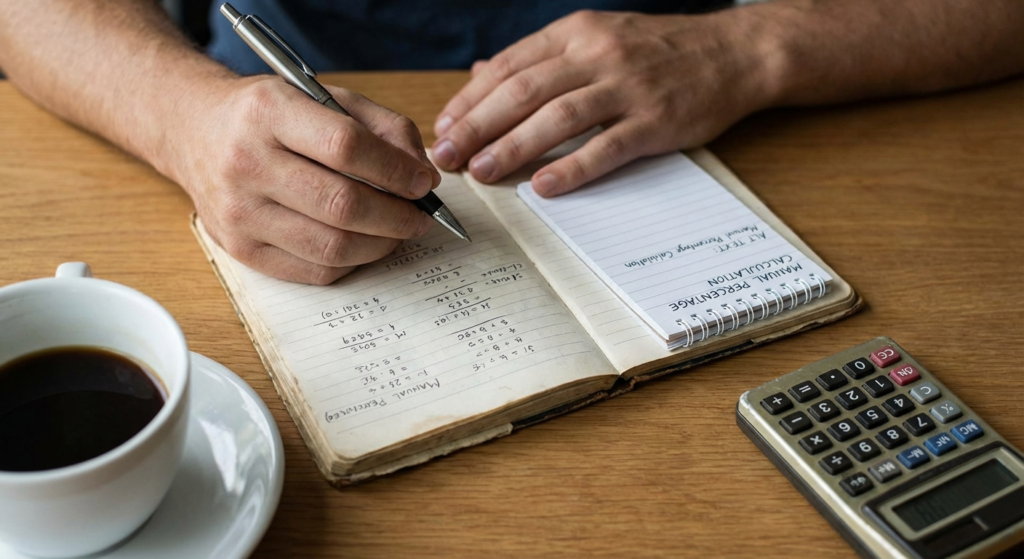
Have you ever stood in a store aisle, staring at a “30% off” sign, desperately fumbling for your phone to find a Percentage Calculator? You are not alone. In our digital age, we have become incredibly reliant on digital tools to solve basic mathematical problems. While these tools are convenient, understanding the logic behind them is a superpower that can save you time, money, and embarrassment.
Percentages are everywhere. From calculating the tip at a restaurant to understanding the interest rate on your mortgage or figuring out how much battery life is left on your laptop, this mathematical concept governs much of our daily lives. While an online Percentage Calculator is a fantastic tool for complex numbers, relying on it for simple tasks can slow you down.
This comprehensive guide will walk you through the mechanics of manual calculation. We will explore the formulas, the mental shortcuts, and the practical applications that will turn you into a human calculator. By the end of this article, you will understand exactly how the math works, allowing you to double-check your digital tools and make faster decisions on the fly.
Why Relying Solely on a Digital Percentage Calculator Limits You
It might seem counterintuitive to learn manual math when you have a Percentage Calculator in your pocket. However, total dependence on technology has its drawbacks. Understanding the underlying mechanics of percentages improves your numerical literacy and critical thinking skills.
When you understand the math, you can spot errors immediately. If you accidentally type an extra zero into a tool, your brain should alert you that the result looks wrong. Without manual knowledge, you might accept a flawed result as fact. Furthermore, in business meetings or negotiations, being able to estimate margins and discounts mentally commands respect and allows for fluid conversation.
Here are the core benefits of mastering this skill:
- Speed: For simple numbers (like 10% or 50%), your brain is faster than unlocking a phone.
- Confidence: You won’t feel helpless when technology isn’t available.
- Negotiation Power: You can calculate deals and savings instantly during discussions.
Mastering the Formula: How a Percentage Calculator Works
To beat the machine, you must understand how the machine thinks. Every Percentage Calculator operates on a very simple algebraic formula. The word “percent” literally means “per 100.” It is a way of expressing a number as a fraction of 100.
The standard formula used in manual calculation is:
(Part / Whole) × 100 = Percentage
Conversely, if you want to find a specific number based on a percentage, the formula rearranges to:
(Percentage / 100) × Whole = Part
For example, if you want to know what 20% of 500 is, you convert 20% into a decimal (0.20) and multiply it by 500. The result is 100. This is exactly what happens in the backend code of any online tool. For a deeper dive into mathematical definitions, authoritative resources like Math is Fun offer excellent visualizations.
The Decimal Method
Convert the percentage to a decimal by moving the point two places to the left. Multiply this by your total number. Example: 50% becomes 0.50.
The Fraction Method
Convert the percentage to a simplified fraction. 25% becomes 1/4. Divide the total number by the denominator. Example: 100 / 4 = 25.
The 1% Method
Find 1% of the number by moving the decimal two spots left. Then multiply that result by the percentage you need. Great for complex numbers.
Real-World Examples: Being Your Own Percentage Calculator
Let’s look at practical scenarios where mental math shines. While you could use a tool, doing it yourself is often more gratifying and efficient. We will cover shopping, tipping, and basic financial growth.
The 10% Rule: A Quick Trick for any Percentage Calculator User
The easiest trick in the book is finding 10%. To find 10% of any number, you simply move the decimal point one place to the left. This is the foundation of almost all mental percentage math.
- 10% of $50.00 is $5.00.
- 10% of $125.00 is $12.50.
- 10% of $4.50 is $0.45.
Once you have 10%, you can easily find 20% (double it) or 5% (halve it). This technique is incredibly useful when you are trying to figure out savings during a sale. Speaking of sales, if you want to dive deeper into calculating specific retail discounts, check out our guide on the percentage calculator for discount shopping.
Calculating Tips Without a Percentage Calculator
Dining out provides a classic test of your math skills. Standard tipping rates usually hover between 15% and 20%. Rather than reaching for an app, use the “10% plus half” method for a 15% tip.
- Calculate 10%: Move the decimal one spot left.
- Calculate 5%: Take half of the 10% value.
- Add them together: The total is your 15% tip.
For example, on a $60 bill: 10% is $6. Half of that (5%) is $3. Therefore, a 15% tip is $6 + $3 = $9. This is significantly faster than unlocking your phone and typing in the numbers.
When to Switch: Manual Math vs. Online Percentage Calculator
There is a time and place for everything. While mental math is excellent for estimation and simple integers, there are moments when precision is non-negotiable. If you are dealing with large financial figures, compound interest, or tax calculations where decimals run deep, a digital tool is superior.
For instance, calculating the compound annual growth rate (CAGR) or complex mutual fund returns manually is prone to human error. In these high-stakes financial scenarios, using a specialized tool ensures accuracy. You can learn more about financial growth calculations in our article about the SIP calculator for mutual funds.
Use Manual Math When:
You are shopping, tipping, checking battery life, or estimating rough business margins during a conversation.
Use a Calculator When:
You are filing taxes, calculating exact loan interest, doing chemistry homework, or managing large payroll data.
Advanced Techniques: Beyond the Basic Percentage Calculator
Once you master the basics, you can tackle more difficult problems. One such concept is the “Reverse Percentage.” This is often used to calculate the original price of an item before a tax was added or a discount was applied.
If you know the final price is $120 and that includes a 20% tax, simple subtraction doesn’t work. You cannot just take 20% of 120 and subtract it. You must understand that $120 represents 120% of the original price. Therefore, the formula is:
$120 / 1.20 = $100
This concept is vital for business owners analyzing VAT or sales tax. It is a feature often found in an advanced Percentage Calculator, but knowing the logic prevents you from underpricing your products. For more on the economic importance of accurate calculations, Investopedia provides great insights into how percentages drive financial markets.
Visualizing Percentages for Better Understanding
Sometimes, numbers on a page are hard to grasp. Visualizing percentages as slices of a pie or segments of a bar can help. 25% is always a quarter. 33.3% is a third. 75% is three-quarters.
Memorizing these common fractions converts a multiplication problem into a division problem, which is often easier for the human brain to handle:
- 20% = Divide by 5
- 25% = Divide by 4
- 33.3% = Divide by 3
- 50% = Divide by 2
- 12.5% = Divide by 8
Conclusion
While the digital Percentage Calculator is an indispensable tool in our modern arsenal, it should not replace your ability to think mathematically. By mastering the basic formulas, learning the decimal shift trick, and memorizing common fractions, you empower yourself to make quicker, smarter decisions.
Whether you are calculating a discount at the mall or estimating profit margins in a boardroom, these manual skills ensure you are never caught off guard. Use the calculator for precision, but use your brain for understanding. With a little practice, you will find that for many daily tasks, you are faster than the app.
FAQs
To calculate a percentage manually, convert the percentage into a decimal (e.g., 20% becomes 0.20) and multiply it by the total number. Alternatively, for simple numbers, use the 10% trick: move the decimal point of the total number one place to the left to find 10%, then multiply that result to reach your desired percentage.
The basic formula is (Part / Whole) × 100. However, if you are looking for a specific percentage of a number, the formula is (Percentage / 100) × Total Value. For example, to find 5% of 200, you calculate (5 / 100) × 200.
Discrepancies often occur due to rounding errors. A digital calculator keeps many decimal places in its memory, whereas manual calculation often involves rounding early in the process. Additionally, ensure you are using the correct order of operations (PEMDAS) when performing complex calculations manually.
To find the percentage change, work out the difference (increase or decrease) between the two numbers first. Then, divide that difference by the original number and multiply by 100. The formula is: ((New Value – Old Value) / Old Value) × 100.
Yes. First, find 10% by moving the decimal point one place to the left. Then, simply multiply that number by 3 (for 30%) or 4 (for 40%). For example, to find 30% of 500: 10% is 50. Multiply 50 by 3 to get 150.