
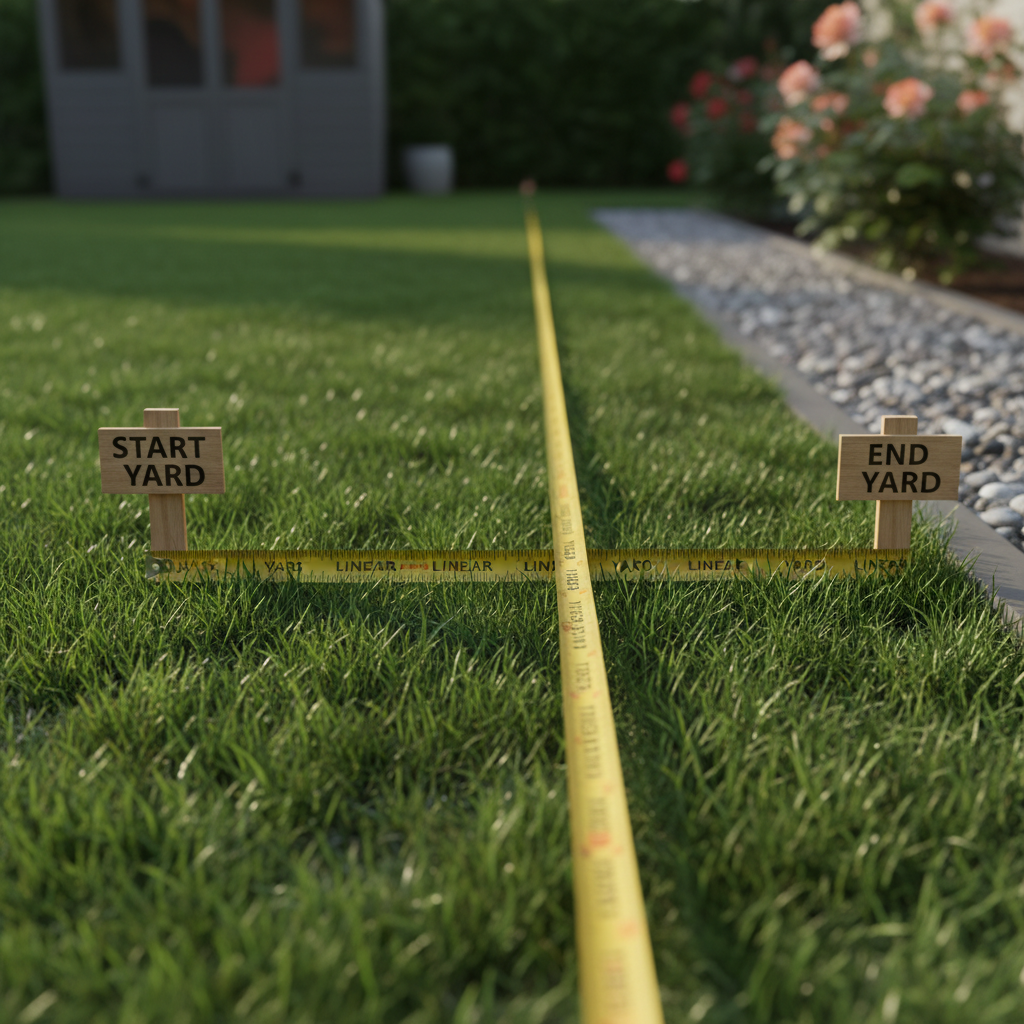
You’re standing in the store, a roll of perfect fabric in hand. The clerk asks, “How many linear yards?” and for a split second, you freeze. Is it a trick question? Is it different from a regular yard? You’re not alone.
This single word—linear—is the source of one of the most common (and costly) misunderstandings in DIY projects, from sewing to construction.
The good news? The answer is shockingly simple. But the implications are huge.
This isn’t just another dictionary definition. This is the guide that will end the confusion for good. You’ll learn the critical difference between measuring for length, area, and volume, and master the exact calculations that prevent you from wasting money and material. By the end of this article, you’ll be able to walk into any hardware or fabric store with total confidence.
📑 What You’ll Learn
The Simple Answer (and the Real Question)
Let’s get this out of the way immediately. The conversion from a linear yard to a yard is 1 to 1.
One linear yard is one yard. Period.
It’s 3 feet. It’s 36 inches. It’s approximately 0.9144 meters. The word “linear” doesn’t change the length one bit. It just adds a crucial piece of context.
Think of it this way: when you say “yard,” you could be talking about the lawn behind your house. When you say “linear yard,” you are unambiguously talking about a measurement of length in a straight line. It answers one question and one question only: “How long is it?”
So, the real question isn’t “How do I convert them?” The real question is, “Why does this distinction matter so much, and how does it affect my project?”
That’s where things get interesting.
Deconstructing Dimensions: Linear vs. Square vs. Cubic
The entire concept hinges on understanding the three dimensions of measurement. In our experience, once this clicks, everything else falls into place. Most project failures happen when you use a one-dimensional unit for a two- or three-dimensional problem.
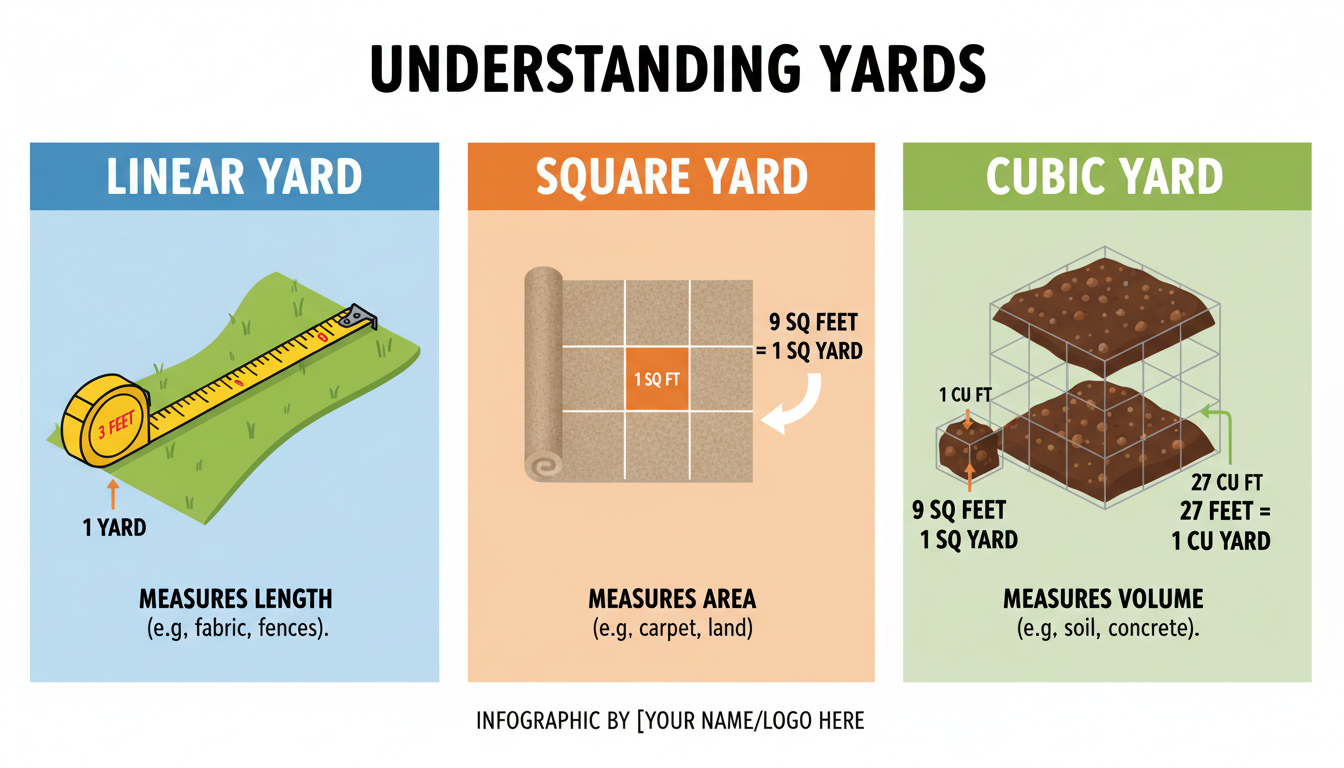
Here’s a breakdown of the three types of “yards” you’ll encounter and when to use them.
| Measurement Type | Dimensions Measured | Core Question | Common Examples |
|---|---|---|---|
| Linear Yard (yd) | Length (1D) | “How long is it?” | Fabric off a bolt, lumber, fencing, trim, ribbon |
| Square Yard (yd²) | Length × Width (2D) | “How much area does it cover?” | Carpet, flooring, lawn size, painting a wall |
| Cubic Yard (yd³) | Length × Width × Height (3D) | “How much volume does it fill?” | Concrete, mulch, soil, gravel |
As you can see, while a linear yard to yard conversion is simple, confusing a linear yard with a square or cubic yard is a recipe for disaster. You wouldn’t order “5 linear yards of concrete” for a patio slab any more than you’d order “2 cubic yards of ribbon” to wrap a gift.
⚠️ Watch Out
Never use linear measurements for materials sold by volume. I’ve seen people try to order mulch for their garden beds by measuring the perimeter (a linear measurement). They ended up with a tiny fraction of what they needed because they should have calculated the volume in cubic yards.
The “Width Factor”: Where Most People Go Wrong
Here’s the million-dollar secret: when you buy something by the linear yard, you’re only paying for the length. But you’re receiving the width for free.
This is most critical with fabrics. Fabric is sold on bolts of a standard width, typically 44/45 inches for quilting cottons or 54/60 inches for upholstery and apparel fabrics. When you ask for 2 linear yards, they unroll the fabric, measure 72 inches (2 yards) down the length, and cut.
You get a piece that is 2 yards long by the entire width of the bolt.
The mistake happens when your project requires a specific area (square yards), but you only think in terms of length (linear yards).
Let’s imagine a real-world scenario. You’re reupholstering two dining chairs and calculate you need exactly 2 square yards of material to do the job. You find a beautiful upholstery fabric that’s 54 inches wide (which is 1.5 yards wide).
If you walk up and ask for “2 linear yards,” you’ll actually get a piece that is 2 yards long by 1.5 yards wide. Your total material would be 2 × 1.5 = 3 square yards. You just overpaid for an entire square yard of fabric you didn’t need.
The correct approach is to calculate the length you need based on the fabric’s width.
💡 Pro Tip
Always check the label on the end of the fabric bolt before you buy. It will state the exact width. Don’t just guess! A fabric that’s 44″ wide provides significantly less area per linear yard than one that’s 60″ wide. This simple check can save you a lot of money and a second trip to the store.
Step-by-Step: Calculating Fabric Needs Like a Pro
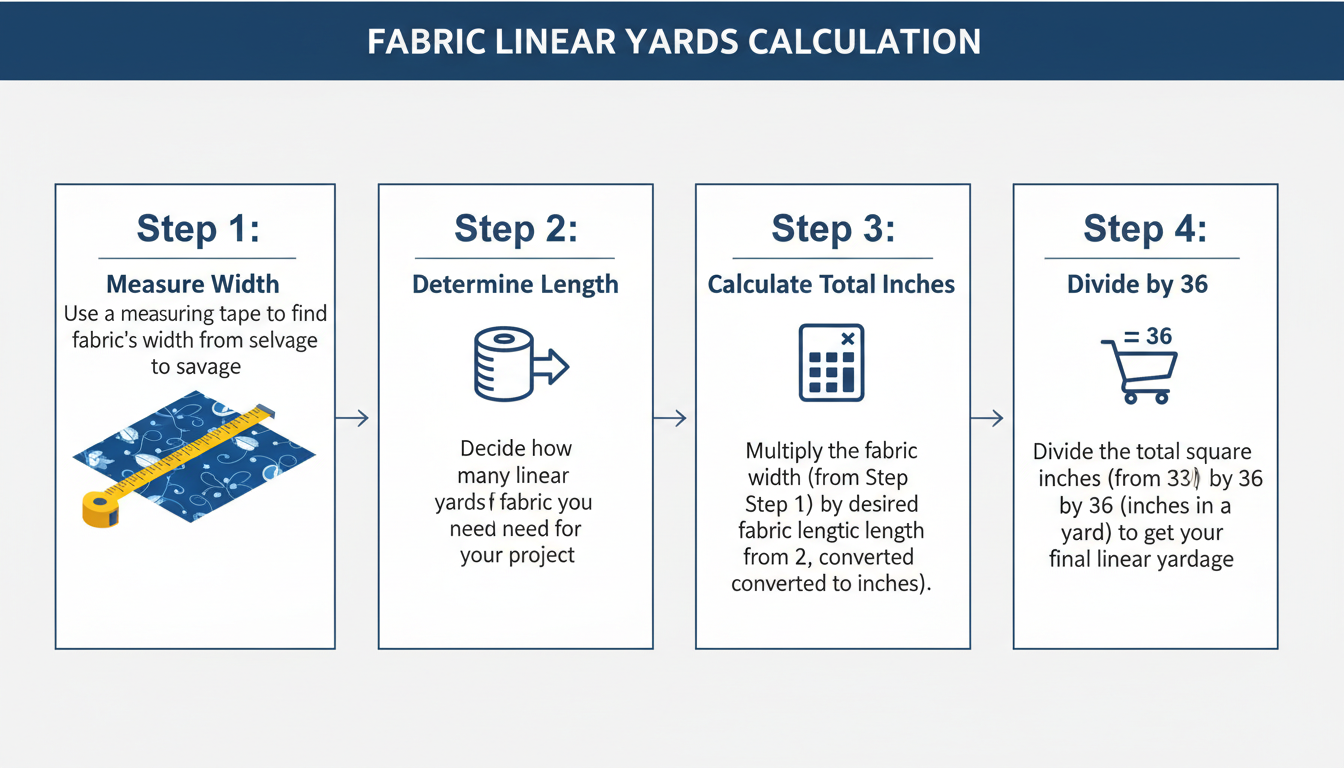
Let’s use our chair upholstery example to create a foolproof, step-by-step process. This works for any project where you need to convert a required area into a linear purchase.
- Determine Your Required Area (in Square Yards): First, calculate the total surface area you need to cover. For our chairs, we’ve determined we need 2 square yards (yd²).
- Find the Material’s Width (and Convert to Yards): Check the bolt. It says the fabric is 54 inches wide. To make our math easy, we must convert this to yards. Since there are 36 inches in a yard, the calculation is:
54 inches ÷ 36 inches/yard = 1.5 yards wide. - Calculate the Required Linear Yards: This is the key formula. Divide your required area by the material’s width.
Formula: Required Area (yd²) ÷ Material Width (yd) = Linear Yards to Buy
Our Calculation: 2 yd² ÷ 1.5 yd = 1.33 linear yards. - Round Up and Purchase: You can’t buy exactly 1.33 yards. You’ll need to round up. Most fabric stores cut to the nearest 1/8 or 1/4 yard. In this case, you’d ask for 1 and 3/8 yards or 1.5 yards to be safe. You’ll have a little extra, but you won’t have overbought by a massive amount.
🎯 Key Takeaway
The linear yard to yard conversion is 1:1, but that’s not the point. Your project’s success hinges on a different calculation: dividing your required area (in square yards) by the material’s fixed width (in yards) to determine the correct length (in linear yards) to buy.
Beyond Fabric: Linear Yards in Construction & Landscaping
While fabric is the classic example, linear measurements are everywhere in home improvement and construction. The principle remains the same: you’re measuring length for items sold with a fixed profile or width.
Based on hands-on testing and countless projects, here’s where you’ll see it and the common pitfalls to avoid.
| Material Type | How It’s Sold | Common Project Mistake |
|---|---|---|
| Lumber & Trim | By the linear foot (easily converted to yards) | Forgetting to add 10-15% to your total length to account for waste from miter cuts and mistakes. |
| Fencing & Wire | By the linear foot or yard (in rolls) | Measuring the property line perfectly but forgetting to account for the extra material needed for gates, corners, and tensioning. |
| Landscape Edging | By the linear foot (in rolls or strips) | Measuring a straight line for a curved garden bed, which results in coming up short. Always use a flexible measuring tape along the actual curve. |
| Pipes & Conduits | By the linear foot | Calculating the direct A-to-B distance without factoring in the extra length required for fittings, elbows, and vertical runs. |
💡 Pro Tip
For trim and baseboards, measure each wall individually and write it down. Then, add them all up. Do NOT just measure the room’s perimeter and call it a day. This method doesn’t account for the intricate cuts around doors and windows and is a classic rookie mistake.
⚠️ Watch Out
Always keep your units consistent! The number one source of calculation errors is mixing feet and inches. Before you do any multiplication or division, convert all your measurements to a single unit—either all inches or all feet. For more on standard units, the U.S. Weights and Measures division of NIST is the ultimate authority.
Understanding these nuances is what separates a frustrating, expensive project from a smooth, successful one. For a deeper dive into calculating project areas, many university extension sites offer fantastic, trustworthy resources, like this guide on the history and definition of the yard from Wikipedia.
❓ Frequently Asked Questions
Is a linear yard the same as a yard?
Yes, in terms of pure length, they are identical. One linear yard is exactly one yard, which is 3 feet or 36 inches. The word ‘linear’ simply clarifies that you are measuring length in a single dimension, not area (square yard) or volume (cubic yard).
How many linear feet are in a linear yard?
There are 3 linear feet in a linear yard. Just like a standard yard, the unit relationship is the same. If a project calls for 12 linear feet of lumber, you need 4 linear yards (12 ÷ 3 = 4).
Why don’t they just sell fabric by the square yard?
It’s a matter of practicality. Fabric is manufactured and stored on large rolls (bolts) of a consistent width. The most efficient way to sell it is to simply unroll it and cut it to the customer’s desired length. Pricing it per linear yard is the industry standard that reflects this process. You can find more about industry practices from sources like the Textile Institute.
What’s the easiest way to convert feet and inches to linear yards?
First, convert everything to inches. For example, 7 feet 6 inches is (7 × 12) + 6 = 90 inches. Then, divide the total inches by 36 to get the yards. So, 90 inches ÷ 36 = 2.5 linear yards. This two-step process prevents a lot of common math errors.
Does the linear yard to yard concept apply to carpet?
It’s a bit of a trick question! Carpet is often priced by the square yard because its primary purpose is to cover an area. However, it comes on very wide rolls (typically 12 or 15 feet). So while the final calculation is for area, the process of cutting it from the roll is technically a linear measurement. Always confirm with your flooring supplier how they price and measure their materials.
Conclusion: You’re Not Just Buying Length, You’re Buying Confidence
So, we’re back where we started. The linear yard to yard conversion is 1:1. It’s simple.
But now you know the truth: that’s not the detail that matters. The game-changing insight is understanding that “linear” is a code word. It tells you that you’re buying length, but you need to be hyper-aware of the material’s other dimensions—especially its width.
You now have the framework and the formulas to move beyond confusion. You can calculate your fabric needs precisely, budget for your construction materials accurately, and avoid the costly over-purchases that plague so many well-intentioned projects.
The next time you’re in the store and hear the words “linear yard,” you won’t freeze. You’ll know exactly what it means and, more importantly, exactly what to do. You’re not just buying material anymore; you’re making a calculated, confident investment in your project’s success.