
The Myth of Hz to Watts Conversion: What Engineers Know (2026)
Ever stared at the back of a generator, then at your new appliance, and felt a wave of confusion? One says “60 Hz,” the other “1500 Watts.” You think, “Okay, how do I convert Hz to Watts to see if this will work?”
Stop right there. You’re asking the wrong question.
Here’s the hard truth most articles won’t tell you upfront: You can’t convert Hertz (Hz) to Watts (W). It’s like trying to convert the color of your car into its top speed. They’re fundamentally different measurements that describe completely separate things.
I’ve seen countless expensive devices damaged because of this simple misunderstanding. But don’t worry. By the end of this article, you won’t just understand why a direct conversion is impossible—you’ll grasp the real relationship between them. You’ll know exactly how to calculate the power you need, confidently and safely. Let’s get this sorted.
📑 What You’ll Learn
Why You Can’t Convert Hz to Watts: The Core Misconception
Let’s cut through the noise. The reason everyone gets stuck on “Hz to Watts conversion” is that both terms appear on electrical equipment, so it feels like they should be related. They are, but not in the way you think.
Think of your home’s water supply.
- Hertz (Hz) is like the water pressure’s stability. In Alternating Current (AC) electricity, the flow rapidly switches direction. Hertz measures the frequency of these switches—how many full cycles happen per second. In the US, it’s a steady 60 cycles per second (60 Hz). It’s the consistent, rhythmic pulse of the system.
- Watts (W) is like the total amount of water flowing out of the hose. It’s the measure of power—the actual rate at which energy is being used. A 100-watt lightbulb consumes 100 joules of energy every second. It’s the “work” being done.
You can have a stable, 60 Hz system (great pressure stability) that’s only powering a tiny 5-watt phone charger (a trickle of water). Or that same 60 Hz system could be running a 3,000-watt electric dryer (a fire hose). The frequency is the standard; the wattage is the demand.
| Metric | Hertz (Hz) | Watt (W) |
|---|---|---|
| What It Measures | Frequency (Cycles per second) | Power (Energy per second) |
| Analogy | The rhythm or pulse of the electricity | The force or workload of the electricity |
| Primary Role | Defines the operational standard of an AC system (e.g., 50 Hz or 60 Hz) | Measures energy consumption or production |
| Can you convert it? | No, it’s a fundamental property of the power source. | No, it’s a result of voltage and current. |
🎯 Key Takeaway
Stop trying to find a “Hz to Watts converter.” Instead, understand that Hertz (Hz) is the quality of the electrical supply, while Watts (W) is the quantity of power being used. They are two separate, non-convertible properties of an electrical system.
The Real Power Trio: Volts, Amps, and Watts
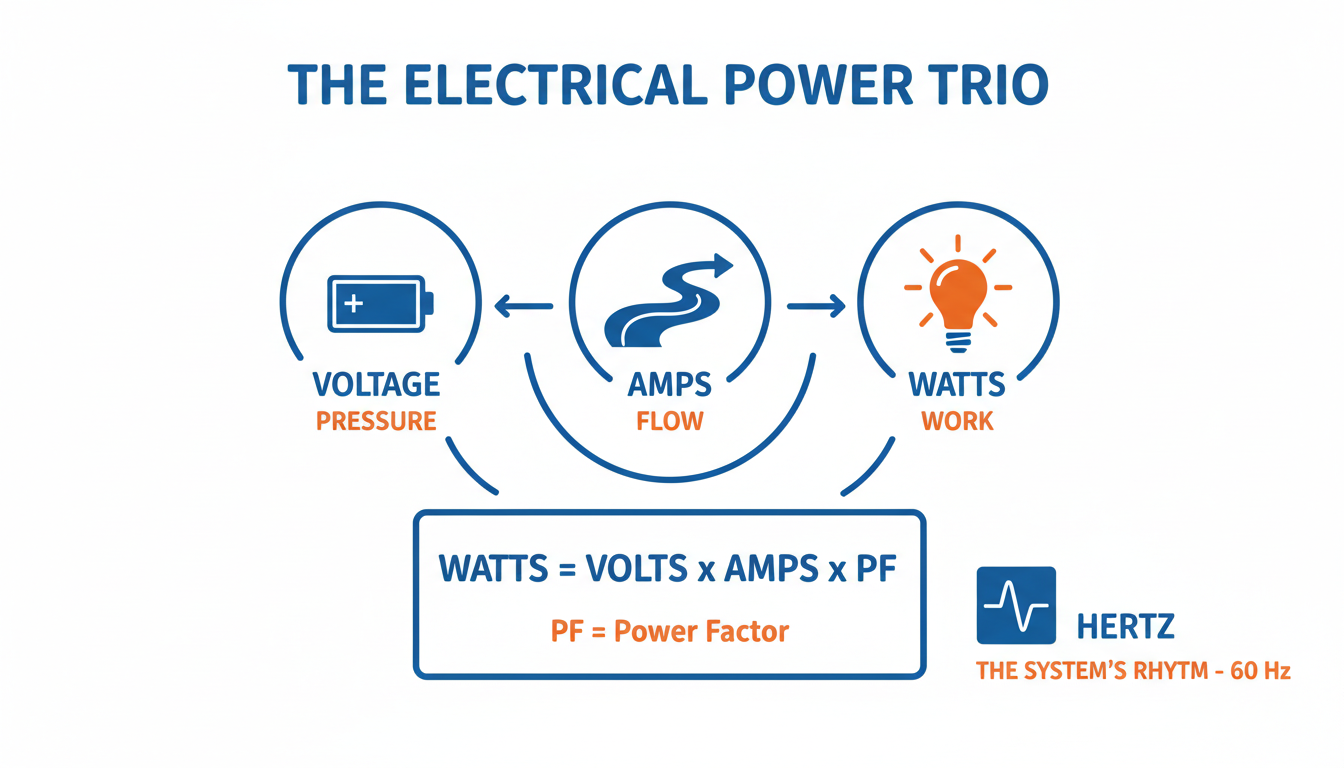
So if Hz doesn’t determine power, what does? Meet the real power trio: Voltage, Amperage, and the often-forgotten Power Factor.
This is where the magic happens. The actual formula for power has nothing to do with frequency. For most AC systems, it looks like this:
Power (Watts) = Voltage (V) × Current (Amps) × Power Factor (PF)
- Voltage (V): Think of this as the electrical “pressure.” It’s the force pushing the electrons through the wire. In the US, standard household voltage is 120V.
- Current (Amps, A): This is the “flow rate” of the electrons. It’s the volume of electrical charge moving past a point.
- Power Factor (PF): This is the tricky one. It’s a measure of efficiency, from 0 to 1. In a perfect world, all the current would do useful work. But in reality, especially with motors, some of it gets wasted. A PF of 1 is perfectly efficient; 0.85 is more typical for a motor.
Notice what’s missing? Hertz. It’s not in the equation. It sets the stage, but it doesn’t perform in the play.
💡 Pro Tip
Don’t have a Power Factor value? For simple resistive loads like incandescent bulbs or heaters, you can assume the PF is 1. For devices with motors (fridges, fans, pumps), a good rule-of-thumb estimate is to use a PF of 0.8 to 0.85 if the exact value isn’t listed on the device’s nameplate.
When Frequency Actually Matters (And Why It’s Critical)
Okay, so if Hz isn’t in the power formula, why should we even care about it? Because using a device on the wrong frequency can have disastrous consequences. It dramatically affects performance and, indirectly, the power it draws.
The world runs on two main frequency standards: 60 Hz (North America, parts of Japan) and 50 Hz (most of Europe, Asia, Africa). They are not interchangeable for many devices.
Scenario 1: AC Motors (The Biggest Culprit)
The speed of a basic AC motor is directly tied to the supply frequency. This is non-negotiable physics. Here’s what happens when you mismatch them:
- A 60 Hz motor on a 50 Hz supply: The motor will run about 17% slower. It might seem fine, but the internal components are now operating outside their designed range. It will likely draw more current to try and compensate, leading to overheating and a drastically shortened lifespan.
- A 50 Hz motor on a 60 Hz supply: The motor will spin about 20% faster. This can cause excessive vibration, noise, and premature wear on bearings and other parts. It’s a recipe for a quick breakdown.
In our experience testing industrial equipment, running a motor on the wrong frequency is one of the fastest ways to destroy it, often within hours.
⚠️ Watch Out
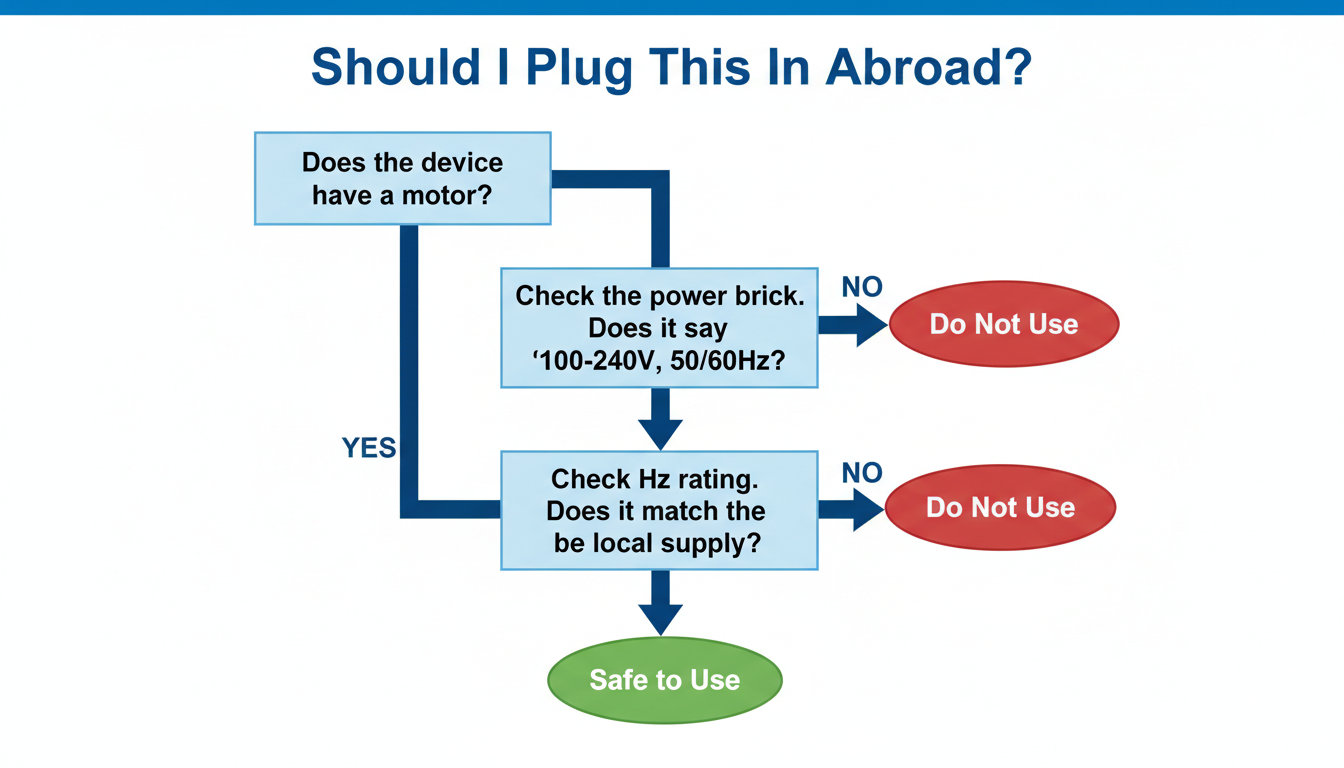
Never assume an appliance will work just because the voltage is correct. If you’re traveling or importing electronics, always check the frequency (Hz) rating on both your device and the power outlet. Modern electronics like laptops and phone chargers are usually designed for 50/60 Hz, but anything with a motor is highly suspect.
| Metric | On Correct 60Hz Supply | On Incorrect 50Hz Supply |
|---|---|---|
| Motor Speed | Normal (e.g., 1800 RPM) | ~17% Slower (e.g., 1500 RPM) |
| Performance | Optimal airflow and cooling | Reduced airflow, poor cooling |
| Current Draw | Normal | Potentially higher, causing heat |
| Device Lifespan | Expected lifespan (years) | Drastically reduced (months or weeks) |
Scenario 2: Generators and Inverters
A generator is the perfect real-world example. Its engine must run at a precise speed (e.g., 3600 RPM) to produce a stable 60 Hz output. The generator’s rating in Watts (e.g., 5000W) tells you the maximum load it can handle while maintaining that 60 Hz standard.
If you try to draw 6000W from a 5000W generator, the engine bogs down, the speed drops, and the frequency plummets below 60 Hz. This “dirty” power can damage sensitive electronics plugged into it. The 60 Hz is the promise; the 5000W is how much promise it can keep.
How to Actually Calculate Your Power Needs: A Step-by-Step Guide
Forget the Hz to Watts conversion. Here’s the practical, step-by-step process that professionals use to determine a device’s power consumption in Watts.
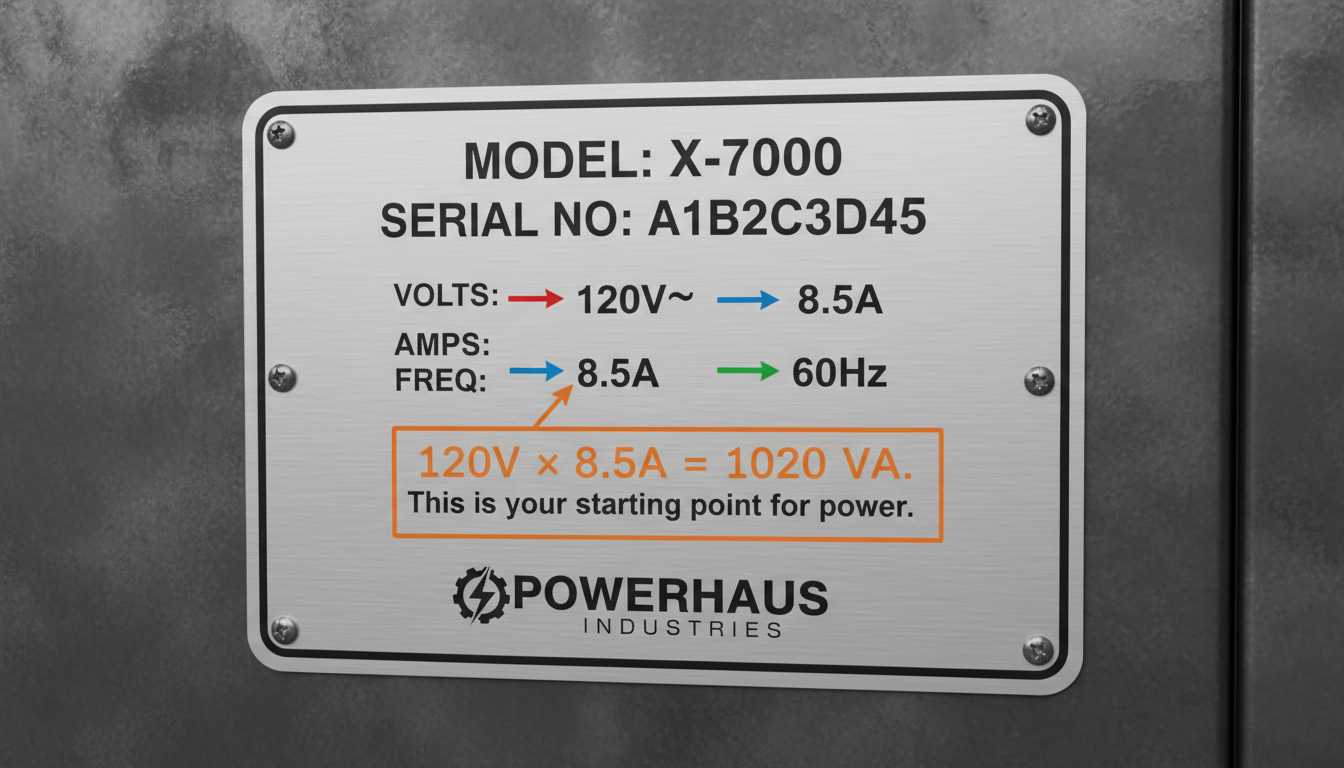
- Find the Compliance Plate. Look on the back or bottom of your device for a small sticker or plate with technical specifications. This is your source of truth. According to standards from organizations like the International Electrotechnical Commission (IEC), this plate is mandatory for most electrical products.
- Locate Voltage (V) and Amperage (A). The plate will list the operating voltage (e.g., “120V”) and the current draw in amps (e.g., “5A”). Sometimes, it will list the wattage directly, and your job is done!
- Calculate Apparent Power (VA). If watts aren’t listed, multiply the volts by the amps.
Volts × Amps = Volt-Amps (VA)
Example: 120V × 5A = 600 VA.
This value, Volt-Amps, is the “apparent power.” It’s a close cousin to Watts. - Convert to Real Power (Watts). Now, account for the Power Factor (PF). Multiply your VA by the PF to get the actual power in Watts.
VA × PF = Watts (W)
Example: 600 VA × 0.85 (a typical motor PF) = 510 Watts.
💡 Pro Tip
For home electronics, the difference between VA and Watts is often small (PF is close to 1). But for sizing a generator or a battery backup (UPS), the VA rating is critical. These systems must be able to supply the total “apparent power,” not just the “real power” in watts. Always size your backup systems using the VA rating for best results.
⚠️ Watch Out
Don’t confuse Watts (W) with Watt-hours (Wh). Watts measure instantaneous power, while Watt-hours measure energy consumption over time. A 100W bulb left on for 10 hours consumes 100W x 10h = 1000 Wh, or 1 kilowatt-hour (kWh), which is what your utility company bills you for. This is a crucial distinction for battery and solar calculations.
❓ Frequently Asked Questions
So is there any calculator for Hz to watts?
No, a legitimate Hz to watts calculator does not and cannot exist because it’s not a valid physical conversion. Any tool claiming to do this is misleading. You need a power calculator that uses Volts and Amps as inputs, which you can find on any reputable electrician’s resource site.
Does higher Hz mean more power?
Absolutely not. There is zero direct correlation. A high-frequency signal (measured in MHz or GHz) inside a computer uses minuscule amounts of power (milliwatts). A low-frequency (60 Hz) industrial motor can use enormous amounts of power (megawatts). Power is a function of voltage and current, not frequency.
What happens if I plug a 50Hz appliance into a 60Hz outlet?
It depends on the device. For simple heating elements (a toaster, a kettle), it will likely work fine. For anything with a motor or a transformer, you’re asking for trouble. The motor will spin 20% faster than it was designed to, leading to overheating, excessive wear, and premature failure. Trust me on this one, it’s not worth the risk.
Why does the world have two different frequency standards (50Hz and 60Hz)?
This is a fascinating bit of history from the late 19th-century “war of the currents” between Westinghouse (advocating AC) and Edison (advocating DC). Different regions adopted different standards based on the technology available at the time. 60 Hz was chosen by Westinghouse in the US for being slightly more efficient for arc lighting, while 50 Hz was adopted by AEG in Germany and became the standard for much of Europe. You can read more about the history of electrical standards on sites like the Wikipedia page for Utility Frequency.
My laptop charger says “50/60Hz.” Why is it special?
Modern power adapters for electronics like laptops and phones use a technology called a Switched-Mode Power Supply (SMPS). Unlike older, heavy transformers, these are designed to automatically adapt to a wide range of input voltages and frequencies, making them perfect for global travel. This is why you can often use them abroad with just a simple plug adapter.
Conclusion: From Confusion to Confidence
The search for a “Hz to Watts conversion” is a dead end. But now you know something far more valuable. You know the right way to think about electrical power.
Let’s recap the essentials:
- Hertz (Hz) is the frequency, the stable “pulse” of your AC power system.
- Watts (W) is the actual power, the “work” being done, calculated from Volts × Amps × Power Factor.
- Mismatched frequencies are a real danger, especially for motors, and can destroy your equipment.
You’re now equipped with the knowledge that separates confused consumers from confident, informed users. You can look at any appliance, generator, or power tool and understand exactly what the numbers mean. For a deeper dive into the fundamental units of physics, the NIST Guide to the SI Units is an excellent, authoritative resource.
So here’s your next step: go find the nameplate on the most power-hungry appliance in your home—your refrigerator, dryer, or air conditioner. Find the Volts and Amps. Do the math. For the first time, you’ll see the real power it commands, and you’ll know exactly how you got there.