
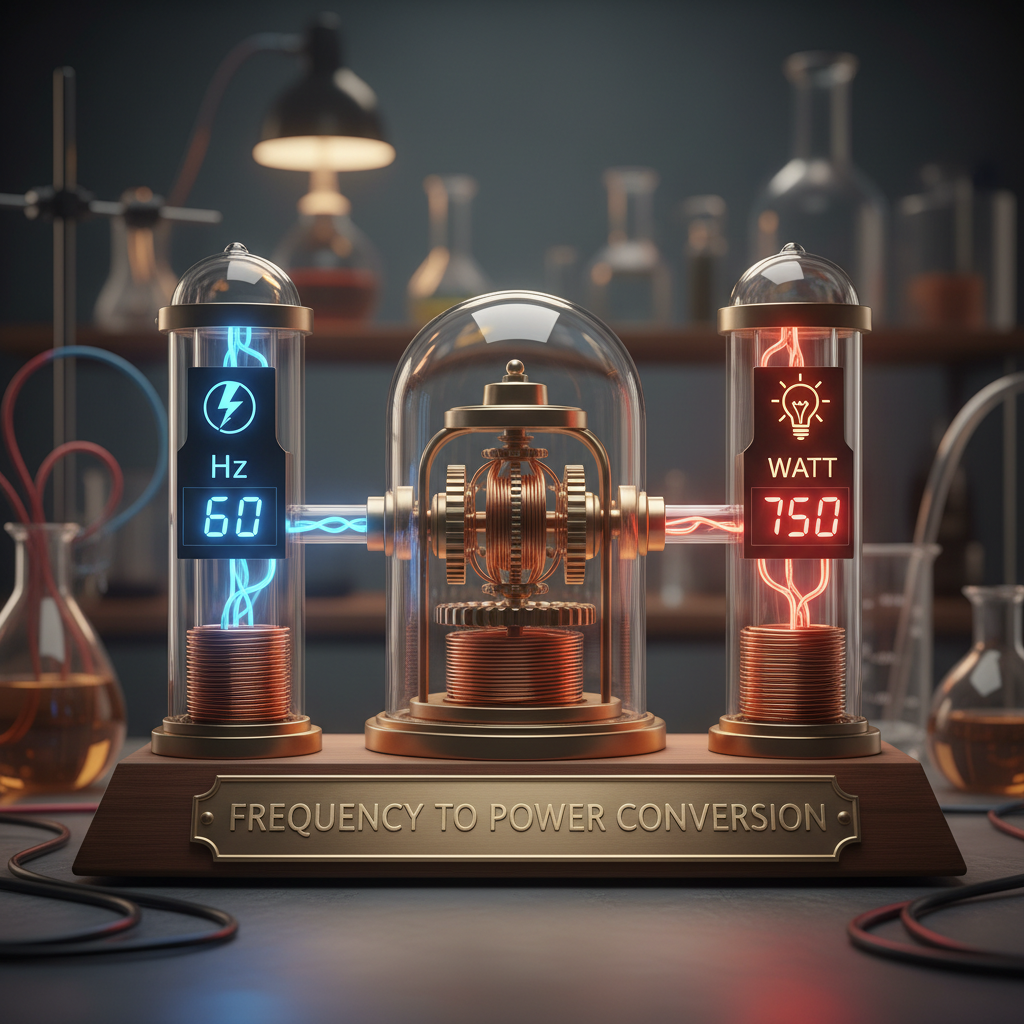
The Fundamental Question: Demystifying the Hz into Watts Relationship
If you’ve ever looked at the specifications for a new monitor, a computer processor, or a home appliance, you’ve likely encountered two common units: Hertz (Hz) and Watts (W). This often leads to a seemingly simple question: How do you convert hz into watts? It’s a question we see time and time again, born from a desire to compare and understand the performance of our devices. However, the answer is far more nuanced and fascinating than a simple conversion calculator can provide. The short, direct answer is that you can’t directly convert Hz into Watts. They are like apples and oranges; they measure two fundamentally different properties of the physical world.
But don’t click away just yet. While there’s no magic formula, the relationship between frequency (Hz) and power (W) is a critical concept in physics and engineering. Understanding this connection is key to truly grasping how your electronics work. This guide will demystify the confusion, explain why a direct conversion is a common misconception, and explore the real-world scenarios where these two crucial units interact. We will dive deep into the definitions, explore the context in different fields like electrical engineering and computing, and provide practical examples to make the concepts crystal clear.
Understanding the Core Units: What Are Hertz and Watts?
Before we can understand their relationship, we must first establish a solid foundation of what each unit represents. Confusing them is easy, but their roles in science and technology are distinct and separate.
Decoding Hertz (Hz): The Rhythm of the Universe
Hertz, named after the 19th-century German physicist Heinrich Hertz, is the standard unit of frequency. In the simplest terms, frequency measures how often a repeating event occurs in a specific period. One Hertz is equal to one cycle per second.
Think about it like this:
- A Heartbeat: If your heart beats 60 times in a minute, its frequency is 1 beat per second, or 1 Hz.
- A Computer Monitor: A monitor with a 144 Hz refresh rate redraws the image on the screen 144 times every second. This high frequency results in smoother motion.
- Alternating Current (AC): The electricity in your home likely operates at 50 Hz or 60 Hz, meaning the direction of the current reverses 50 or 60 times per second.
Frequency is all about timing, rhythm, and oscillation. It tells you the “how often,” not the “how much.”
Decoding Watts (W): The Measure of Power
Watts, named after the 18th-century Scottish inventor James Watt, is the unit of power. Power is defined as the rate at which energy is transferred or used. One Watt is equal to one Joule of energy per second.
Here are some relatable examples:
- A Light Bulb: A 60-Watt light bulb consumes 60 Joules of electrical energy every second, converting it into light and heat.
- A Microwave Oven: A 1000-Watt microwave transfers energy to your food at a rate of 1000 Joules per second. More Watts means faster cooking.
- Human Exertion: An average person might generate around 100 Watts of power while walking, which increases significantly during intense exercise.
Power is all about energy transfer and intensity. It tells you the “how much” or “how fast” energy is being used, not its cyclical nature.
Hertz (Hz) at a Glance
Measures: Frequency (cycles per second)
Physical Dimension: [Time]⁻¹
Core Concept: How often an event repeats.
Example: A 60 Hz electrical grid.
Watts (W) at a Glance
Measures: Power (energy per second)
Physical Dimension: [Mass][Length]²[Time]⁻³
Core Concept: The rate of energy transfer.
Example: A 100W light bulb.
The Core Misconception: Why a Direct Hz into Watts Conversion Fails
Now, we can clearly see the issue. Asking to convert hz into watts is like asking to convert the tempo of a song (beats per minute) into its volume (decibels). The tempo tells you how fast the song is, while the volume tells you how loud it is. They are related—a band might play louder during a faster section—but there’s no formula to convert one into the other. They are independent characteristics.
The same logic applies to Hz and Watts. An electrical device can operate at a high frequency (high Hz) but consume very little power (low Watts), or vice versa. The frequency is a fundamental property of an operation, while the power is the energy cost of performing that operation.
“In physics, clarity comes from understanding dimensions. Frequency and Power have different fundamental dimensions, making a direct, universal conversion between them a logical impossibility.”
Therefore, any online “Hz to Watts calculator” you might find is likely misleading or is making massive assumptions about a very specific system, which won’t apply universally.
The Hidden Connection: How Hz and Watts Relate in Real-World Systems
If a direct conversion is off the table, why is there so much confusion? Because in many practical systems, frequency and power are indeed linked. Changing one can affect the other, but the relationship is indirect and highly dependent on the context. Let’s explore the most common scenarios where people try to connect hz into watts.
In Electrical Engineering: AC Power and Grid Frequency
In Alternating Current (AC) systems, like the power grid that supplies our homes, frequency is a critical parameter. In North America, the standard is 60 Hz, while in Europe and other parts of the world, it’s 50 Hz. This frequency is kept extremely stable across the entire grid.
The power (Watts) drawn by a device on this grid is determined by the famous power formula:
Power (P) = Voltage (V) × Current (I) × Power Factor (cos φ)
Notice that frequency (Hz) is not a direct variable in this core formula. You can plug a 10-Watt phone charger and a 1500-Watt electric kettle into the same 60 Hz outlet. They both operate at the same frequency, but their power consumption is vastly different. However, frequency does play an indirect role. Certain devices, especially those with motors and transformers, are designed to operate optimally at a specific frequency. Running a 60 Hz motor on a 50 Hz supply can cause it to run slower, overheat, and become less efficient, which in turn alters its power consumption and can damage the device.
In Electromagnetism and Physics: The Energy of a Photon
Here is where we find the most direct mathematical link, but it’s between frequency and energy, not power. For electromagnetic waves like light, radio waves, or X-rays, the energy of a single particle (a photon) is directly proportional to its frequency. This is described by one of the most fundamental equations in quantum mechanics, Planck’s equation, introduced by Max Planck.
Energy (E) = h × f
Where:
- E is the energy of a single photon (in Joules).
- h is Planck’s constant (a very small, fixed number).
- f is the frequency of the wave (in Hz).
To get to power (Watts), you need to consider how many of these photons are arriving per second. Since Watts = Joules per second, the power of a beam of light would be:
Power (W) = Number of photons per second × (h × f)
So, even here, you can’t get from hz into watts without knowing an additional, crucial piece of information: the photon flux (how many photons are involved). A very high-frequency gamma ray (high Hz) can have less total power than a low-frequency infrared beam (low Hz) if the infrared beam is composed of trillions more photons.
In Computing: CPU Clock Speed (GHz) vs. Power Consumption (TDP)
This is perhaps the most common source of the Hz-to-Watts confusion. A Central Processing Unit (CPU) has a clock speed measured in Gigahertz (GHz), which is billions of cycles per second. Its power consumption is often represented by its Thermal Design Power (TDP), measured in Watts.
It’s generally true that a CPU running at a higher clock speed will consume more power. Each cycle involves millions of transistors switching on and off, and doing this more frequently requires more energy. This is why overclocking a CPU (increasing its Hz) almost always leads to higher temperatures and more power draw (higher Watts).
However, the relationship is not a simple conversion. It is highly dependent on:
- CPU Architecture: A newer, more efficient CPU at 4.0 GHz could use significantly less power than an older, less efficient CPU at 3.0 GHz.
- Workload: A CPU running a demanding task will draw far more power than the same CPU sitting idle, even though its clock speed might be the same.
- Voltage: The voltage supplied to the CPU is a major factor in its power consumption.
Therefore, while higher Hz often correlates with higher Watts in a specific CPU, you cannot use a formula to predict the power draw of one CPU based on the specs of another.
Practical Contexts for the Hz and Watts Relationship
Let’s ground these concepts in everyday devices to see why context is everything. Understanding complex topics and presenting them clearly is a cornerstone of effective communication, much like what’s discussed in guides on mastering SEO writing.
Audio Speakers
A speaker is rated in Watts (e.g., 100W) to indicate its power-handling capability, which relates to its maximum volume. It is also designed to reproduce a range of frequencies (e.g., 20 Hz to 20,000 Hz), which corresponds to the pitch of the sound. You can play a very low-frequency note (low Hz) at a very high power level (high Watts) to create a deep, loud bass sound. The two are independent controls.
Radio Transmitters
An FM radio station broadcasts at a specific carrier frequency, like 101.1 MHz (MegaHertz). This is its address on the radio dial. The station also has a transmitter power, measured in thousands of Watts (kilowatts). This power determines its broadcast range. A low-power local station and a high-power national station can have very similar frequencies, but their Wattage determines who can receive their signal.
Induction Cooktops
An induction cooktop uses an oscillating magnetic field to heat cookware. The frequency of this field is typically in the kilohertz (kHz) range. The power setting on the cooktop, measured in Watts (e.g., 1800W), controls the amplitude or strength of this magnetic field, not its frequency. Increasing the Watts delivers more energy per second, cooking the food faster, while the frequency remains relatively constant.
Conclusion: Embrace the Context, Not the Conversion
The quest to find a direct hz into watts conversion, while understandable, is ultimately a journey to a dead end. The two units measure fundamentally different aspects of our world: frequency measures the *rate of repetition*, while power measures the *rate of energy transfer*.
The key takeaway is that their relationship is entirely dependent on the system in question. In some cases, like with a CPU, higher frequency often implies higher power consumption. In others, like an AC power grid, frequency is a stable background constant, while power varies dramatically. And in quantum mechanics, frequency is directly tied to the energy of a single particle, but not the total power of a system without more information.
So, the next time you see Hz and Watts on a spec sheet, don’t try to convert them. Instead, appreciate them for what they are: two distinct but equally important pieces of a larger puzzle that describe the performance and operation of the technology that powers our lives. For a deeper dive into how energy and motion relate, consider exploring resources on the physics of waves and power from reputable educational sources like Khan Academy Physics.
FAQs
No, there is no legitimate, universal calculator to convert Hz into Watts. Because they measure different physical quantities (frequency vs. power), a direct conversion is not possible. Any tool claiming to do so is either incorrect or is designed for a single, highly specific system with many assumed values.
Not necessarily. For most household appliances, the difference in power consumption between operating on a 60 Hz grid versus a 50 Hz grid is negligible. Power consumption is primarily determined by the device’s design, voltage, and the current it draws. However, for certain types of motors, operating on the non-designed frequency can lead to inefficiency and slightly altered power usage.
In a specific CPU, a higher clock speed (GHz) generally leads to higher power consumption (Watts) because the internal components are switching more frequently. However, this is a correlation, not a conversion. A newer, more power-efficient CPU at 4.0 GHz might use less power than an older CPU at 3.5 GHz due to superior design and manufacturing processes.
For electromagnetic radiation like light or radio waves, the energy of a single photon is directly proportional to its frequency. This is defined by Planck’s equation, E = hf. This means higher-frequency waves (like X-rays) have more energetic photons than lower-frequency waves (like radio waves).
It’s a common point of confusion because both units frequently appear on the specification sheets for electronics. Users naturally want to compare products, and when they see numbers associated with Hz and Watts, they assume a relationship or conversion exists. This search reflects a desire to understand how a device’s speed or operational frequency relates to its power needs and energy costs.