

Let’s be honest. The term “keyword density” feels like a dusty relic from 2005, right next to flashing banner ads and visitor counters. You’ve probably heard it’s dead, that Google is too smart for such a primitive metric. And you’re not wrong. Mostly.
But what if I told you that elite SEOs still obsess over the data from a keyword density checker? Not to hit some mythical “perfect” percentage, but as a diagnostic tool—a content X-ray that reveals exactly why a competitor is outranking you.
Forget everything you think you know about keyword stuffing. This isn’t about cramming keywords. It’s about surgical precision.
In this deep dive, you’ll learn the modern, nuanced way to use keyword density analysis to refine your content, dominate your niche, and give Google *exactly* what it wants to see. No fluff, just the battle-tested process we use on high-stakes content campaigns.
📑 What You’ll Learn
The Myth of the “Perfect” Keyword Density
First, let’s clear the air. There is no magic number. Anyone who tells you to aim for a 2.5% keyword density is selling you snake oil from a bygone era of SEO. It just doesn’t work like that anymore.
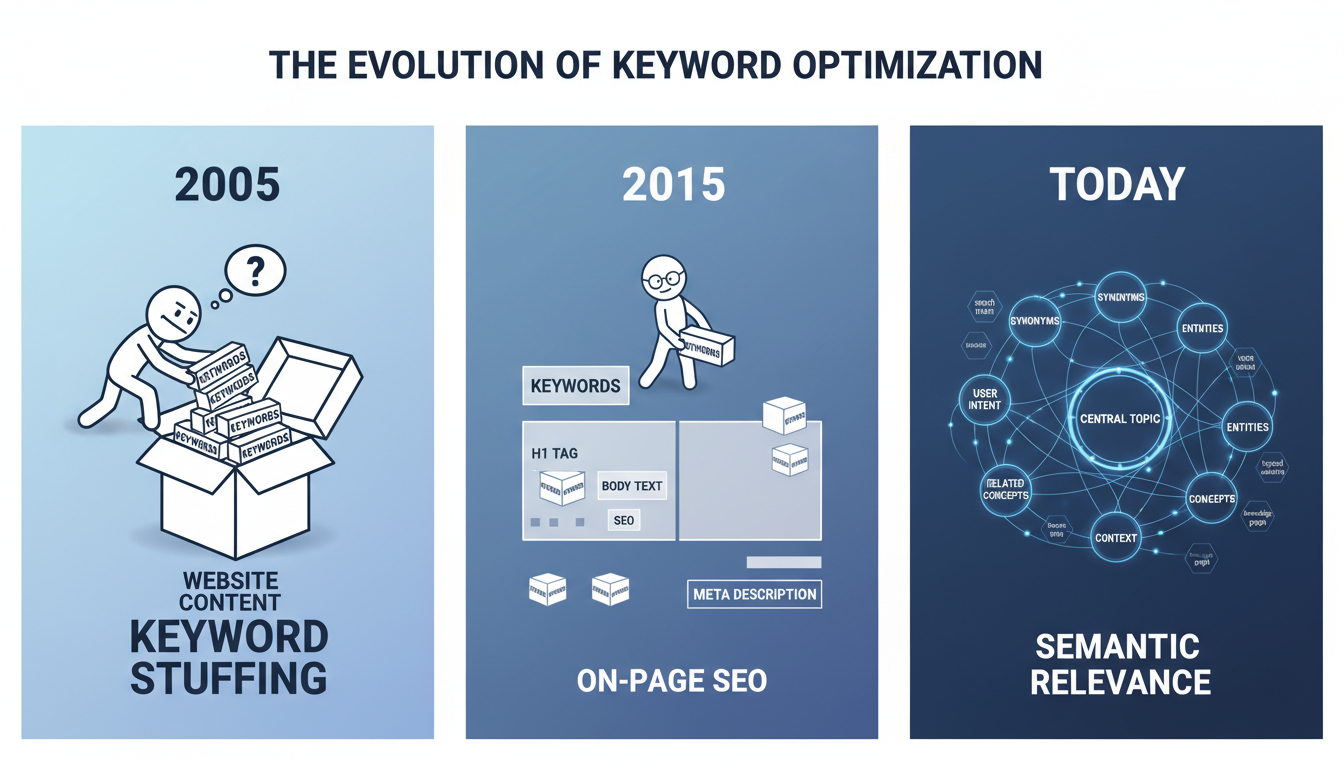
Why? Two words: Semantic Search.
Google’s algorithms, like BERT and the more recent MUM, don’t just count keywords. They understand context, relationships between words, and user intent. They know that “best espresso machine,” “cappuccino maker,” and “home coffee brewer” are all part of the same topical universe. They’re looking for a comprehensive resource, not a repetitive one.
I’ve seen it play out dozens of times. A client comes to us with a page that’s meticulously optimized to a 1.5% density for their main keyword, yet it’s stuck on page three. Meanwhile, the number one result might have a density of 0.8% but covers the topic from every conceivable angle.
The old way: “How many times did I use my keyword?”
The new way: “Does my content’s language profile match what Google considers authoritative for this topic?”
A keyword density checker is your window into that language profile. It’s not a target; it’s a diagnostic tool.
⚠️ Watch Out
Chasing a specific percentage is a fool’s errand. Your density “target” should be based on the average of the top-ranking pages for your specific query. What works for a “local plumber” query will be wildly different from a “quantum computing” query.
Why Density Analysis Still Matters (Just Not How You Think)
So if it’s not about hitting a target, why bother? Because a good analysis helps you in three critical areas:
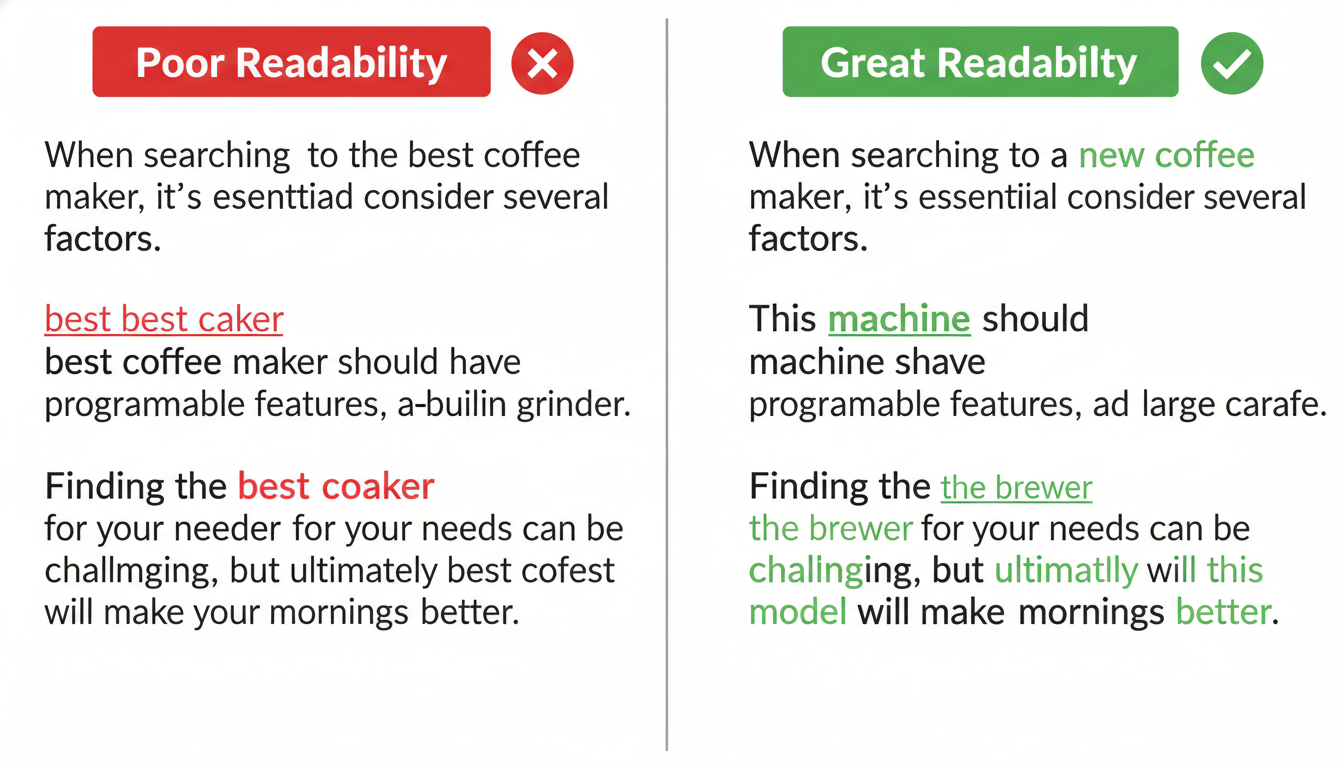
- Avoiding Over-Optimization: This is the big one. It’s incredibly easy to sound like a broken record when you’re trying to signal relevance. Running your text through a checker is a quick sanity check. If your primary keyword has a density of 4% or more, you’re in the danger zone. It reads poorly for users and sends a massive spam signal to Google. Trust me, it’s a penalty you don’t want to mess with.
- Benchmarking Against Competitors: This is the secret weapon. A keyword density checker lets you spy on the top-ranking pages. You can instantly see the main terms they use, the secondary phrases they emphasize, and how they structure their content. It’s like getting a copy of their playbook.
- Ensuring Topical Depth: A great checker won’t just show you your primary keyword. It will show you the most common two, three, and even four-word phrases in your text. This helps you see if you’re truly covering a topic in-depth or just scratching the surface with one or two phrases.
🎯 Key Takeaway
Stop using a keyword density checker as a goal-setting tool. Start using it as a diagnostic and competitive intelligence tool to ensure your content’s language is natural, comprehensive, and aligned with what’s already winning on Google.
The Modern 5-Step Workflow for Using a Keyword Density Checker
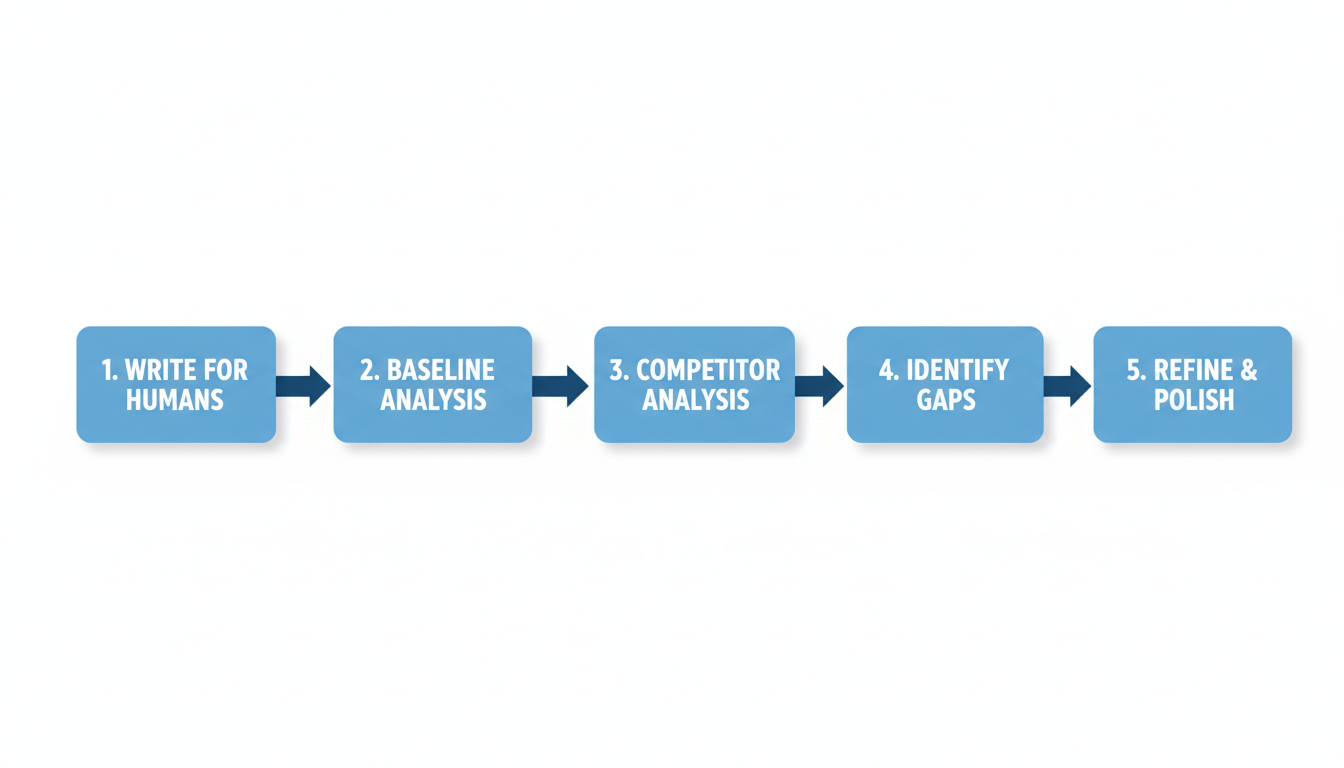
Ready to put this into practice? Here is the exact, battle-tested workflow we use. It turns a simple tool into a strategic powerhouse.
Step 1: Write for Your Audience, Not a Robot
This is non-negotiable. Write your first draft completely blind to keyword counts. Focus on answering the user’s query. Solve their problem. Tell a story. Pour your expertise onto the page. If you start with keywords, your writing will be stiff and unnatural. Always write for humans first.
Step 2: Run a Baseline Analysis of Your Draft
Once your draft is done, copy and paste the text into your chosen keyword density checker. Don’t change anything yet. Just get the raw data. Pay attention to the top 3-5 one-word, two-word, and three-word phrases. Does the data reflect the main topic you intended to write about? Sometimes, you’ll be surprised what phrases pop up.
Step 3: Perform Competitive Espionage
This is where the magic happens. Open an incognito browser window and search for your target keyword. Take the URLs of the top 3 organic results and run each one through the density checker.
Plug that data into a simple table. You’re looking for patterns.
| Metric | Competitor #1 | Competitor #2 | Competitor #3 | Your Draft |
|---|---|---|---|---|
| Primary Keyword Density | 1.2% | 0.9% | 1.4% | (Your Data Here) |
| Top 2-Word Phrase | “density checker” | “keyword density” | “checker tool” | (Your Data Here) |
| Top 3-Word Phrase | “keyword density checker” | “use a keyword” | “seo keyword density” | (Your Data Here) |
| Notable Secondary Term | “user intent” | “semantic search” | “over-optimization” | (Your Data Here) |
This table immediately gives you a data-driven benchmark. You’re no longer guessing what Google wants to see; you’re looking at the evidence.
💡 Pro Tip
Look for the “semantic gap.” Are all three competitors mentioning a specific concept or phrase (like “TF-IDF analysis” or “topical authority”) that you’ve completely missed? That’s a golden opportunity to add a new section to your article to make it more comprehensive.
Step 4: Identify Gaps and Over-Optimization
Now, compare your draft’s data to the competitor benchmark.
- Is your primary keyword density way off? If they’re all around 1% and you’re at 3%, you need to trim it down. Replace the keyword with pronouns (“it,” “they”) or synonyms.
- Are you missing key phrases? If the top results consistently use a phrase like “competitive analysis” and you don’t, it’s a strong signal to weave that concept into your content.
- Is your focus wrong? Maybe you focused heavily on “keyword tool,” but the winners are all focused on “density analysis.” This insight allows you to subtly shift your article’s focus to better match user intent.
Step 5: Refine, Polish, and Reread
Go back to your draft and make surgical edits based on your analysis. This isn’t a rewrite; it’s a refinement. Add the missing concepts. Rework sentences to reduce over-optimization. After you’ve made the changes, read the entire article out loud. This is the ultimate test. If it sounds robotic or repetitive, you need to keep polishing.
Beyond the Basics: Advanced Tactics for Power Users
Once you’ve mastered the basic workflow, you can layer on more advanced techniques. From our hands-on testing, these are the tactics that separate good content from great content.
Analyze Keyword Prominence
It’s not just about *how many* times you use a keyword, but *where* you use it. According to Google’s own guidelines, words at the top of a page, in headings (H2, H3), and in bold or italic text carry more weight. A good keyword density checker should give you a sense of this. Ensure your primary keyword appears naturally in:
- Your SEO Title (and ideally, your H1)
- The first 100 words of your article
- Your conclusion
– At least one or two subheadings (H2s)
Look at TF-IDF (Term Frequency-Inverse Document Frequency)
This sounds complicated, but the concept is simple. TF-IDF analysis compares the frequency of a word in your article to its frequency across a large set of other documents (like the other top 10 results). It helps you find words that are uniquely important to your topic. Many modern SEO tools have this built-in, and it’s the logical next step after a basic density check.
⚠️ Watch Out
Don’t forget to filter out irrelevant terms. Many checkers will pick up common words from your site’s navigation or footer (“About Us,” “Contact,” your brand name). A good tool lets you add these to a “stop words” list so they don’t skew your analysis of the main content.
How to Choose a Keyword Density Checker That Doesn’t Suck
There are hundreds of free and paid tools out there. Most are basic, but the best ones offer features that provide deeper insights. Here’s what to look for, based on what we find most useful in our day-to-day work.
| Feature | What It Does | Why It’s Critical |
|---|---|---|
| N-Gram Analysis | Shows you the most common 1-word, 2-word (bigram), and 3-word (trigram) phrases. | Moves beyond single keywords to show you the actual topics and phrases your content is about. Essential for semantic SEO. |
| URL & Text Input | Allows you to analyze both a live webpage URL and raw text you paste in. | You need both. URL input is for competitor analysis, while text input is for checking your unpublished drafts. |
| Stop Word Filtering | Option to ignore common words like “the,” “and,” “is,” which have no SEO value. | Without this, your data will be cluttered and inaccurate. A must-have for a clean analysis. |
| Keyword Prominence/Location | Highlights where your keywords appear (headings, title, bold text, etc.). | Gives you a qualitative understanding of your on-page SEO, not just a quantitative count. |
💡 Pro Tip
Use a density checker to audit your internal linking opportunities. Run an existing, high-performing article through the tool. Identify relevant 2- and 3-word phrases within it that match the target keywords of other articles you want to boost. It’s a quick and data-driven way to find powerful internal linking spots.
Your New Secret Weapon
So, is keyword density dead? As a primary goal, absolutely. But as a diagnostic and competitive intelligence tool? It’s more valuable than ever.
Stop guessing. Stop chasing mythical percentages. Start using a keyword density checker the modern way: to understand the language of the top-ranking pages and to ensure your own content is comprehensive, relevant, and natural.
Your next step is simple. Take one of your most important articles—one you want to rank higher—and run it through this 5-step process. Analyze your text, benchmark it against the top 3 competitors, and see what the data tells you. I guarantee you’ll find actionable insights in less than 15 minutes.
❓ Frequently Asked Questions
What is the ideal keyword density in 2024?
There is no single ideal percentage. The “sweet spot” is determined by the average density of the top-ranking pages for your specific keyword. Based on our experience, this often falls between 0.5% and 1.5%, but you must check your specific search results page (SERP) to get a relevant benchmark.
Can a keyword density checker help me avoid Google penalties?
Yes, absolutely. Its primary modern use is as a guardrail against over-optimization. If a checker shows your main keyword density is creeping into the 3-5%+ range, it’s a strong warning sign that you’re at risk of “keyword stuffing,” which can lead to a poor user experience and potential algorithmic penalties.
Does keyword density matter more than user intent?
No. User intent is always the top priority. Your content must first and foremost answer the user’s question comprehensively. Density analysis is a secondary refinement step to ensure your language aligns with what search engines expect for that topic, without sacrificing readability or quality.
Should I check the density of my entire page or just the main body text?
For the most accurate analysis of your content’s topic, you should analyze only the main body text. Many tools scrape the entire HTML, including navigation, sidebars, and footers, which can skew your results. If possible, use a tool that allows you to paste in just the article text itself.
How do synonyms and LSI keywords fit into this?
They are crucial. When your density check shows you’re repeating a phrase too often, you should actively replace it with synonyms and related LSI keywords. This improves readability and demonstrates topical breadth to Google, which is a key part of modern, semantic SEO.
Is a higher keyword density better?
Definitely not. In fact, an unnaturally high keyword density is a negative signal. The goal is not to achieve the highest possible number but to align with the natural language patterns of the top-ranking, most authoritative content for your query. More is not better; relevant and natural is better.