
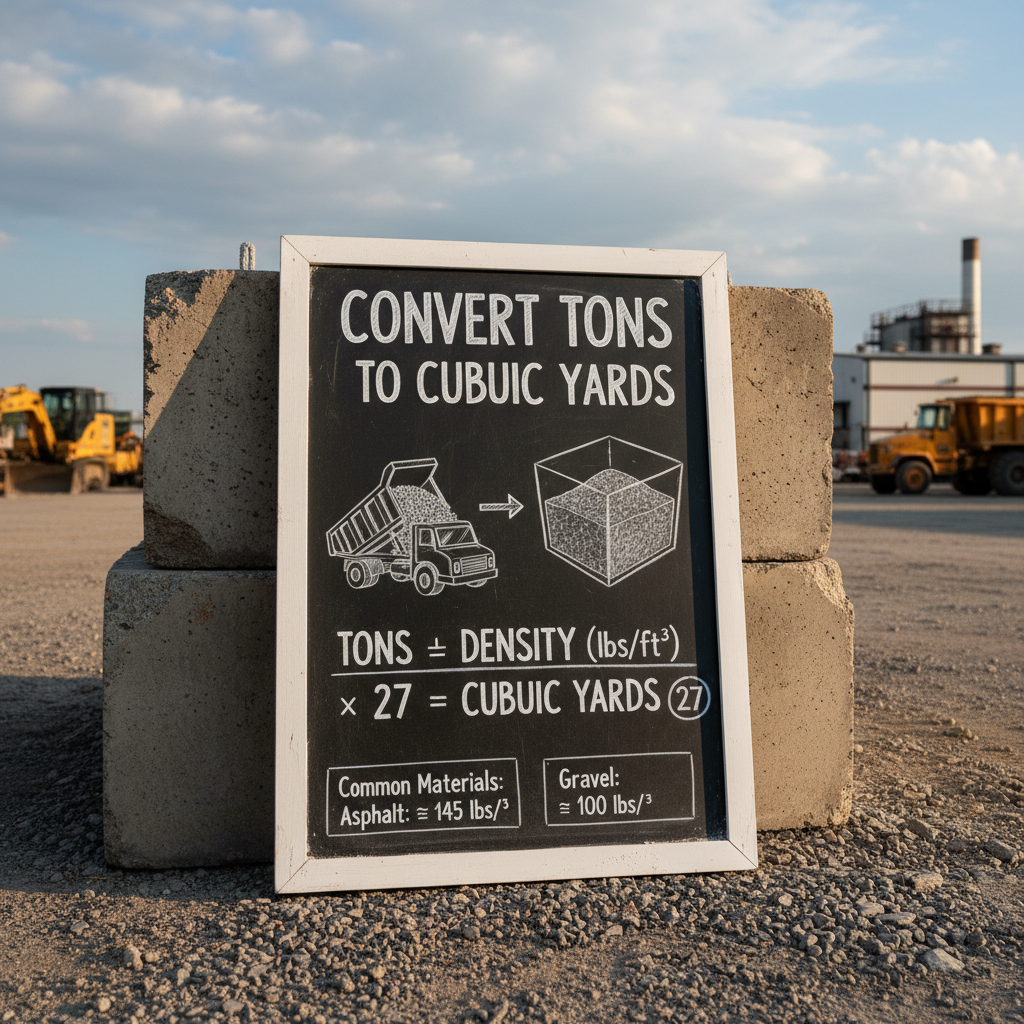
It’s a classic project-planning nightmare. You order 10 tons of gravel for your new driveway, feeling confident. The truck arrives, dumps the load, and… it’s a mountain. Way too much. Or worse, it’s a molehill, and now your project is stalled, waiting for a second, costly delivery.
Here’s a hard truth I’ve learned from over a decade in project management: guessing your material volume has probably cost you hundreds, if not thousands, of dollars.
The problem is a simple misunderstanding between weight (tons) and volume (cubic yards). They aren’t directly interchangeable. But there’s a secret key that connects them, and once you understand it, you’ll never order the wrong amount of material again.
This guide will give you that key. You’re about to learn the one simple formula to accurately convert tons to cubic yards, see real-world examples, and get an insider’s “cheat sheet” for common materials. Let’s save you some money.
📑 What You’ll Learn
- The Missing Link: Why Weight and Volume Aren’t the Same
- The Only Formula You Need to Convert Tons to Yards
- Your 3-Step Guide to a Perfect Calculation
- Material Density Cheat Sheet: From Gravel to Mulch
- The “Gotchas”: Two Critical Factors That Skew Your Numbers
- Real-World Scenarios: See the Conversion in Action
- Frequently Asked Questions
The Missing Link: Why You Can’t Directly Convert Tons to Cubic Yards
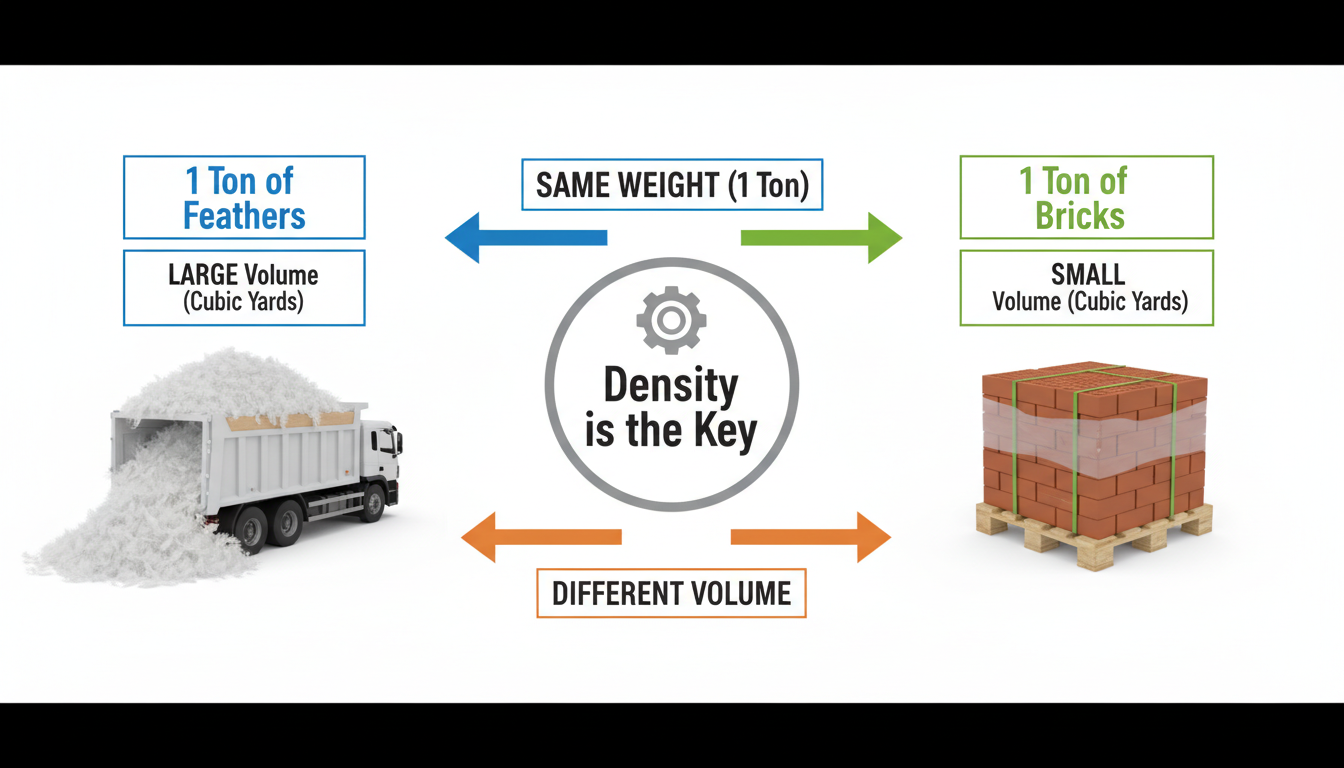
Think about this for a second. What takes up more space: a ton of bricks or a ton of feathers?
It’s an old riddle, but it perfectly explains the core problem. They both weigh the same—one ton. But the feathers would fill a massive room (high volume), while the bricks would make a neat, compact stack (low volume).
This difference is all because of density.
Density is the bridge between weight and volume. It’s the measurement of how much “stuff” is packed into a given space. In the world of landscaping and construction, it’s typically measured in pounds per cubic yard (lbs/yd³).
- Low-Density Materials: Things like mulch or compost are light and airy. A cubic yard doesn’t weigh much.
- High-Density Materials: Things like granite, wet sand, or crushed concrete are heavy and compact. A cubic yard weighs a lot.
Without knowing the density, asking “how many cubic yards are in a ton?” is like asking “how long is a piece of string?” It’s impossible to answer. You need that one critical number first.
The Only Formula You Need to Convert Tons to Yards
Once you have the material’s density, the math is surprisingly simple. No complex calculus, just basic arithmetic. Here’s the formula we use on every single project:
Cubic Yards = (Total Tons × 2,000) / Material Density (in lbs/yd³)
Let’s break that down so it makes perfect sense:
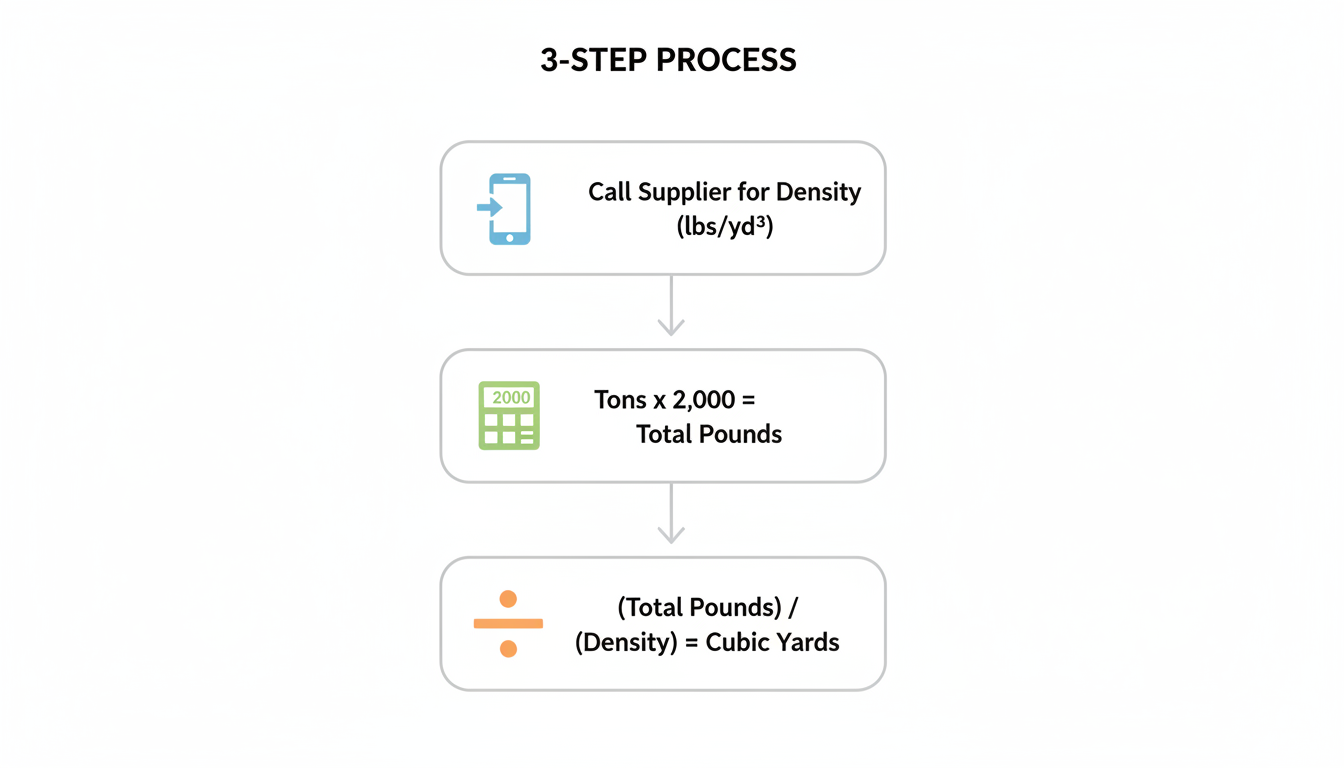
- Total Tons × 2,000: This first step is non-negotiable. It converts the weight from tons into pounds, because density is almost always given in pounds per cubic yard. (Remember: 1 US ton = 2,000 pounds).
- / Material Density: You then divide that total weight in pounds by the density (lbs/yd³). The “pounds” unit cancels out, leaving you with the answer in pure, beautiful cubic yards.
That’s it. That’s the whole secret. Now, let’s put it into practice.
💡 Pro Tip
Don’t just Google a material’s density. Always ask your supplier directly. Their specific gravel might be from a different quarry or have a different moisture content than a generic value you find online. Asking them for the “pounds per cubic yard” of the exact product you’re buying is the single most important step for accuracy.
Your 3-Step Guide to a Perfect Calculation
Ready to banish guesswork forever? Follow these three steps. It’s the exact process professionals use.
- Step 1: Find Your Material’s Density. This is your mission-critical number. Call your supplier and ask, “What is the density of your screened topsoil in pounds per cubic yard?” If they can’t tell you, find a new supplier. Seriously. It’s that important.
- Step 2: Convert Your Order Weight to Pounds. This is the easy part. Take the number of tons you think you need and multiply it by 2,000. For example, if you’re planning on 8 tons, your calculation is 8 × 2,000 = 16,000 lbs.
-
Step 3: Divide Total Pounds by the Density. Now, use the formula. Take your total pounds from Step 2 and divide it by the density from Step 1.
Example: 16,000 lbs / 2,200 lbs/yd³ (for topsoil) = 7.27 cubic yards.
Boom. You now know that 8 tons of that specific topsoil will give you exactly 7.27 cubic yards of material to work with.
Material Density Cheat Sheet: From Gravel to Mulch
While you should always confirm with your supplier, it helps to have a general idea of what to expect. Based on our field experience and industry data, here are the typical density ranges for common materials. I’ve also included the approximate conversion factor to give you a quick reference.
| Material | Typical Density (lbs/yd³) | Approx. Cubic Yards per Ton |
|---|---|---|
| Crushed Stone / Gravel | 2,400 – 2,900 | 0.69 – 0.83 |
| Sand (Dry) | 2,600 – 3,000 | 0.67 – 0.77 |
| Topsoil (Screened) | 2,000 – 2,400 | 0.83 – 1.00 |
| Fill Dirt (Unscreened) | 2,200 – 2,700 | 0.74 – 0.91 |
| Asphalt (Paving) | 3,900 – 4,100 | 0.49 – 0.51 |
| Wood Mulch | 400 – 800 | 2.50 – 5.00 |
Notice how much mulch you get per ton compared to asphalt? That’s density in action! This is why mulch is almost always sold by the cubic yard, while heavy aggregates are often sold by the ton. This data aligns with standards provided by organizations like the National Stone, Sand & Gravel Association, which helps regulate the aggregates industry.
⚠️ Watch Out
Moisture is a budget-killer. Water is incredibly heavy. A pile of sand that just got rained on will be significantly denser than dry sand. This means one ton of wet sand will take up less space (fewer cubic yards) than one ton of dry sand. If you order by the ton on a rainy day, you’re paying for water weight. Always ask your supplier if their density figures are for wet or dry material.
The “Gotchas”: Two Critical Factors That Skew Your Numbers
Even with the right formula, a couple of real-world factors can throw off your calculations. Being aware of them is half the battle.
1. The Compaction Factor
The density your supplier gives you is for loose material—the state it’s in when it’s dumped from the truck. But what happens when you spread that gravel for a driveway or that topsoil for a lawn? You compact it.
Compaction reduces volume. From real-world campaigns, we’ve found you often need to order 10-25% more material than your initial volume calculation suggests to account for how much it will shrink when tamped down. The exact amount depends on the material and its final use, a concept well-documented in geotechnical resources like those from the U.S. Geological Survey.
2. The “Fluff” Factor
This is the opposite of compaction and applies mostly to soils. When soil is excavated and screened, it becomes “fluffed up” with more air pockets. This means a cubic yard of loose topsoil will settle and take up less space over time in your garden bed. It’s less of an issue than compaction but worth keeping in mind for projects where precise final height is critical.
💡 Pro Tip
When planning a project that requires compaction (like a paver base or driveway), tell your supplier your final, compacted volume. An experienced supplier can help you work backward, suggesting how many tons of their loose material you’ll need to achieve that final compacted depth. They do this calculation all day long.
Real-World Scenarios: See the Conversion in Action
Let’s look at how this prevents costly errors. Here’s a tale of two homeowners.
| Scenario | The Guesser (Bob) | The Calculator (Sarah) |
|---|---|---|
| Project | New gravel driveway, needs 10 cubic yards of material. | New gravel driveway, needs 10 cubic yards of material. |
| Method | Bob Googles “how many tons in a yard of gravel” and sees a “rule of thumb” of 1.4 tons/yard. He orders 14 tons (10 x 1.4). | Sarah calls the supplier, who tells her their specific gravel has a density of 2,800 lbs/yd³. |
| Calculation | No real calculation, just a guess. | (10 yd³ × 2,800 lbs/yd³) / 2,000 lbs/ton = 14 tons. She also adds 15% for compaction, ordering 16.1 tons. |
| The Problem | The supplier’s gravel was actually denser, at 2,800 lbs/yd³. His 14 tons only gave him 10 cubic yards of loose gravel. After compaction, it wasn’t enough to cover the area to the required depth. | Sarah’s calculated order of 16.1 tons gave her enough material to achieve a final, compacted volume of over 10 cubic yards. Perfect amount. |
| The Result | Project delayed. Bob had to place a second, expensive “short load” order for 2 more tons, paying extra delivery fees. | Project completed on time and on budget. No stress, no extra costs. |
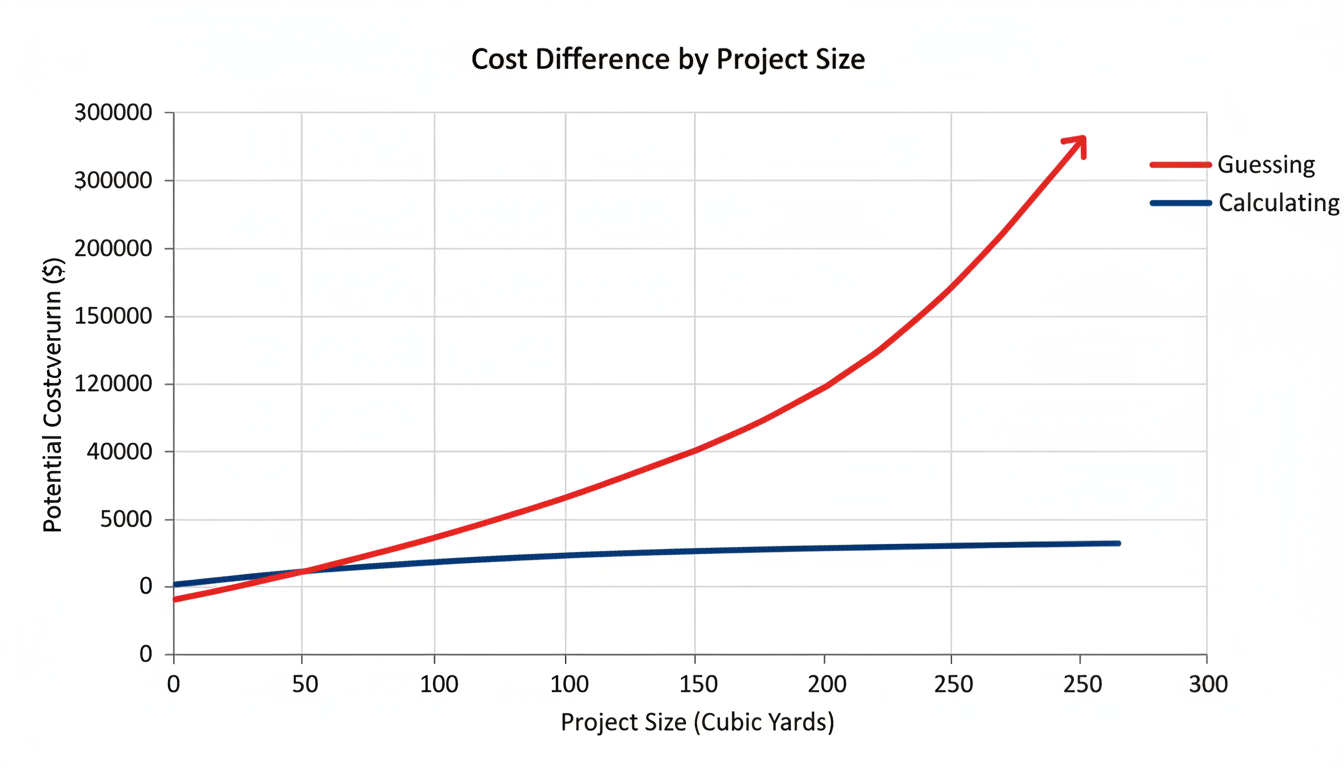
Sarah’s approach—a quick phone call and simple math—saved her time, money, and a massive headache. That’s the power of moving from guessing to calculating.
🎯 Key Takeaway
You cannot convert tons to cubic yards without knowing the material’s density (in lbs/yd³). This single number is the bridge between weight and volume. Always get the density directly from your supplier, then use the formula: Cubic Yards = (Tons × 2,000) / Density.
⚠️ Watch Out
Online calculators are convenient, but they are garbage-in, garbage-out. An online tool is only as accurate as the density number you provide. If you use a generic density value, you’ll get a generic—and likely incorrect—answer. The calculator is for the math, not for the data gathering.
❓ Frequently Asked Questions
How many cubic yards are in a ton of gravel?
There’s no single answer because it depends entirely on the gravel’s density. However, a ton of typical crushed stone gravel is usually between 0.69 and 0.83 cubic yards. Always confirm the specific density with your supplier for an accurate number.
What is the formula to convert tons to cubic yards again?
The formula is simple and reliable: Cubic Yards = (Total Tons × 2,000) / Density (in lbs/yd³). You must have the density of your specific material to get a correct result.
Can I just use a rule of thumb for my project?
You can, but we strongly advise against it. As our example with Bob showed, a “rule of thumb” doesn’t account for variations between suppliers and materials. A two-minute phone call to your supplier for the exact density can save you hundreds of dollars and prevent project delays.
Why do suppliers sell by the ton if I need it by the cubic yard?
Heavy, dense materials like sand, gravel, and stone are easier and more accurately measured by weight using a certified scale at the quarry or yard. Lighter, bulkier materials like mulch and compost are more easily measured by volume (i.e., the size of the loader bucket). It’s simply a matter of industry logistics, as explained by many state transportation and materials handbooks, like this one on soil mechanics.
Does compaction really make that big of a difference?
Absolutely. For projects that need to be stable, like a driveway base or a foundation for a patio, compaction is essential. It can easily reduce the volume of loose material by 15-25%. Failing to account for this is one of the most common reasons people run short of material.
Your Next Step: From Guesswork to Confidence
You’re now armed with the knowledge that separates amateur planners from seasoned pros. You understand that density is the non-negotiable key to unlocking the right material quantity for your job.
You no longer have to rely on vague “rules of thumb” or make a blind guess and hope for the best. You have the formula, you know the process, and you understand the critical variables like moisture and compaction.
So here’s your next step. Before you place your next order for soil, sand, or gravel, pick up the phone. Call your supplier and ask that one simple question: “What’s the density of your material in pounds per cubic yard?”
That single question is your first step to a project that runs on time, on budget, and without a single moment of material-related stress. Go plan with confidence.

