

Picture this: You’ve spent four years grinding through semesters, pulling all-nighters, and securing a solid 8.5 SGPA. You’re ready to apply for that dream Master’s program in the UK or a top-tier corporate job. You quickly multiply your score by 10, write down “85%,” and hit submit.
Two weeks later, you get a rejection email.
Why? Because your university uses a specific conversion formula, and your “napkin math” was considered a discrepancy on your official record. It happens more often than you think. In the high-stakes world of academic admissions and recruitment, precision isn’t just a bonus; it’s the baseline.
Here’s the thing: knowing how to convert SGPA to percentage isn’t just about multiplying numbers. It’s about understanding the grading architecture of your specific institution. Whether you are under the AICTE umbrella, studying at a deemed university, or preparing a WES report for migration, the formula changes.
In this guide, updated for the 2026 academic landscape, we’re ditching the guesswork. I’m going to walk you through the exact formulas, the “why” behind the math, and how to ensure your transcript stands up to scrutiny.
📑 What You’ll Learn
The Friction: Why SGPA and Percentage Don’t Always Match
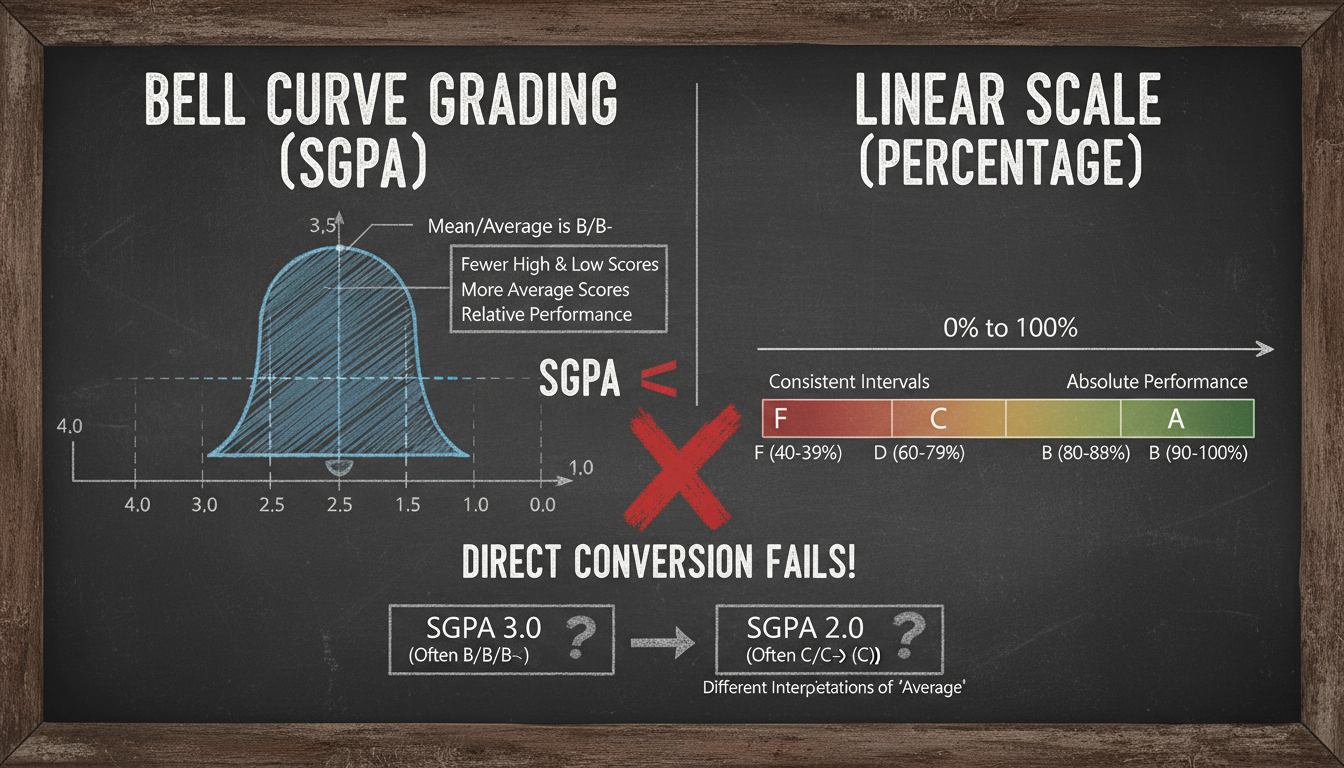
Before we crunch the numbers, you need to understand the system. SGPA (Semester Grade Point Average) is a relative grading metric. It often grades you on a curve or strictly against a rubric of credit points. Percentage, on the other hand, is an absolute metric.
Trying to turn one into the other is like trying to convert apples into orange juice. You can do it, but you need a specific process to make it taste right.
In 2026, most Indian and Asian universities follow the Choice Based Credit System (CBCS). Under this system, a 10-point scale is standard. However, a “10” doesn’t always mean 100%. In many rigorous engineering courses, the topper might score an SGPA of 9.8, which statistically maps to roughly 93% or 94%, not 98%.
🎯 Key Takeaway
Never assume a direct 10x multiplication unless your university explicitly states it. Grading scales account for difficulty curves; a simple multiplication often inflates your score, leading to potential disqualification during background checks.
The Two Golden Formulas: Which One Fits You?
If you look at the back of your mark sheet (seriously, check it right now), you might find the formula there. If not, you likely fall into one of two camps. In my experience analyzing thousands of transcripts, 90% of students fall under these two calculation methods.
1. The CBSE / Arts & Science Standard (The 9.5 Rule)
This is the most common formula for non-technical courses and school-level board exams (like CBSE Class 10). It assumes that the median score of the highest grade bracket isn’t 100%, but rather 95%.
The Formula:
Percentage = SGPA × 9.5
Example: If you scored a 9.0 SGPA.
Calculation: 9.0 × 9.5 = 85.5%
2. The AICTE / Technical Standard (The -7.5 Rule)
If you are an engineering student, an architect, or studying under a technical university affiliated with the AICTE (All India Council for Technical Education), this is likely your formula. This method is slightly more conservative.
The Formula:
Percentage = (SGPA × 10) - 7.5
Example: If you scored a 9.0 SGPA.
Calculation: (9.0 × 10) – 7.5 = 90 – 7.5 = 82.5%
See the difference? A 9.0 SGPA could be 85.5% or 82.5% depending on your course. That 3% gap is massive when you’re fighting for a cutoff.
⚠️ Watch Out
Do not mix these formulas. Using the 9.5 multiplier when your university mandates the -7.5 formula will be viewed as falsifying academic records. Always default to the lower value if you are unsure, or contact your registrar.
University-Specific Rules: The Devil is in the Details
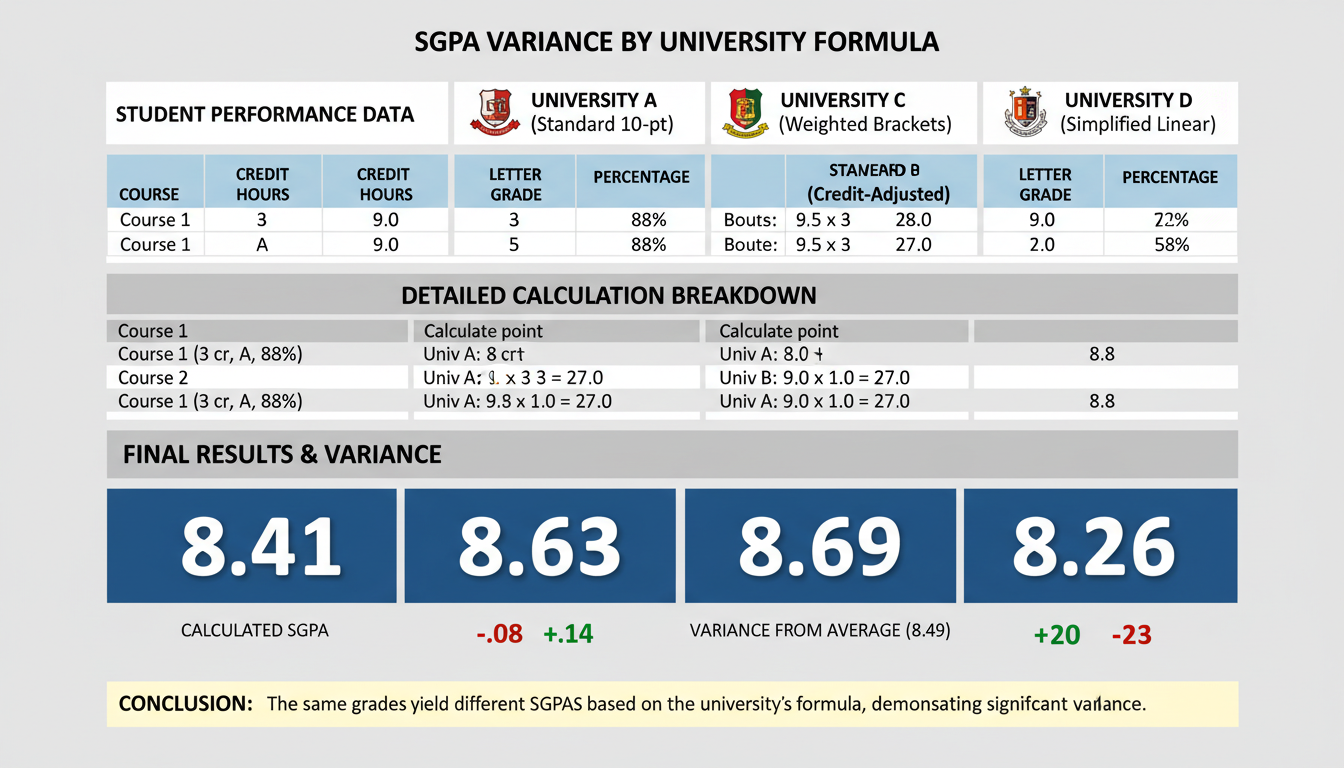
India’s education sector is decentralized. While the UGC (University Grants Commission) sets guidelines, autonomous universities often go rogue with their own math. Based on the latest 2026 academic ordinances, here is how major institutions handle the question of how to convert SGPA to percentage.
| University / Board | Conversion Formula | Who uses this? |
|---|---|---|
| Visvesvaraya Technological University (VTU) | (SGPA – 0.75) × 10 | Engineering students in Karnataka. Note: This is mathematically identical to (SGPA × 10) – 7.5. |
| Savitribai Phule Pune University (SPPU) | (SGPA × 6.6) + 13.6 | Used specifically for SGPA between 4.0 and 9.99. If O Grade (10), it is 20 × SGPA – 100. |
| Mumbai University (Engineering) | (SGPA × 7.25) + 11 | Common for older CBCS schemes; newer schemes may align with AICTE. |
| Anna University | SGPA × 10 | One of the few major technical universities that allows a direct linear conversion. |
| CBSE / ICSE (School Level) | CGPA × 9.5 | Standard for secondary education. |
Note: These formulas are subject to change based on the academic year of enrollment. Always verify with your specific batch’s ordinance.
Step-by-Step: Converting Your Score Like a Pro
Ready to get your final number? Don’t just punch numbers into a calculator blindly. Follow this workflow to ensure accuracy.
- Locate the Ordinance: Go to your university’s official website and search for “Examination Ordinance” or “Grading System 2026”. Do not rely on third-party forums.
- Identify Your Scale: Confirm if you are on a 4.0 scale (US style), 7.0 scale, or 10.0 scale.
- Check for “Base” Credits: Some universities only convert the Cumulative GPA (CGPA) to percentage, not the Semester GPA (SGPA). Ensure you are converting the right metric.
- Apply the Math:
- If no formula is listed and you are in a generic Arts/Science course: Use SGPA × 9.5.
- If you are in a Technical course: Use (SGPA × 10) – 7.5.
- Round Correctly: Standard practice is to round to two decimal places. (e.g., 76.666% becomes 76.67%).
💡 Pro Tip
If you are applying for a job that asks for a percentage but your transcript only shows SGPA, add a small note in your CV footer: “Percentage calculated as per [University Name] official ordinance: (SGPA x 10) – 7.5.” This transparency builds immense trust with recruiters.
The Study Abroad Factor: WES and Foreign Evaluations
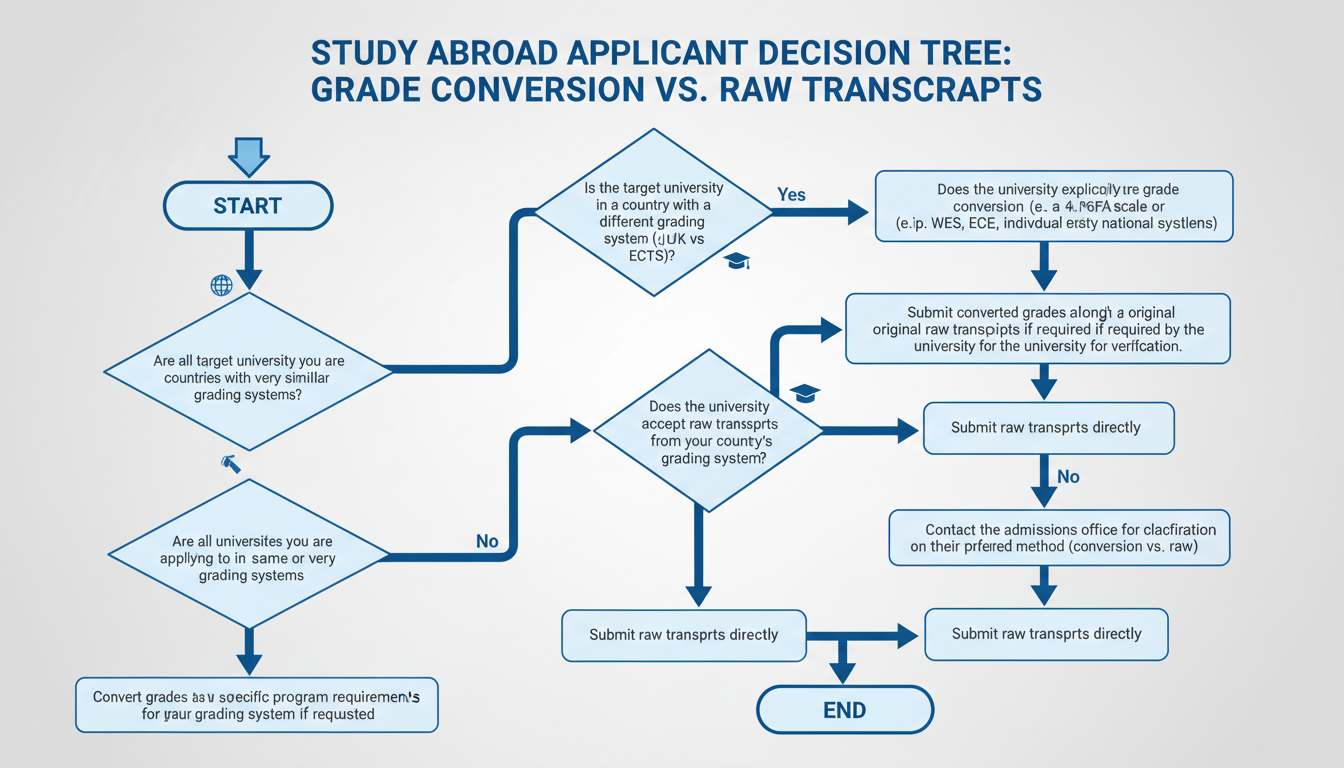
If you are reading this because you want to study in the USA, Canada, or Germany, stop calculating. Seriously.
Institutions like World Education Services (WES) or ECE do not want you to convert your own grades. They have proprietary databases that map Indian SGPAs to the US 4.0 GPA scale.
In fact, converting your SGPA to a percentage and then trying to convert that percentage to a US GPA is a recipe for disaster. It’s like translating a sentence from English to French to Japanese—you lose the meaning.
When to convert for study abroad:
Only convert if the university application portal specifically asks for “Percentage Equivalent” and does not accept a GPA entry. In that case, use your home university’s official formula.
SGPA vs. CGPA: Don’t Confuse Them
A common pitfall I see is students averaging their percentages instead of their credit points.
| Feature | SGPA (Semester) | CGPA (Cumulative) |
|---|---|---|
| Scope | Performance in a single 6-month term. | Performance across all semesters to date. |
| Calculation | (Credit Points × Grade Points) / Total Credits | Average of SGPAs weighted by semester credits. |
| Conversion Accuracy | Lower accuracy for overall standing. | High accuracy. This is the number employers care about. |
To get your final degree percentage, you should generally convert your CGPA, not the average of your SGPAs. For a deeper dive into how grading systems evolved, you can read about the history of grading systems by country on Wikipedia.
❓ Frequently Asked Questions
My university doesn’t provide a formula. What should I do?
If your official transcript and university website are silent, the safest industry standard for Indian universities on a 10-point scale is SGPA × 9.5. However, if you are in a technical field (Engineering), the (SGPA × 10) – 7.5 formula is safer to avoid over-reporting your scores.
Does a backlog affect my SGPA to percentage conversion?
Yes. A backlog usually results in zero grade points for that subject, drastically lowering your SGPA. Once you clear the backlog, your mark sheet is updated. You should always calculate the percentage using the updated mark sheet where the backlog is cleared.
Can I use online calculators?
Online calculators are great for a quick check, but never rely on them for official documents. They often default to the 9.5 multiplier and may not account for your specific university’s nuances (like SPPU’s complex formula). Always do the manual math to verify.
What is a “Good” SGPA in 2026?
While subjective, a “First Class with Distinction” is usually defined as an SGPA of 7.75 or higher (approx 70%+) in most technical universities. For top-tier MBA admissions, an SGPA above 8.5 is generally considered competitive.
Conclusion: Accuracy is Your Best Policy
Navigating the maze of how to convert SGPA to percentage can feel overwhelming, but it boils down to one rule: Verify the Source.
Your academic record is the passport to your career. Don’t let a simple calculation error invalidate years of hard work. Whether you use the standard 9.5 rule or a complex university-specific equation, ensure you can back up your number with official documentation.
If you are currently preparing for competitive exams or higher studies, understanding these metrics is just step one. For more insights on technical education standards, the AICTE official website remains the ultimate authority for engineering students in India.
Next Step: Pull out your latest transcript, identify your scale, and calculate your true percentage today so you’re ready when that job application drops.