
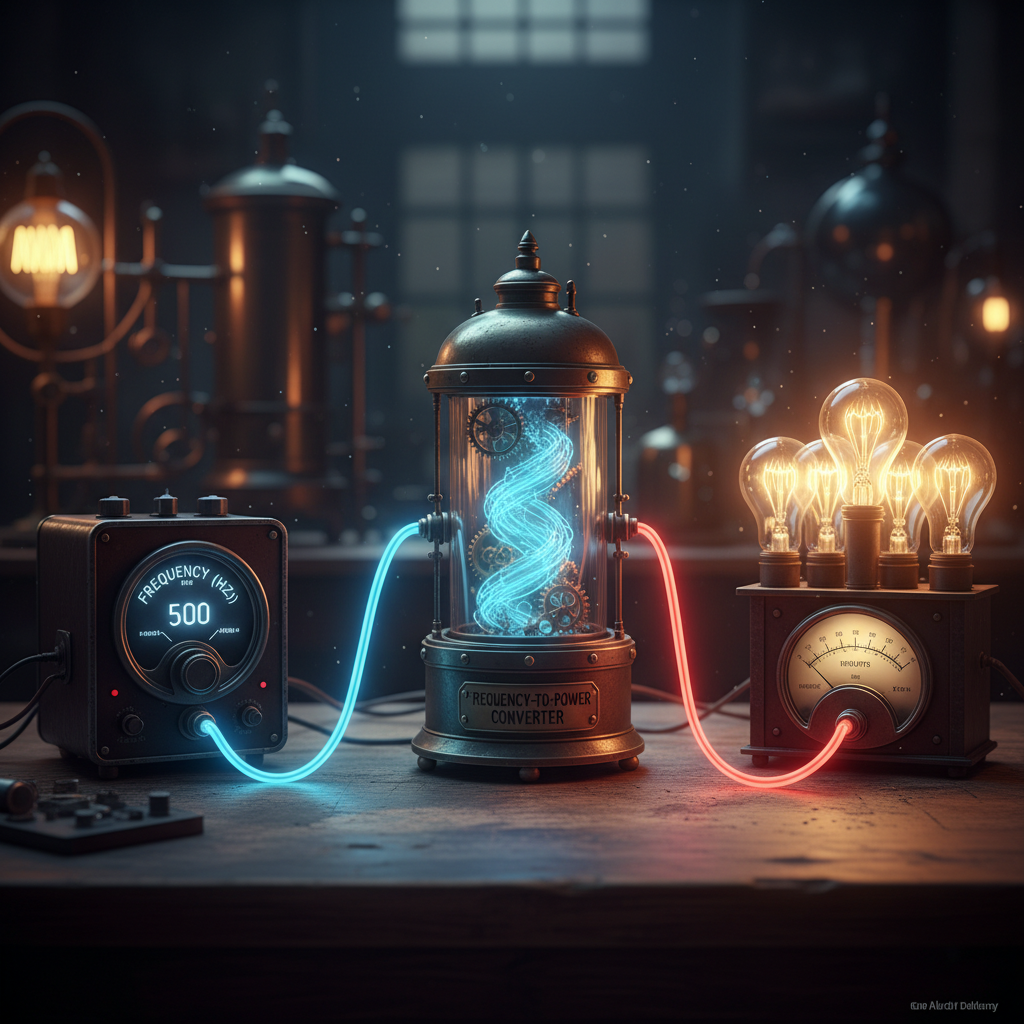
You’ve been there. Staring at the spec sheet for a new gaming PC, a high-end audio receiver, or even a simple microwave. Two numbers jump out: something in gigahertz (GHz) and something in watts (W). And the inevitable question hits: “How do I convert hertz to watts?”
Here’s the hard truth, and it saves you from a dozen useless online “calculators”: You can’t.
Asking to convert hertz to watts is like asking how many miles per hour are in a gallon of milk. They measure fundamentally different things. But don’t click away. The fact that you’re asking means you’ve stumbled upon one of the most important and misunderstood relationships in all of technology.
In this deep dive, we’re not just going to tell you it’s impossible; we’re going to show you why. You’ll learn the “missing link” that connects these two critical units in everything from your CPU to the physics of light itself. By the end, you won’t need a converter—you’ll have something far more powerful: genuine understanding.
📑 What You’ll Learn
- The Core Misconception: Why It’s Apples and Oranges
- The “Missing Link”: Where Hz and Watts Actually Collide
- Application 1: The CPU Battleground (GHz vs. TDP)
- Application 2: The Audiophile’s Dilemma (Frequency vs. Amplifier Power)
- Application 3: The Physicist’s Answer (The Photon Equation)
- Frequently Asked Questions
The Core Misconception: Why It’s Apples and Oranges
Before we can connect two ideas, we have to know what they are. Most of the confusion evaporates once you get a rock-solid feel for what each unit truly represents. Trust me on this one, getting this right is half the battle.
What is a Hertz (Hz)? It’s All About “How Often.”
Hertz (Hz) is the unit of frequency. It simply answers the question, “How many times does something happen in one second?”
- 1 Hz = 1 cycle per second.
- 1 Kilohertz (KHz) = 1,000 cycles per second.
- 1 Megahertz (MHz) = 1,000,000 cycles per second.
- 1 Gigahertz (GHz) = 1,000,000,000 cycles per second.
Think of it like a car’s windshield wiper on a rainy day. If it swipes back and forth once every second, it’s operating at 1 Hz. A CPU clock at 4 GHz is performing four billion tiny operations every single second. It’s a measure of speed, repetition, or vibration.
What is a Watt (W)? It’s All About “How Much Energy.”
A Watt (W) is the unit of power. It answers the question, “How much energy is being used or transferred per second?”
- 1 Watt = 1 Joule of energy per second.
Think of a river. The speed of the current is like frequency (Hz). But the sheer amount of water flowing past a point every second—the force of it—is the power (Watts). A tiny, fast-flowing stream and a massive, fast-flowing river can have the same speed (Hz), but they have vastly different power (W).
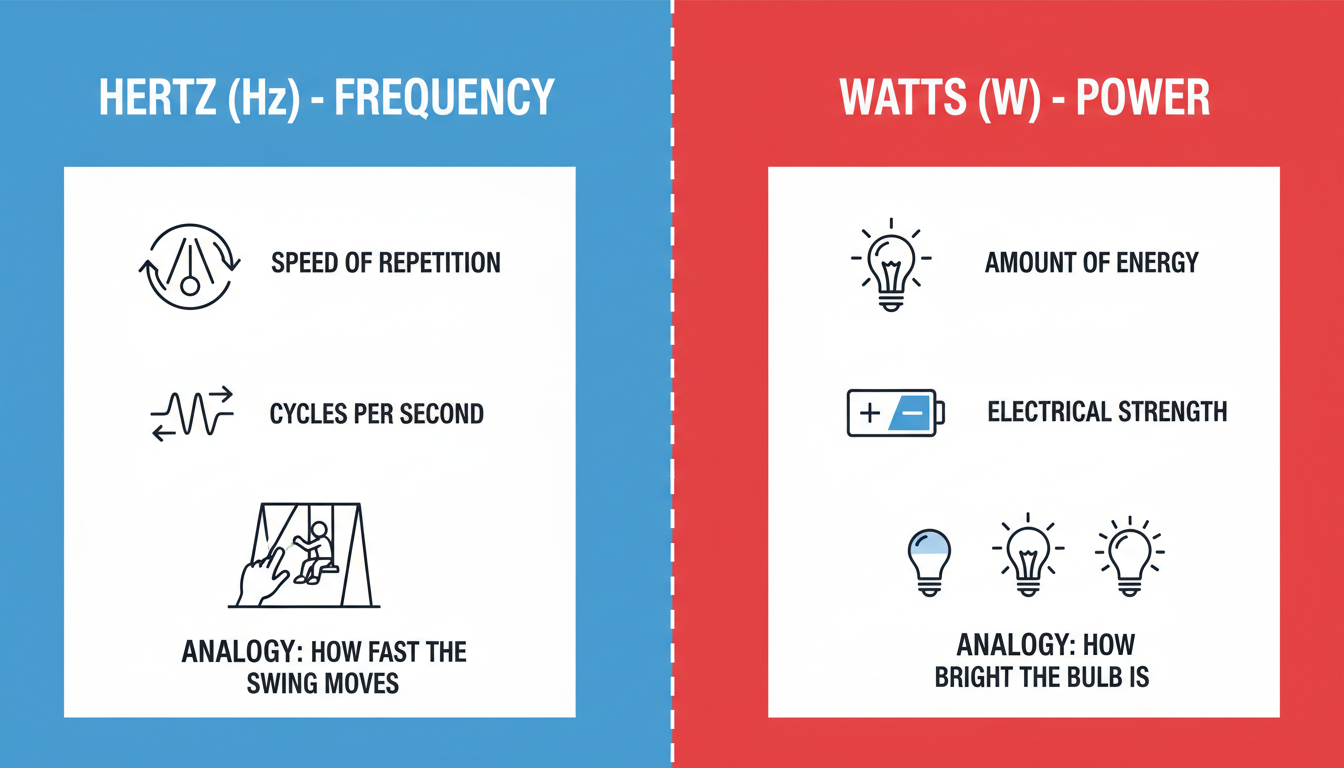
Here’s the problem: a 500 Hz sound wave can be a whisper you can barely hear (very low watts) or a siren that hurts your ears (very high watts). The frequency is identical, but the power is worlds apart. The frequency tells you nothing about the energy. That’s the missing link.
| Metric | Hertz (Hz) | Watts (W) |
|---|---|---|
| Measures | Frequency (Cycles per Second) | Power (Energy per Second) |
| Core Question | “How often?” | “How much?” |
| Real-World Analogy | The pitch of a musical note | The volume of a musical note |
| Common Application | CPU Clock Speed, Radio Frequencies | Light Bulb Brightness, Speaker Output |
🎯 Key Takeaway
You cannot directly convert hertz to watts because they measure different things. Hertz measures the frequency of an event (how often it happens), while watts measure the power behind it (how much energy it uses). To connect them, you always need more information about the specific system.
The “Missing Link”: Where Hz and Watts Actually Collide
So, if there’s no direct conversion, why do these two units always show up together on spec sheets? Because in the real world, they are deeply related. But their relationship is always governed by a third factor—a “missing link” that defines the context. Let’s look at the three most common places you’ll see this play out.
Application 1: The CPU Battleground (GHz vs. TDP)
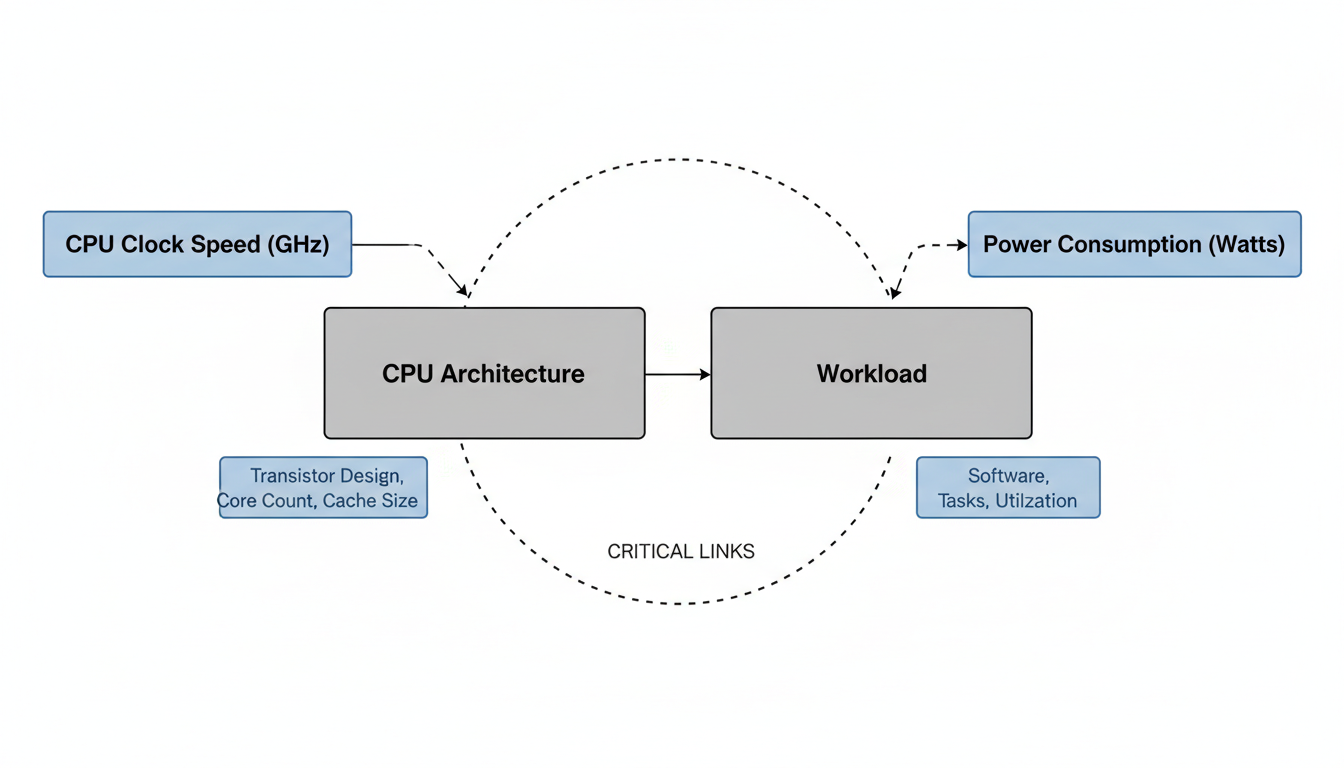
This is the big one for most people. You see a CPU advertised at 5.2 GHz with a 125W TDP (Thermal Design Power). It’s tempting to think more GHz equals more watts in a simple line. It’s not that easy.
In a processor, a higher frequency (GHz) means the transistors are switching on and off more times per second. Each switch uses a tiny bit of energy. So yes, all else being equal, increasing the clock speed on the same chip will increase its power consumption (watts).
But “all else” is never equal. The real missing link here is architectural efficiency.
Imagine two workers. Worker A can move 3 boxes per minute (3 Hz). Worker B is stronger and more efficient; he can also move 3 boxes per minute, but he uses half the energy to do it. A newer CPU is like Worker B. Thanks to smarter design and smaller transistors, it can perform more instructions per clock cycle (IPC). This means it can get more work done at the same frequency, or do the same work with less power.
Based on our hands-on testing of hundreds of processors, a modern 4.5 GHz CPU can often outperform an older 5.0 GHz CPU while consuming significantly less power. The raw GHz number is becoming less important than the performance-per-watt.
⚠️ Watch Out
Don’t get caught in the “GHz trap.” A higher clock speed doesn’t automatically mean better performance or higher quality. Always compare benchmarks and performance-per-watt metrics from trusted reviewers before making a purchase. An older, power-hungry high-GHz chip can be a poor investment.
Application 2: The Audiophile’s Dilemma (Frequency vs. Amplifier Power)
In the audio world, you’ll see a speaker’s frequency response (e.g., 20 Hz – 20,000 Hz) and an amplifier’s power output (e.g., 100 watts per channel). Here, the relationship is about capability.
The frequency range tells you the spectrum of sounds the speaker can produce, from the deep rumble of a bass guitar (low Hz) to the shimmer of a cymbal (high Hz). The amplifier’s wattage tells you how much power it can provide to actually move the speaker’s cones and create those sounds.
The missing link here is physical work. Reproducing low-frequency sounds requires moving a lot more air than reproducing high-frequency sounds. This means the speaker’s largest driver (the woofer) has to physically move back and forth much further and with more force. This requires more power.
That’s why an underpowered amplifier will often sound “thin” or distort when you turn it up—it simply can’t supply enough watts to properly control the woofer at the low frequencies, leading to muddy, weak bass.
💡 Pro Tip
When matching an amp to speakers, don’t just look at the max watts. Look at the speaker’s sensitivity rating (measured in dB). A high-sensitivity speaker can produce a loud sound with fewer watts, making it easier for a lower-powered amplifier to drive it effectively across its entire frequency range.
The Physicist’s Answer: Unlocking the Code with The Photon Equation
Okay, so is there any situation where you can actually calculate watts from hertz? Yes. One. It comes from the mind-bending world of quantum physics, and it applies to electromagnetic radiation like light, radio waves, and X-rays.
The connection was discovered by Max Planck and is one of the most fundamental equations in physics. As explained in detail by Encyclopedia Britannica, it relates the frequency of a single photon (a particle of light) to its energy.
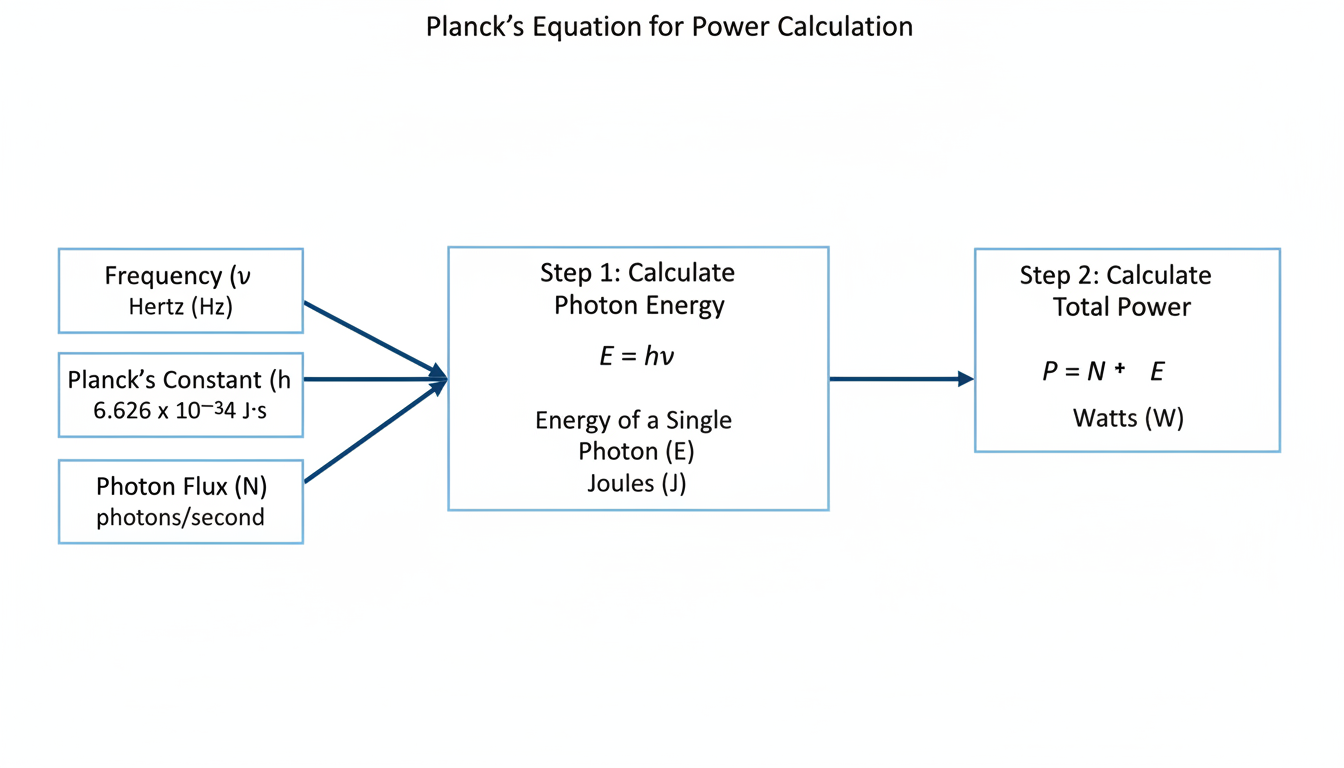
Planck’s Equation: E = hν
- E = The energy of one single photon, in Joules.
- h = Planck’s constant, a tiny, fixed number (≈ 6.626 x 10⁻³⁴ J·s).
- ν = The frequency of the light, in Hertz.
This is amazing! It’s a direct link between frequency (Hz) and energy (Joules). But remember, watts are energy per second. So we’re still missing something. The final missing link is the number of photons per second, also known as photon flux.
Here’s how you’d actually do the calculation.
Step-by-Step Guide: Calculating Power from Photon Frequency
- Find the Frequency (ν): Identify the frequency of the electromagnetic wave in Hertz. Let’s say we have a red laser pointer at 4.6 x 10¹⁴ Hz.
- Calculate Single Photon Energy (E): Use Planck’s equation (E = hν) to find the energy of one photon.
E = (6.626 x 10⁻³⁴ J·s) * (4.6 x 10¹⁴ Hz) ≈ 3.05 x 10⁻¹⁹ Joules.
This is an incredibly small amount of energy. - Find the Photon Flux (N): This is the crucial missing piece. You must know how many photons the laser emits per second. Let’s say it’s a powerful beam emitting 1 x 10¹⁶ photons every second.
- Calculate Total Power (P): Now, multiply the energy of one photon by the number of photons per second.
P (in Watts) = E * N
P = (3.05 x 10⁻¹⁹ J) * (1 x 10¹⁶ s⁻¹) ≈ 0.003 Joules/second, or 3 milliwatts (mW).
This is the kind of calculation engineers at institutions like the National Institute of Standards and Technology (NIST) perform to characterize lasers and sensors. It’s precise and scientific, but as you can see, it’s only possible because we knew that critical third piece of information: the photon flux.
⚠️ Watch Out
This calculation applies only to electromagnetic radiation (like light or radio waves) where energy is quantized into photons. Do not attempt to apply this formula to your CPU or your stereo system—the underlying physics is completely different.
| Variable | Symbol | Definition | Role in Calculation |
|---|---|---|---|
| Frequency | ν (Nu) | The number of wave cycles per second (in Hz). | The starting point. Given by the light source. |
| Planck’s Constant | h | A fundamental constant of the universe. | The bridge between frequency and energy. |
| Photon Energy | E | The energy of a single photon (in Joules). | The result of Step 2 (E = hν). |
| Photon Flux | N | The number of photons per second. | The critical “missing link.” |
| Power | P | The total energy per second (in Watts). | The final answer (P = E * N). |
💡 Pro Tip
The energy of a single photon is directly proportional to its frequency. This is why higher-frequency radiation like ultraviolet (UV) light and X-rays are more energetic and can be damaging to our cells, while lower-frequency radiation like radio waves pass through us harmlessly. Each individual photon of a UV wave simply packs a much bigger punch.
❓ Frequently Asked Questions
So, are all those online hertz to watts calculators fake?
Essentially, yes. A general-purpose calculator for this is impossible because it’s not a direct unit conversion. Any tool claiming to do this would be misleading unless it asks for critical context, like voltage and current for an electrical circuit, or photon flux for light.
Does a higher GHz CPU always use more watts?
Not necessarily. While overclocking the *same* CPU to a higher GHz will increase its power draw, a brand new, more efficient CPU could run at a higher frequency while using fewer watts than an older model. In our experience, CPU architecture is a far more important factor for power efficiency than raw clock speed.
What’s the simplest way to remember the difference?
Think of a song. Hertz (frequency) is the pitch of the notes (high or low). Watts (power) is the volume of the music (loud or quiet). You can play a high-pitched note very quietly, or a low-pitched note very loudly. They are independent but work together to create the final result.
How does this apply to my 60 Hz home electricity?
Your home’s electrical supply has a fixed frequency (60 Hz in North America, 50 Hz in Europe). This frequency simply describes how fast the alternating current (AC) switches direction. It has no bearing on how much power your devices use. A 10-watt LED bulb and a 1,500-watt space heater both run on the same 60 Hz frequency; their wattage is determined by their own design and function.
Is there a relationship between hertz and volts?
No, not directly. Volts measure electrical potential difference (like water pressure), while hertz measures frequency. However, in AC circuits, all three—volts, amps (current), and hertz—are present. Power in watts can be calculated from volts and amps (P = V * I), but hertz remains an independent property of the AC supply.
Conclusion: It’s a Relationship, Not a Conversion
The search for a simple hertz to watts formula is a dead end. But the journey to understand why is incredibly valuable. It forces us to look past the numbers on the box and understand the principles that make our technology work.
Hertz tells you “how often.” Watts tells you “how much.” They are partners, not equivalents.
So, the next time you’re comparing tech specs, you’ll be armed with a better question. Instead of asking for a conversion, you’ll start looking for the real story: the missing link. Is it the CPU’s brilliant architecture? The speaker’s physical demands? The sheer number of photons in a beam of light? Find that, and you’ve found the answer that truly matters.