
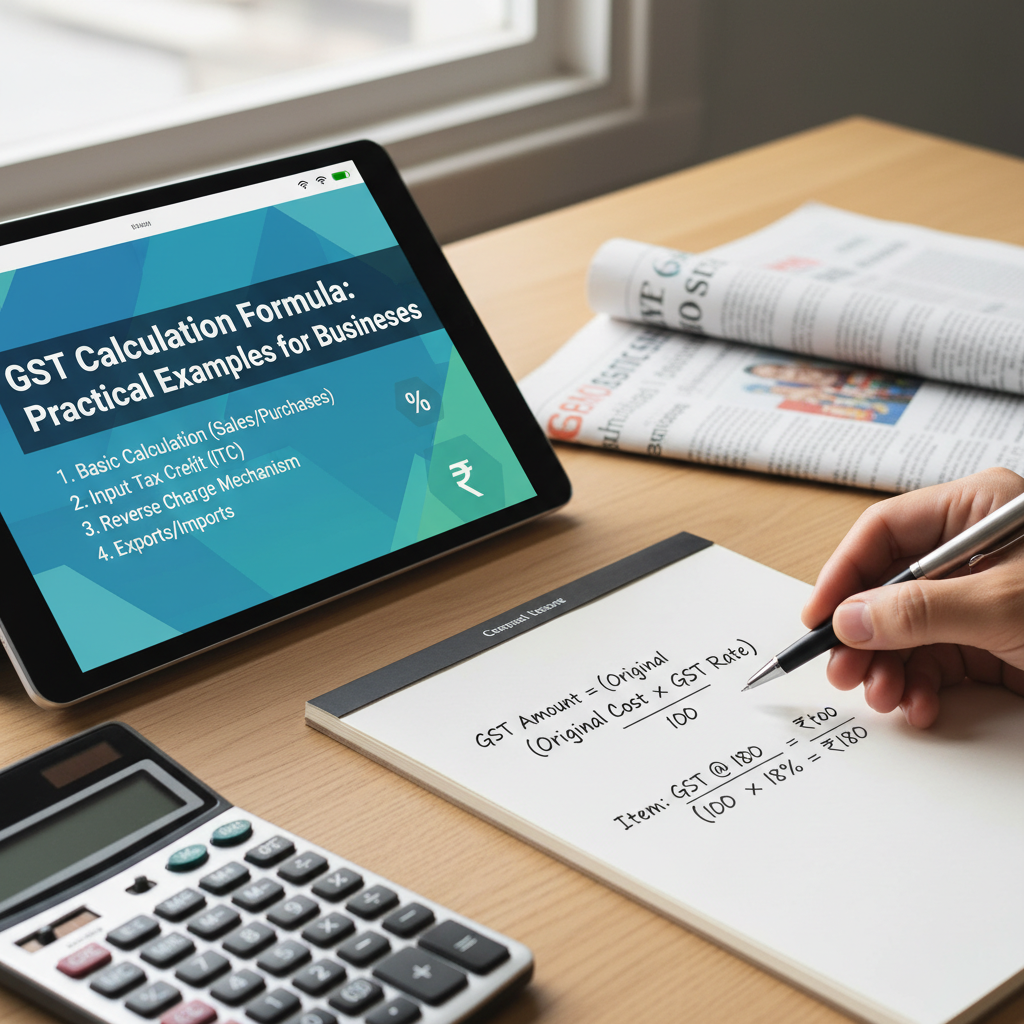
Why Understanding the GST Calculation Formula is Crucial for India Business
For any enterprise operating in India, mastering the intricacies of the Goods and Services Tax (GST) is not just a compliance requirement—it is a fundamental aspect of financial health. Whether you are a small retailer or a large manufacturer, accurate invoicing and timely tax remittance depend entirely on correctly applying the gst calculation formula examples india business relies upon daily.
The GST regime, introduced in 2017, unified a complex web of central and state taxes into a single structure. While this simplification was welcomed, the calculations involving Central GST (CGST), State GST (SGST), and Integrated GST (IGST), along with the crucial mechanism of Input Tax Credit (ITC), still pose challenges. This comprehensive guide provides you with the definitive formulas and practical, real-world scenarios necessary to handle your GST obligations confidently.
Within the next few minutes, we will break down the core mechanics, explore detailed gst calculation formula examples india business owners need to know, and ensure you are equipped to handle both forward and reverse charge calculations.
The Fundamentals: Deconstructing the Core GST Calculation Formula
GST is levied at the final consumption point, but its calculation begins at the point of sale or service provision. The base of the calculation is always the taxable value of the goods or services, excluding the tax itself. The overall rate is determined by the classification of the goods/services and the location of the transaction.
The primary calculation is straightforward:
GST Amount = (Value of Supply × GST Rate) / 100
Total Invoice Value = Value of Supply + GST Amount
However, the real complexity lies in determining which components (CGST, SGST, or IGST) apply.
Intra-State Supply (Within the Same State)
When goods or services are supplied within the same state or union territory, the tax is divided equally between the Central Government and the State Government.
- CGST: Central GST (Half of the total rate).
- SGST/UTGST: State GST or Union Territory GST (The remaining half of the total rate).
Inter-State Supply (Across Different States)
When the supply is made from one state to another, or from India to an international destination, only one unified tax is charged.
- IGST: Integrated GST (The full rate).
- IGST is collected by the Centre, which then shares the relevant portion with the consuming state.
Key GST Rate Slabs (India)
Most goods and services fall into one of these five primary rate categories:
- 0% (Essential goods, specific services)
- 5% (Mass consumption items)
- 12% (Processed foods, specific services)
- 18% (Standard rate, most services)
- 28% (Luxury goods, sin items)
Applying the GST Calculation Formula to Real-World Scenarios
To truly master GST compliance, you must be comfortable with two primary calculation types: adding GST to a base price and reversing the calculation to find the original base price when the total is known.
Scenario 1: Forward GST Calculation (Adding Tax)
This is the standard calculation used when generating an invoice. You have the price of the item (exclusive of tax) and need to find the total payable.
Example A: Intra-State Sale (18% Rate)
A business in Maharashtra sells machinery spares to another business in Maharashtra. The taxable value is ₹ 50,000. The applicable GST rate is 18%.
- Determine Tax Components: Since this is an intra-state sale, the 18% rate splits into CGST (9%) and SGST (9%).
- Calculate CGST Amount:CGST Amount = (50,000 × 9) / 100 = ₹ 4,500
- Calculate SGST Amount:SGST Amount = (50,000 × 9) / 100 = ₹ 4,500
- Calculate Total GST:Total GST = 4,500 + 4,500 = ₹ 9,000
- Calculate Total Invoice Value:Total Invoice Value = 50,000 (Taxable Value) + 9,000 (GST) = ₹ 59,000
Example B: Inter-State Sale (12% Rate)
A service provider in Delhi provides IT consultancy services to a client in Karnataka. The taxable value is ₹ 1,20,000. The applicable GST rate is 12%.
- Determine Tax Components: Since this is an inter-state sale, only IGST (12%) applies.
- Calculate IGST Amount:IGST Amount = (1,20,000 × 12) / 100 = ₹ 14,400
- Calculate Total Invoice Value:Total Invoice Value = 1,20,000 + 14,400 = ₹ 1,34,400
Scenario 2: Reverse GST Calculation Formula Examples for India Business (Excluding Tax)
Sometimes, a business knows the final price (inclusive of GST) but needs to determine the base taxable value for accounting or pricing purposes. This requires the reverse gst calculation formula examples india business often uses when dealing with Maximum Retail Price (MRP).
Reverse GST Calculation Formula:
Taxable Value = Total Price / (1 + (GST Rate / 100))
GST Amount = Total Price – Taxable Value
Example C: Finding the Taxable Base (28% Rate)
A product has an MRP of ₹ 12,800, which includes 28% GST.
- Apply the Denominator:1 + (28 / 100) = 1 + 0.28 = 1.28
- Calculate Taxable Value:Taxable Value = 12,800 / 1.28 = ₹ 10,000
- Calculate GST Amount:GST Amount = 12,800 – 10,000 = ₹ 2,800
Quote: “Accurate GST calculation is the cornerstone of preventing penalties. Understanding the difference between intra-state and inter-state tax application is non-negotiable for compliance,” advises tax expert commentary.
Advanced GST Calculation Formula Examples: Input Tax Credit (ITC) and Net Liability
The most important mechanism in GST, which prevents cascading taxation, is the Input Tax Credit (ITC). ITC allows businesses to claim credit for the GST paid on purchases (inputs) against the GST collected on sales (outputs). The final amount a business pays to the government is the ‘Net GST Liability’.
Net GST Liability Formula:
Net GST Payable = Output GST (Tax Collected on Sales) – Input Tax Credit (Tax Paid on Purchases)
Example D: Calculating Net GST Liability
A manufacturing company, Acme Goods, operates in Gujarat. In a given month, its transactions are as follows:
- Sales (Output): Total taxable value ₹ 5,00,000 (12% GST rate).
- Purchases (Input): Total taxable value ₹ 3,00,000 (12% GST rate).
Step 1: Calculate Output GST (Tax Collected)
Since the business is in Gujarat and selling within Gujarat (intra-state), the 12% rate splits into CGST and SGST (6% each).
- Output CGST = 5,00,000 × 6% = ₹ 30,000
- Output SGST = 5,00,000 × 6% = ₹ 30,000
- Total Output Tax = ₹ 60,000
Step 2: Calculate Input Tax Credit (ITC) (Tax Paid)
Assuming all purchases were also intra-state (Gujarat to Gujarat):
- Input CGST (ITC) = 3,00,000 × 6% = ₹ 18,000
- Input SGST (ITC) = 3,00,000 × 6% = ₹ 18,000
- Total Input Tax Credit = ₹ 36,000
Step 3: Calculate Net GST Payable
The crucial rule of ITC is that CGST credit must be used against CGST/IGST liability, and SGST credit must be used against SGST/IGST liability. They generally cannot be cross-utilized against each other (SGST against CGST).
- Net CGST Payable: Output CGST (₹ 30,000) – ITC CGST (₹ 18,000) = ₹ 12,000
- Net SGST Payable: Output SGST (₹ 30,000) – ITC SGST (₹ 18,000) = ₹ 12,000
Total Net GST Liability for the month: ₹ 12,000 (CGST) + ₹ 12,000 (SGST) = ₹ 24,000.
This comprehensive approach to the gst calculation formula examples india business utilizes ensures that tax is only paid on the value addition created by the company.
Handling Complexities and Leveraging Tools
While the manual application of the GST calculation formula is essential for understanding the underlying principles, high-volume businesses often face complexities related to mixed supplies, exempted goods, and varying inter-state ITC adjustments.
Pitfall 1: Incorrect Rate Application
Applying the wrong GST rate (e.g., 18% instead of 12%) is a common error. Businesses must regularly check the official classification codes (HSN/SAC) to ensure the correct rate is applied to goods and services, as rates are subject to change by the GST Council. The Central Board of Indirect Taxes and Customs (CBIC) provides updated notifications.
Pitfall 2: Mismanaging ITC
ITC claims are dependent on the supplier uploading the invoice (GSTR-1) and the recipient accepting it (GSTR-2B). Missing or unmatched invoices can lead to the loss of ITC, significantly increasing the net tax liability. Proper reconciliation is vital.
Pitfall 3: Classification Errors
Confusing an intra-state supply with an inter-state supply (or vice versa) leads to paying the wrong tax head (e.g., paying CGST/SGST when IGST was due). This often requires tedious rectification processes and potential interest payments.
For businesses dealing with numerous transactions, manual calculation can be prone to human error. Utilizing specialized software or an accurate online tool simplifies compliance dramatically. An effective GST Calculator Tool can instantly provide both the forward and reverse calculations, mitigating errors and speeding up invoice generation.
Furthermore, businesses must track their expenditure meticulously. Tools designed to manage and track business costs, like an expense splitter tool, can help in accurately separating taxable and non-taxable expenses, which is foundational to precise ITC claims.
Final Considerations for GST Compliance in India
The key to successful GST management is consistency and accurate record-keeping. Every transaction, whether inward or outward, must be documented to support the application of the relevant gst calculation formula examples india business relies upon. Remember that GST compliance extends beyond simple rate application; it involves understanding the place of supply rules, time of supply rules, and the stringent conditions for claiming ITC.
Regular review of official government notifications ensures your business remains compliant with the dynamic tax environment. For example, the official Ministry of Finance often issues clarifications that impact rate application and procedural compliance.
By mastering the basic formulas for adding and reversing GST, and by diligently managing your Input Tax Credit, you can optimize your working capital and ensure your business avoids costly penalties and audits.
FAQs
Read Also:
- Best Productivity Tools for Remote Teams [2026 Guide]
- The Ultimate Meta Tag Analyzer SEO Optimization Guide: Boost Your Rankings Now
- Mean, Median, Mode, and Range Calculator
- Guide to robots.txt and sitemap.xml: Essential SEO Files Explained in 2025
- 7 Powerful Ways a Retirement Calculator Can Secure Your Financial Future
- Best PDF to Word Converter Guide: 7 Expert Tips for Flawless Edits
- Lap Time Calculator: Find Your True Race Pace in 2026
- Stop Wasting Material in 2026
- Mirrored Text Generator: The Ultimate Guide for 2026
- Hex to Binary Converter: The Ultimate 2026 Guide