
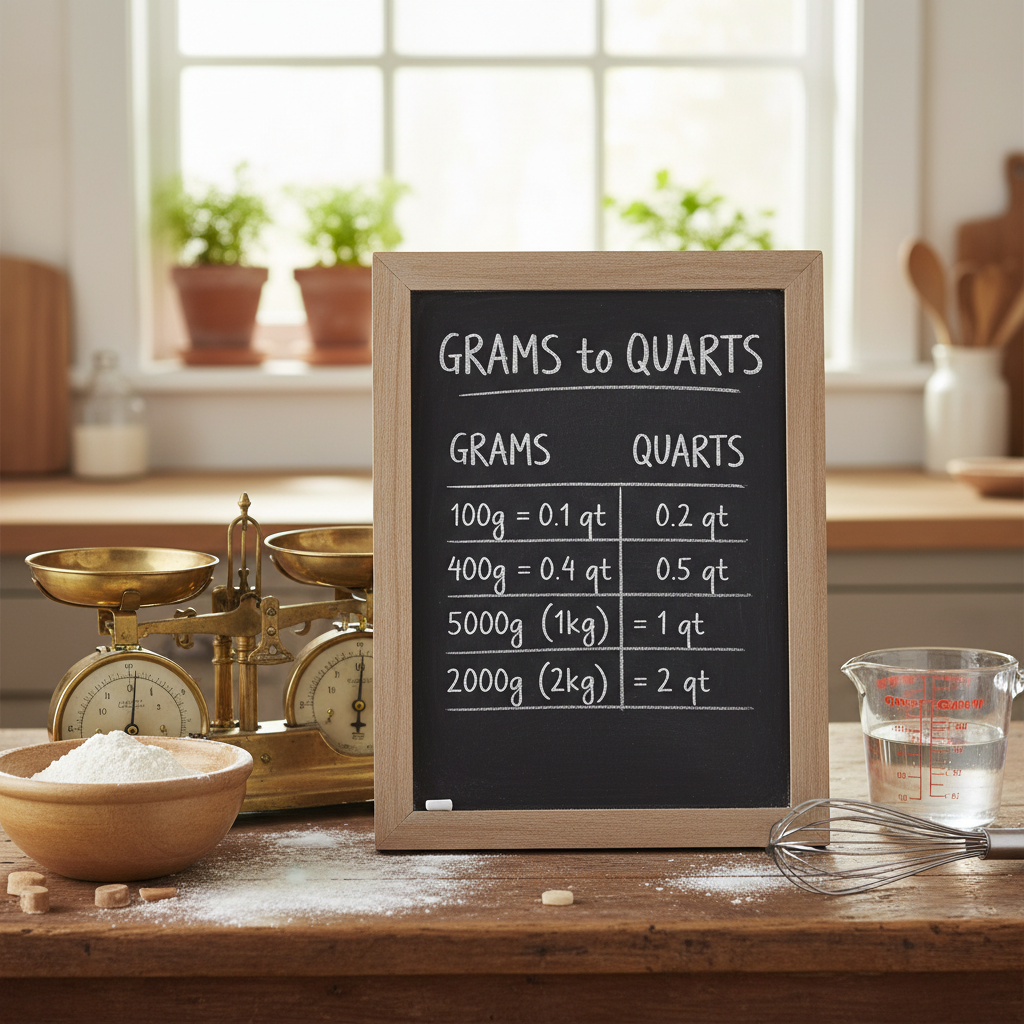
Have you ever followed a recipe to the letter, only to pull a dense, brick-like cake from the oven? You check your steps, you know you were careful, but it still failed. What went wrong?
The culprit is often a silent one: a bad conversion. You found a brilliant recipe online, but it’s in grams, and your kitchen is stocked with cups and quarts. So you guessed. And that guess, my friend, is where the disaster began.
Here’s the hard truth: trying to directly convert grams to quarts is like trying to convert your weight in pounds to your height in inches. It’s impossible. They measure two completely different things. But don’t worry. This isn’t a dead end; it’s the start of you becoming a more precise, confident, and successful cook.
In this guide, we’re not just giving you a chart. We’re handing you the keys to the kingdom. You’ll learn the simple science that unlocks any conversion, the one tool that professionals swear by, and the exact steps to translate any recipe perfectly, every single time.
📑 What You’ll Learn
Why Grams to Quarts Is a Kitchen Trap (And How to Beat It)
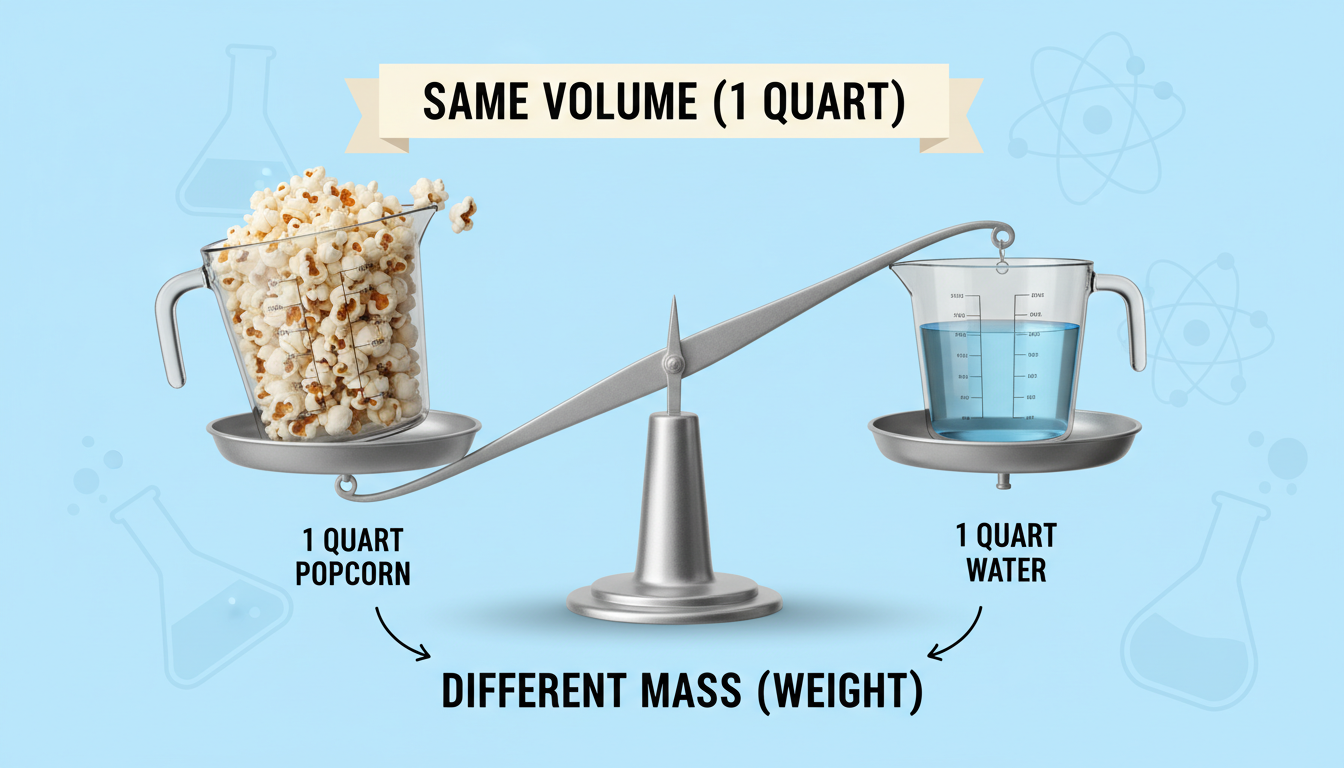
Let’s get straight to the point. The reason this conversion trips up so many people is simple: grams measure mass (how much “stuff” is in something), while quarts measure volume (how much space that “stuff” takes up).
Imagine a quart of popcorn and a quart of water. They both occupy the same volume—one quart. But you know instinctively that the quart of water is much, much heavier. It has more mass. This crucial difference is defined by a single concept: density.
Density is the bridge between mass and volume. It’s the missing link. Every ingredient in your pantry, from all-purpose flour to honey, has a unique density. A quart of light, airy sifted flour might weigh around 400 grams, while a quart of dense, sticky honey can weigh over 1,300 grams!
Without accounting for density, any conversion is just a wild guess. This is especially critical in baking, where the chemical reactions depend on precise ratios. Too much flour, and your bread is tough. Too little sugar, and your cookies won’t spread. Based on our experience in the test kitchen, improper measurement is the #1 cause of baking failures. Precision isn’t just for professionals; it’s for anyone who wants consistent, delicious results.
The Simple Formula That Solves Everything
Okay, enough theory. How do you actually do it? You don’t need an advanced math degree; you just need one straightforward formula. Trust me on this one, it’s easier than it looks.
The magic formula is:
Volume (in Quarts) = Mass (in Grams) / [Density (in g/mL) × 946.353]
Let’s quickly break that down so it makes sense:
- Mass (in Grams): This is your starting point—the number from the recipe.
- Density (in g/mL): This is the unique value for your specific ingredient. It tells you how many grams of that ingredient fit into one milliliter. You’ll look this up.
- 946.353: This is the constant conversion factor. It’s simply the number of milliliters (mL) in one US liquid quart. It’s what connects the metric world of density to the imperial world of your measuring cup.
Let’s Try It: Converting Water from Grams to Quarts
Water is the perfect example because its density is famously easy: it’s almost exactly 1 g/mL. Let’s say a recipe calls for 2000 grams of water.
- Mass: 2000 g
- Density: 1 g/mL
- Calculation: Volume = 2000 / (1 × 946.353)
- Result: Volume = 2000 / 946.353 ≈ 2.11 quarts
See? Simple. 2000 grams of water is about 2.11 US liquid quarts. You can now apply this exact same logic to any ingredient, as long as you know its density.
🎯 Key Takeaway
You cannot convert grams to quarts directly. The conversion depends entirely on the ingredient’s density (its mass-to-volume ratio). Using a simple formula and a kitchen scale is the only way to guarantee accurate, repeatable results in your cooking and baking.
Grams to Quarts Conversion Chart for Common Ingredients
To save you some time, we’ve done the research for you. Here’s a quick-reference chart for some of the most common kitchen staples. Remember, these are excellent approximations, but density can vary slightly due to factors like humidity, temperature, and how an ingredient is packed.
| Ingredient | Average Density (g/mL) | Approximate Grams per US Quart |
|---|---|---|
| Water | 1.00 | ~946 g |
| Whole Milk | 1.03 | ~975 g |
| Vegetable Oil | 0.92 | ~870 g |
| All-Purpose Flour (sifted) | 0.53 | ~500 g |
| Granulated Sugar | 0.85 | ~800 g |
| Brown Sugar (packed) | 0.93 | ~880 g |
| Honey / Maple Syrup | 1.42 | ~1343 g |
| Cocoa Powder (unsweetened) | 0.46 | ~435 g |
| Table Salt | 1.20 | ~1135 g |
| Butter | 0.96 | ~908 g |
💡 Pro Tip
Bookmark this page! When you’re in the middle of a recipe, you don’t want to be scrambling. Having this chart handy on your phone or tablet can be a real lifesaver. For obscure ingredients, a quick search for “[ingredient name] density g/ml” will usually give you a reliable number.
Your 4-Step Blueprint for Perfect Conversions
Ready to put this into practice? Follow this foolproof process. After doing it once or twice, it’ll become second nature.
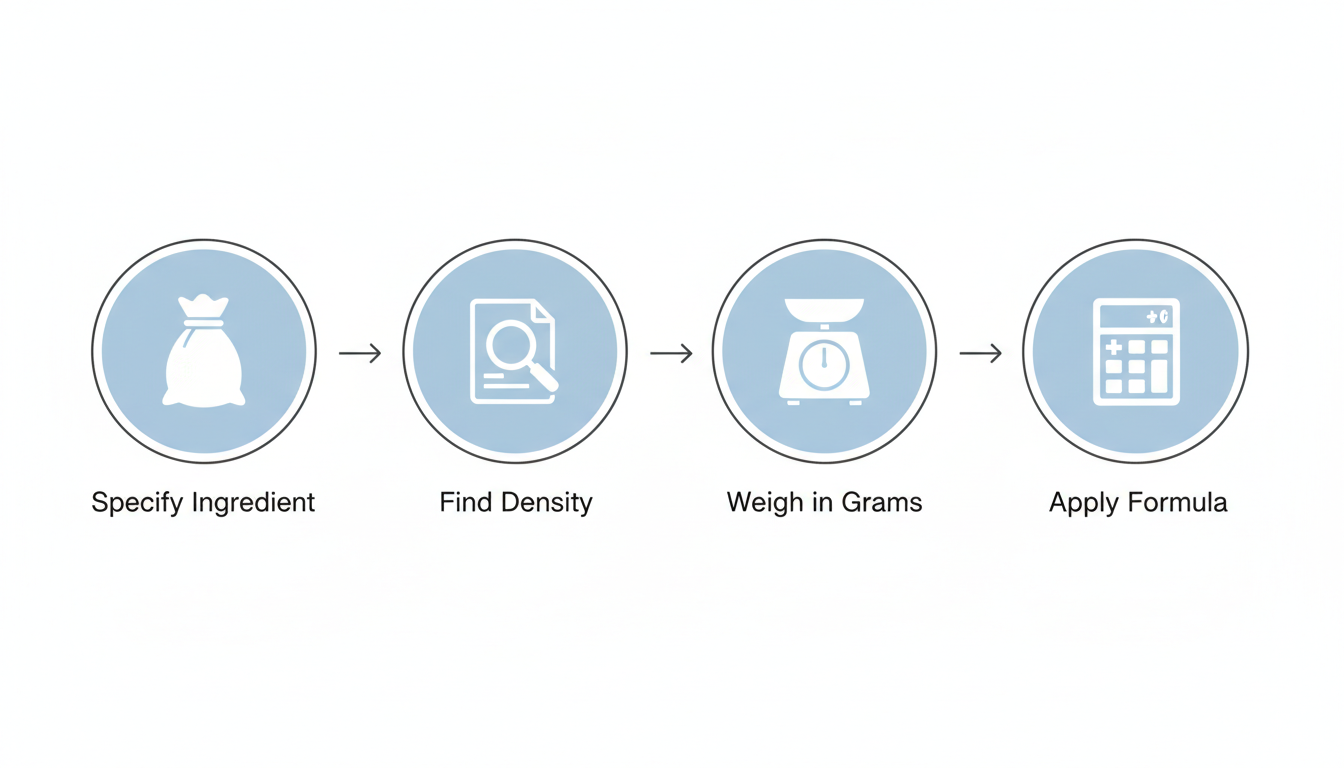
- Step 1: Identify the Exact Ingredient. Don’t just look for “flour.” Is it all-purpose, bread, cake, or whole wheat? Is your sugar granulated or powdered? Specificity is key, as their densities are wildly different.
- Step 2: Find the Ingredient’s Density. This is your one research task. Use our chart above or search online. For the most authoritative data, especially for raw ingredients, the USDA FoodData Central is an incredible resource used by nutritionists and food scientists.
- Step 3: Weigh Your Ingredient in Grams. This is where your digital kitchen scale comes in. Place your bowl on the scale, hit the “tare” or “zero” button to ignore the bowl’s weight, then add your ingredient until you hit the target number of grams from your recipe. It’s fast and perfectly accurate.
- Step 4: Plug Your Numbers into the Formula. Grab your phone’s calculator and use the formula: Quarts = Grams / (Density × 946.353). The number you get is the precise volume you need in US liquid quarts.
Why a Kitchen Scale Is Your Secret Weapon
If you take only one thing away from this article, let it be this: buy a digital kitchen scale.
I’ve seen it play out hundreds of times. A baker struggles with inconsistent results, blaming their oven or their ingredients. Then they invest $15 in a digital scale, and suddenly, everything just… works. It’s the single biggest upgrade you can make to your kitchen for the least amount of money.
Why? Because measuring dry ingredients by volume (with cups) is a recipe for disaster. Here’s a real-world scenario:
- Scoop Method: You dip your measuring cup directly into the flour bag and level it off. This compacts the flour. You might get 150 grams.
- Spoon & Level Method: You use a spoon to lightly fill the measuring cup, then level it. This keeps the flour airy. You might get 120 grams.
That’s a 25% difference! In a delicate cake, that’s the difference between fluffy perfection and a hockey puck. A scale eliminates this variable completely. 200 grams is always 200 grams. It’s the ultimate guarantee of consistency, and it’s how every single professional bakery and restaurant operates.
⚠️ Watch Out
Never use a liquid measuring cup (like a Pyrex jug) for dry ingredients. They are designed for you to read the volume at eye level, accounting for the liquid’s meniscus. They are notoriously inaccurate for measuring flour, sugar, or powders.
Warning: Not All Quarts Are Created Equal
Just when you thought you had it all figured out, there’s one more curveball. The word “quart” can mean different things depending on where your recipe comes from. It’s crucial to know the difference.
This is a common source of confusion, especially when using recipes from the UK or older American cookbooks. According to the National Institute of Standards and Technology (NIST), standardized measurements are vital for commerce and science, but culinary traditions vary.
| Quart Type | Region | Volume (in mL) | Common Use |
|---|---|---|---|
| US Liquid Quart | United States | ~946 mL | The default for almost all modern US recipes (milk, water, oil). |
| US Dry Quart | United States | ~1101 mL | Rare in recipes; used for measuring produce like berries or mushrooms. |
| Imperial Quart | United Kingdom | ~1137 mL | Used in UK recipes. It’s about 20% larger than a US liquid quart! |
💡 Pro Tip
How can you tell which quart a recipe means? Check the source! If the recipe is from a UK-based blog, author, or TV show (like The Great British Bake Off), it’s almost certainly using Imperial measurements. If it’s from the US, assume US Liquid Quart unless it explicitly says “dry quart.”
⚠️ Watch Out
Be very skeptical of any online “grams to quarts” converter that gives you an instant answer without asking what ingredient you’re converting. These tools are almost always programmed to only convert for water, making them dangerously inaccurate for flour, sugar, or oil.
❓ Frequently Asked Questions
How many grams are in a quart of water?
Since water’s density is about 1 g/mL and a US liquid quart is 946.353 mL, there are approximately 946 grams in a quart of water. This is the simplest conversion because the density is one.
Is a gram a measure of weight or volume?
A gram is a unit of mass. On Earth, we use the terms mass and weight interchangeably in everyday conversation. It is not a measure of volume, which is the space something occupies (measured in quarts, liters, etc.). For a deeper dive into the physics, the concept of density is key.
Why do American recipes still use cups and quarts?
It’s a matter of tradition. In the late 19th century, the Boston Cooking School, led by Fannie Farmer, popularized the use of level-volume measurements (cups, tablespoons) in American home kitchens. This system became standard long before the metric system was widely adopted elsewhere for its scientific precision.
What if I can’t find the density for a specific ingredient?
If you’re converting a common ingredient like a different type of flour or sugar, try finding a similar ingredient on our chart for a close estimate. For a more complex item like a blended protein powder, your best bet is to measure out exactly one cup, weigh that amount in grams, and then multiply by four to get a very accurate grams-per-quart measurement for that specific product.
Is a US dry quart bigger than a US liquid quart?
Yes, it is. A US dry quart is approximately 1101 mL, while a US liquid quart is only 946 mL. This is why you should never use them interchangeably. Fortunately, dry quarts are very rarely called for in modern cooking recipes.
Your Newfound Superpower: Precision Cooking
The journey from grams to quarts isn’t about memorizing numbers. It’s about understanding a single, powerful concept: the link between mass, volume, and density. Once you see it, you can’t unsee it. You’re no longer at the mercy of confusing recipe formats.
You now have the knowledge and the formula to tackle any conversion with confidence. You understand why precision matters and how a simple tool can transform your results from inconsistent to incredible.
So, what’s your next step? It’s simple. Go buy a digital kitchen scale. It’s the best $15 you’ll ever spend on your kitchen. Stop guessing and start knowing. Your future self—and anyone who tastes your food—will thank you for it.