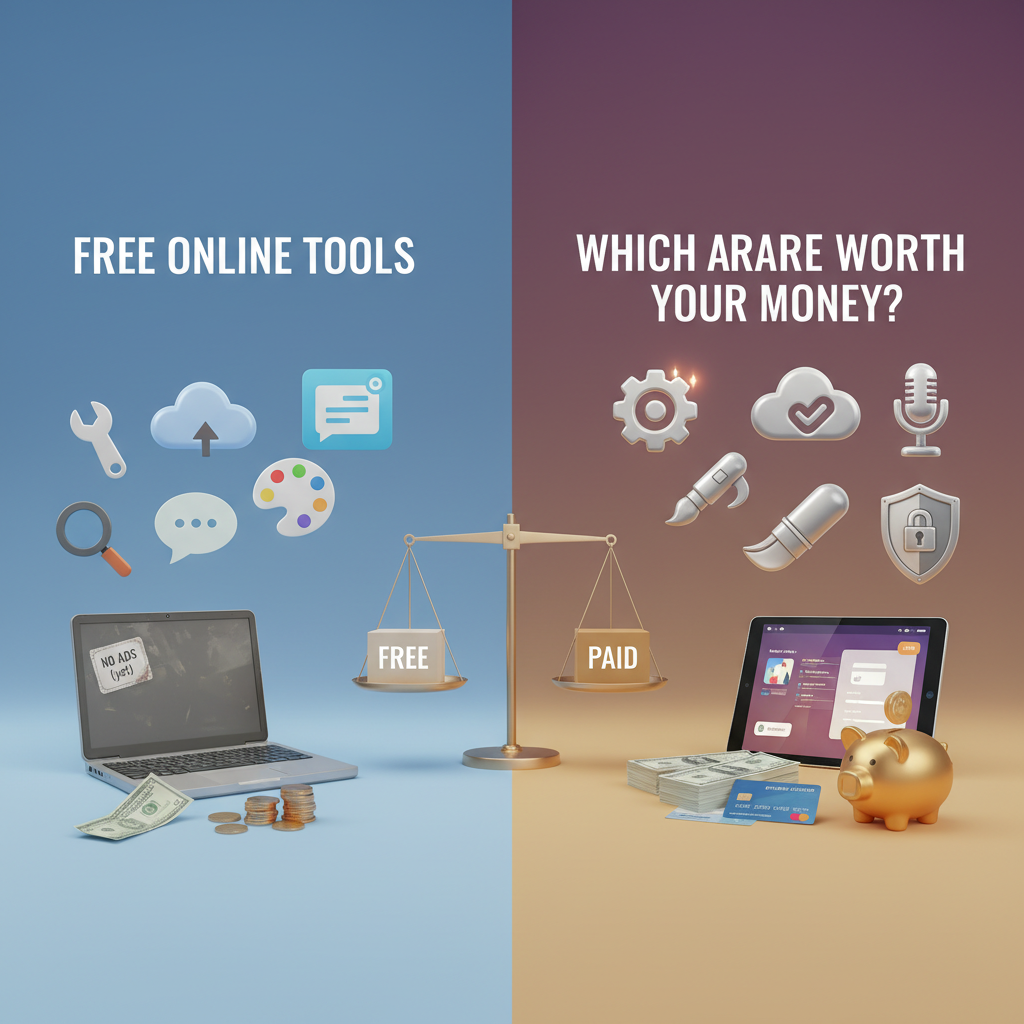
Understanding the Free vs Paid Online Tools Dilemma
In today’s digital landscape, we are constantly bombarded with options for software, apps, and platforms. Whether you are a student, a freelancer, or a business owner, the debate of free vs paid online tools is a recurring theme. We all love the idea of getting something for nothing, but as the saying goes, “if you aren’t paying for the product, you are the product.” However, that isn’t always true in the world of utility-based software. Many high-quality tools offer incredible value without costing a dime, while others demand a subscription fee that can significantly impact your monthly budget.
The decision to upgrade from a free version to a premium one often hinges on a few critical factors: your specific needs, the frequency of use, and the level of security required. In this guide, we will dive deep into the world of free vs paid online tools to help you determine where to allocate your hard-earned money and where to embrace the generosity of the open-web community. From text processing to advanced image generation, understanding the ROI of your digital stack is essential for modern productivity.
When to Rely on Free vs Paid Online Tools for Productivity
For many daily tasks, free tools are not just “good enough”—they are often superior because of their simplicity and lack of bloatware. If you are performing occasional tasks like checking the difference between two documents or organizing a few pages of a PDF, there is rarely a need to pay for a heavy enterprise suite. This is where platforms like Tools River shine, providing accessible utilities for everyone.
Take, for example, the need to compare text. Instead of paying for a complex legal-grade document comparison software, you can use a Text Converter Tool for free. These tools allow you to spot changes instantly without a monthly subscription. Similarly, for those managing documents, a free PDF Tool can handle tasks like merging, splitting, or reordering pages perfectly. When your needs are transactional and occasional, the free route is almost always the smarter financial choice.
The Case for Free Tools
Free tools are ideal for one-off tasks, personal projects, and users who prioritize simplicity over deep feature sets. They offer low barriers to entry and zero financial risk.
The Case for Paid Tools
Paid versions are designed for professionals who need advanced automation, bulk processing, high-level security, and dedicated customer support to ensure workflow continuity.
The Hybrid Approach
Many users find success using free tools for 80% of their work and investing in 1 or 2 “power tools” that directly contribute to their primary source of income.
Evaluating Free vs Paid Online Tools for Creative Work
Creative professionals often face the toughest choices. In the realm of image generation and editing, the gap between free and paid can be massive. While free AI generators might produce impressive results, they often lack the fine-tuned controls, high-resolution exports, and commercial usage rights found in paid tiers. If you are just making a social media post for fun, a free tool is great. However, if you are designing a brand identity, the investment in a paid tool ensures consistency and legal protection.
According to research from Gartner, the shift toward SaaS (Software as a Service) has made it easier for users to test premium features through “freemium” models. This allows you to experience the value before committing. For instance, you might use a free image cropper for basic edits but pay for a premium AI suite when you need to generate complex assets from scratch. The key is to identify the “pain point” that only a paid tool can solve.
The Financial Impact: ROI of Free vs Paid Online Tools
When we talk about free vs paid online tools, we must talk about Return on Investment (ROI). A tool that costs $20 a month but saves you 5 hours of manual work is essentially paying for itself. If your hourly rate is $50, you’ve gained $230 in value. Conversely, spending time trying to “hack” a free tool to do something it wasn’t designed for is a hidden cost known as “time poverty.”
Consider the following comparison of features that usually separate the two categories:
- Batch Processing: Paid tools often allow you to process hundreds of files at once, whereas free tools often limit you to one by one.
- Cloud Storage: Premium versions usually include synced cloud storage, making your work accessible anywhere.
- Ad-Free Experience: Free tools often rely on ads, which can be distracting or even pose security risks if the ad network is poorly managed.
- Security & Privacy: Paid tools generally offer better data encryption and stricter privacy policies, as their revenue comes from you, not from selling your data.
Comparing Popular Categories: Where Should You Spend?
Not all software categories are created equal. In some niches, the free options are so good that paying feels like a waste. In others, the free versions are merely “teasers” that are barely functional. Let’s break down where the free vs paid online tools debate currently stands in major industries.
1. SEO and Marketing Tools
This is an area where paying usually pays off. While you can use free keyword research tools, the depth of data provided by premium platforms is unmatched. They offer historical data, competitor analysis, and backlink tracking that free tools simply cannot afford to maintain. However, for quick checks, a free tool to calculate potential earnings, like a YouTube Money Calculator, is perfectly adequate for a quick reality check on your channel’s growth.
2. Content Creation and Writing
Basic grammar checkers are free and excellent. However, if you are a professional author or editor, the “pro” versions offer stylistic suggestions, plagiarism checks, and tone adjustments that elevate your writing. Here, the decision depends on your audience. For a casual blog, free is fine. For a corporate whitepaper, paid is a necessity.
PDF & Document Management
Free: Tools River PDF Organizer.
Paid: Adobe Acrobat Pro.
Verdict: Stick to free unless you need legal e-signatures and complex form creation.
Graphic Design
Free: Canva (Free Tier) or GIMP.
Paid: Adobe Creative Cloud.
Verdict: Paid is essential for high-end professional design and print media.
Project Management
Free: Trello or Notion (Personal).
Paid: Monday.com or Asana Business.
Verdict: Free is great for individuals; paid is vital for teams over 5 people.
The Security Aspect of Free vs Paid Online Tools
One often overlooked factor in the free vs paid online tools discussion is cybersecurity. Maintaining a secure server infrastructure is expensive. Companies that offer tools for free have to cut costs somewhere. This might mean they don’t update their security patches as often, or they might collect more metadata about your usage than a paid provider would. For sensitive business documents, paying for a reputable service provides a layer of legal and technical protection that is worth every penny.
According to a report by Forbes, data privacy is becoming a primary differentiator for premium software. Users are increasingly willing to pay a premium to ensure their data isn’t being harvested for advertising profiles. If you are handling client data or proprietary information, the “free” price tag might come with a hidden risk that your business cannot afford.
Conclusion: Finding Your Balance
In the end, the choice between free vs paid online tools isn’t about which is objectively better, but which is better for you at this moment. If you are starting out, leverage every free resource available. Use the text checkers, the PDF organizers, and the basic editors to keep your overhead low. As your needs grow and your time becomes more valuable than your money, start transitioning your core workflow to paid tools that offer speed, security, and scale.
The smartest digital citizens use a “stacked” approach: a foundation of reliable free utilities for general tasks and a selective few premium subscriptions for their most critical work. By being intentional with your software choices, you can maximize your productivity without draining your bank account.
Frequently Asked Questions
It depends on the provider. Reputable free tools like those on Tools River are safe for general use, but for highly sensitive or legal documents, a paid service with end-to-end encryption is often recommended for better compliance.
You should upgrade when a free tool’s limitations (like file size, daily limits, or lack of features) start costing you more in time than the subscription price. If you use the tool daily for your primary job, it’s usually worth paying for.
Not necessarily. For specific tasks like text difference checking or basic PDF merging, free tools often provide the exact same output as paid ones without the unnecessary complexity.
Most reputable SaaS companies offer a 7-to-30-day money-back guarantee or a free trial. Always check the refund policy before entering your credit card details.
Yes, hidden costs can include time spent dealing with ads, potential data privacy trade-offs, and the lack of professional support if something goes wrong with your file.