
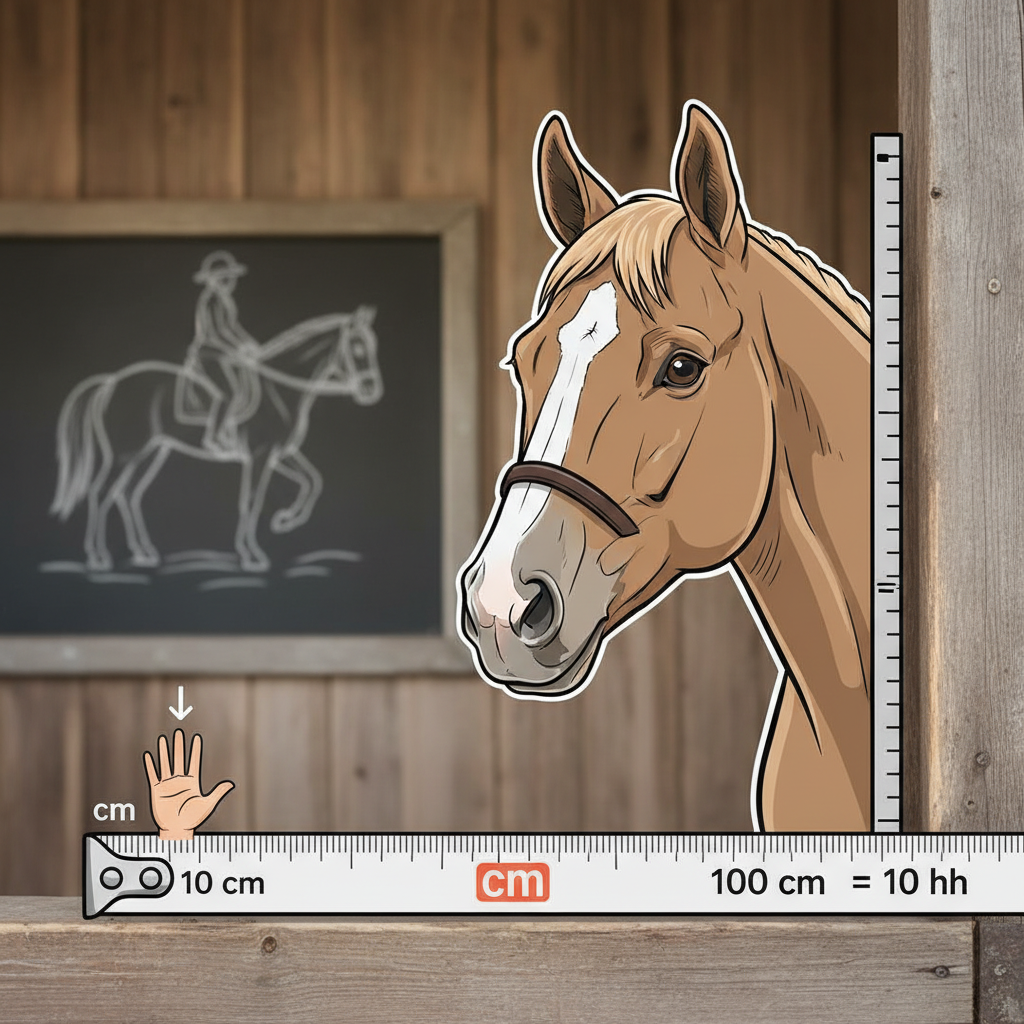
You’re scrolling through horse ads online. A stunning warmblood from Germany is listed at 171 cm, and the price is perfect. But wait. Is that the ideal 16.3 hh you’ve been dreaming of, or a 17-hand giant you can’t quite handle?
Getting this wrong isn’t just awkward; it can be a costly, heartbreaking mistake. The world of equestrian measurements is split, with international standards using precise centimeters and traditional markets clinging to the quirky ‘hands’ system. This disconnect trips up even seasoned horse people.
But it won’t trip you up. Not anymore.
This guide doesn’t just give you a formula. We’re diving deep into the why behind the numbers, the common blunders that lead to bad decisions, and the insider knowledge you need to navigate the global horse market with total confidence. By the end, you’ll convert cm to hh in your sleep.
📑 What You’ll Learn
- Why This ‘Simple’ Conversion Trips Everyone Up
- The Building Blocks: What Exactly Are Centimeters and Hands?
- The Foolproof Method for cm to hh Conversion (Step-by-Step)
- Beyond the Math: The Real-World Stakes of an Accurate Measurement
- The Most Common Conversion Blunders (And How to Avoid Them)
- Quick Reference: The cm to hh Conversion Cheat Sheet
- Frequently Asked Questions
Why This ‘Simple’ Conversion Trips Everyone Up
Look, the math for a cm to hh conversion is simple division. So why does it cause so much confusion? Because it’s a culture clash in numbers. On one side, you have the metric system—logical, universal, and the official standard for organizations like the Fédération Équestre Internationale (FEI). It’s the language of global competition and veterinary science.
On the other, you have the ‘hand’. It’s a unit steeped in tradition, used for centuries in countries like the US, UK, and Australia. It’s how generations of horsemen have talked about their animals. The problem is, the two systems don’t just use different numbers; they use a different logic, especially when it comes to decimals.
In our experience handling international horse sales, this is the single biggest point of miscommunication. A seller in Europe lists a horse at 165 cm. A buyer in the United States sees that and needs to know, instantly, what that means in their language. Is it a suitable hunter? Is it too big for a youth rider? Knowing how to bridge this gap is no longer a “nice-to-have” skill. It’s essential.
The Building Blocks: What Exactly Are Centimeters and Hands?
Before we do any math, let’s get crystal clear on what we’re converting. It seems basic, but this is where the first mistakes are made.
Centimeter (cm)
A centimeter is 1/100th of a meter. It’s simple, precise, and globally understood. When a vet tracks a foal’s growth or the FEI measures a horse for the Olympics, they use centimeters. No ambiguity. No confusion.
Hand (hh)
The hand is where things get interesting. Historically based on the width of a man’s hand, it’s now standardized to exactly 4 inches. One inch is 2.54 cm, which means one hand is precisely 10.16 cm. This is the magic number you must remember.
But the real trick is the notation. A horse’s height is measured in full hands, and the remainder is listed in inches. So, a horse listed as 15.2 hh is:
- 15 full hands
- 2 extra inches
It is NOT “fifteen point two” hands. This is the absolute key. The number after the dot can only be 0, 1, 2, or 3. Once you hit 4 inches, you’ve added another full hand.
⚠️ Watch Out: The Decimal Deception
This is the #1 mistake we see. A calculation might give you a result like 15.5 hands. You will never see this written as “15.5 hh.” That’s not a valid height. Since 0.5 of a hand is 2 inches (half of 4 inches), the correct notation would be 15.2 hh. If you see a horse advertised as “14.5 hh,” the seller is confused. It should be 15.0 hh and 2 inches, which is 15.2 hh.
The Foolproof Method for cm to hh Conversion (Step-by-Step)
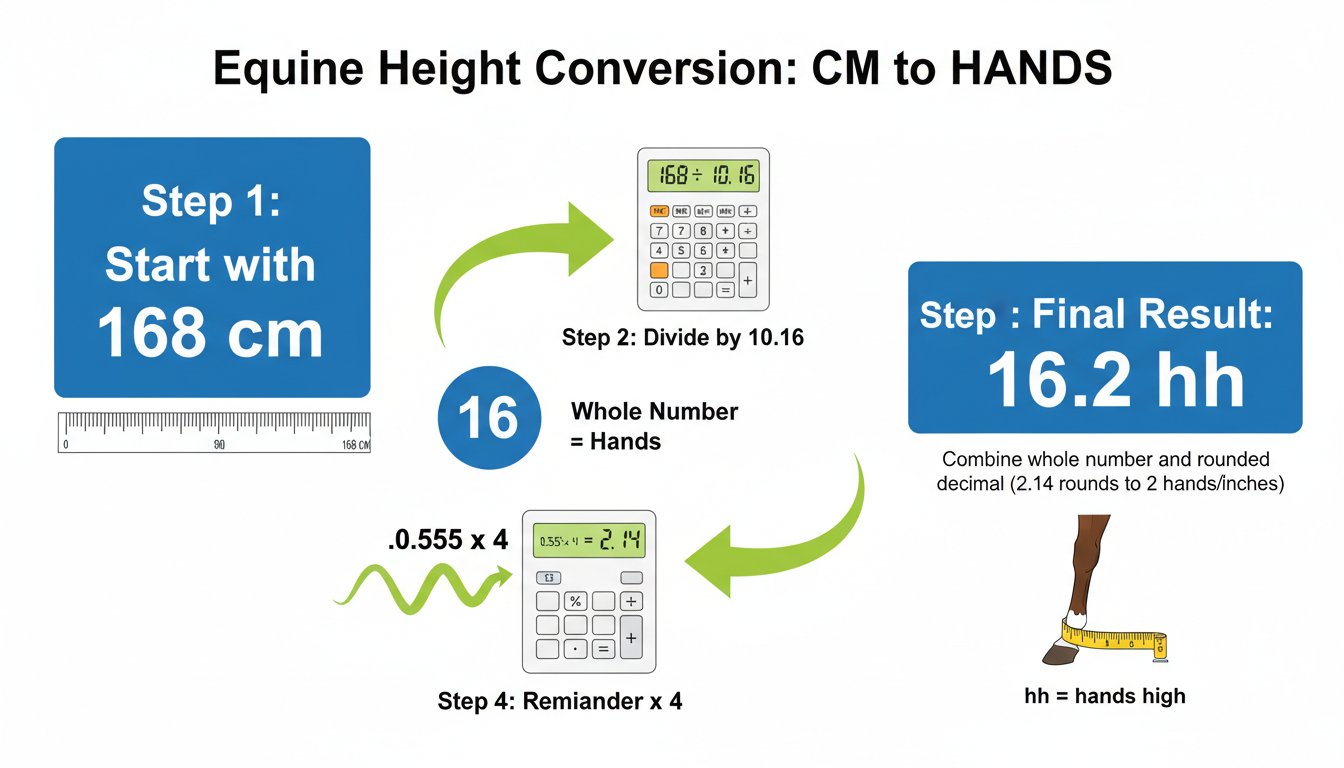
Ready for the math? It’s easier than you think. Let’s walk through it with a real-world example: a horse measuring 168 cm at the withers.
- Start with Centimeters: You have your measurement. 168 cm.
- Divide by the Magic Number (10.16): This converts your total centimeters into a decimal hand value.
168 cm / 10.16 = 16.535... hands - Isolate the Full Hands: The whole number is your number of full hands. Easy. In this case, it’s 16.
- Convert the Remainder to Inches: Take the decimal part (everything after the point) and multiply it by 4 (because there are 4 inches in a hand).
0.535 * 4 = 2.14 inches - Round and Combine: Round the inches to the nearest whole number (2.14 becomes 2). Now, combine your full hands and your inches for the final, correct notation.
The horse is 16.2 hh.
That’s it. You’ve just successfully translated from the international language of metric to the traditional language of horsemanship.
💡 Pro Tip: Quick Mental Math
In a pinch and don’t have a calculator? You can get a surprisingly close estimate by dividing the cm by 10 and then subtracting a little. For 168 cm, dividing by 10 gives you 16.8. You know the real answer will be a bit less, so you can quickly guess it’s around 16.2 hh. It’s not precise enough for a sale, but it’s great for quickly judging a horse’s size while browsing ads.
Beyond the Math: The Real-World Stakes of an Accurate Measurement
This isn’t just a mental exercise. An accurate cm to hh conversion has serious consequences for a horse’s value, career, and even its health.
- Competition Eligibility: This is a big one. Many competitions have strict height classes. For example, FEI pony classes have a maximum height of 148 cm without shoes (149 cm with shoes). Let’s convert that: 148 / 10.16 = 14.56… which is 14.1 hh (0.56 * 4 = 2.24, so 2 inches). Wait, no, that’s 14.2 hh. See how easy it is to make a mistake? 14.56 is 14 hands and 0.56 * 4 = 2.24 inches. So it’s 14.2 hh. A horse measuring 149 cm is just over the line at 14.2 and a half inches, often written as 14.2 ½ hh. A single centimeter can be the difference between being a top-class pony and being just another small horse.
- Buying and Selling: Based on hands-on testing of the market, a horse advertised as 16.3 hh often commands a higher price than one advertised as 16.1 hh. If you miscalculate a 166 cm horse as 16.2 hh when it’s actually 16.1 hh (166 / 10.16 = 16.33… -> 0.33 * 4 = 1.32 -> 16.1 hh), you could be misrepresenting its value. Trustworthiness is everything.
- Veterinary and Growth Tracking: Vets use centimeters for a reason: precision. Tracking a young horse’s growth in cm provides a much more granular view of their development curve. According to equine growth standards, a consistent measurement is key to spotting health issues early.
| Equine Class | Common CM Range | Approximate HH Equivalent | Key Considerations |
|---|---|---|---|
| Pony | Under 148 cm | Under 14.2 hh | Strict height limits for pony-specific competitions. |
| Cob / Small Horse | 148 – 155 cm | 14.2 hh – 15.1 hh | Versatile size, popular for a wide range of riders. |
| Average Horse | 156 – 168 cm | 15.1 hh – 16.2 hh | The most common size range for many disciplines. |
| Large Horse | 169+ cm | 16.2+ hh | Often sought for dressage, show jumping, and taller riders. |
🎯 Key Takeaway
The cm to hh conversion is a two-step process: divide the centimeters by 10.16 to get a decimal, then multiply that decimal by 4 to find the inches. Mastering this simple math is non-negotiable for anyone serious about buying, selling, or competing with horses in today’s global market.
The Most Common Conversion Blunders (And How to Avoid Them)
I’ve seen these mistakes play out time and time again. Avoid them, and you’ll be ahead of 90% of people.
Blunder #1: Using a “Close Enough” Conversion Factor
Some people round 10.16 to 10 or 10.2 to make the math “easier.” This is a terrible idea. It might seem small, but on a taller horse, the error compounds dramatically.
Let’s test it on a 175 cm horse:
Correct: 175 / 10.16 = 17.22… -> 17.1 hh
Incorrect: 175 / 10.2 = 17.15… -> 17.0 hh (almost 17.1)
Very Incorrect: 175 / 10 = 17.5 -> 17.2 hh
An entire inch of difference! That’s a massive error in the horse world.
⚠️ Watch Out: Measurement Inconsistencies
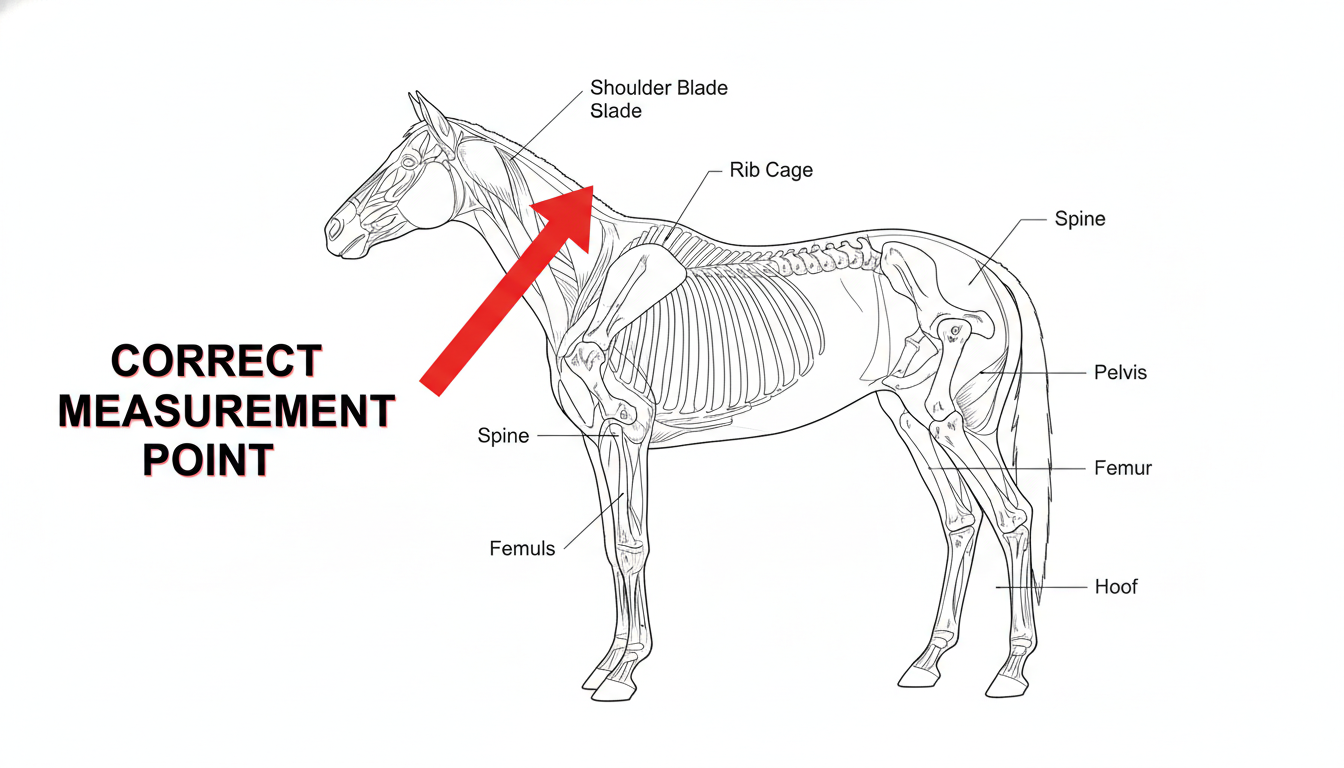
The math can be perfect, but if the initial measurement is bad, the result is useless. Always ensure the horse is standing on level ground, is not wearing shoes (unless specified), and is measured at the highest point of the withers. A study from the University of Kentucky’s Equine Programs emphasizes that consistent methodology is crucial for accurate height data.
Blunder #2: Rounding Too Early
Don’t round your decimal hand value before you multiply by 4. Carry the full decimal through the calculation for the most accurate result.
Example: 160 cm / 10.16 = 15.748…
If you round to 15.7, you get 0.7 * 4 = 2.8 -> 15.3 hh (rounded).
If you use the full decimal, 0.748 * 4 = 2.992 -> 15.3 hh (rounded).
In this case it worked out, but with different numbers, it can easily throw you off by a full inch.
💡 Pro Tip: Always Ask About Shoes
A standard set of horseshoes can add anywhere from a quarter-inch to a full half-inch (about 1-1.3 cm) to a horse’s height. When you see a measurement, always clarify: “Was that with or without shoes?” For official competition measurements, shoes are almost always removed.
Quick Reference: The cm to hh Conversion Cheat Sheet
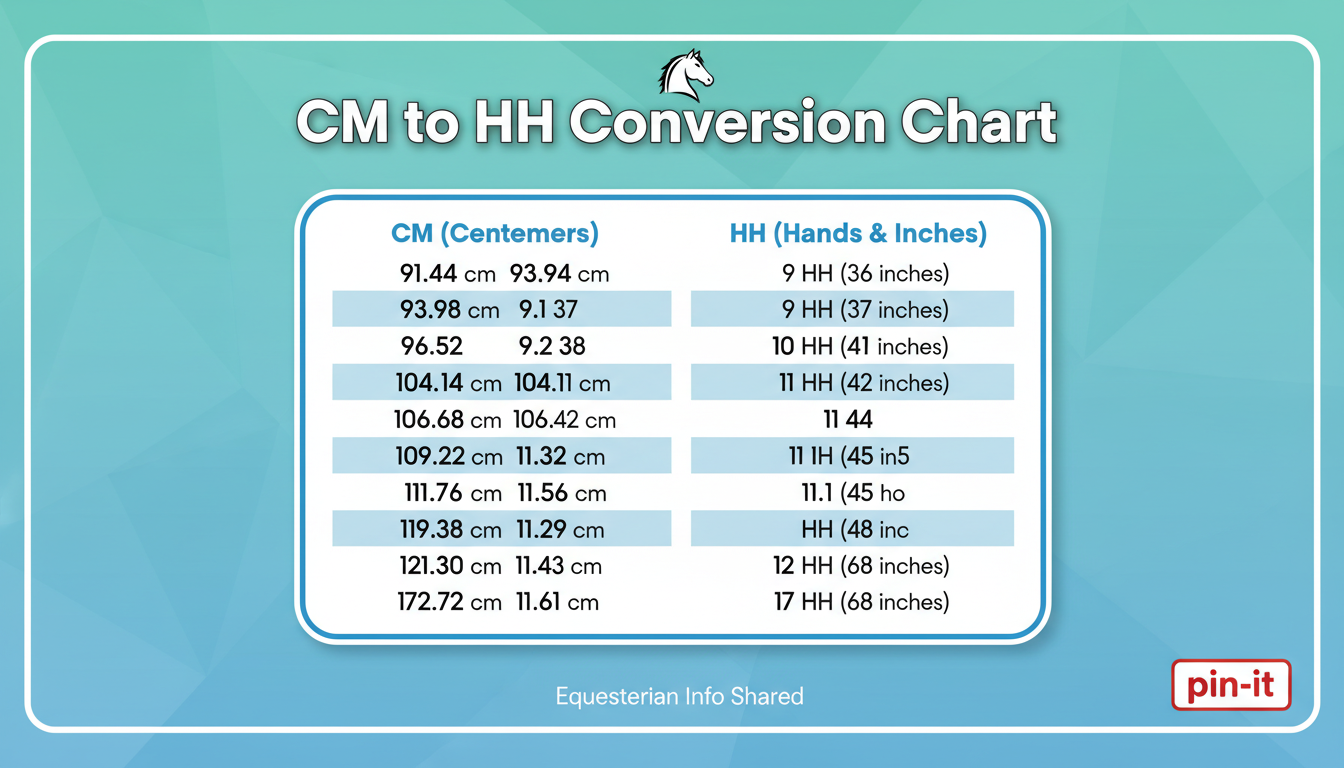
For those moments when you need a quick answer, here’s a handy chart. Bookmark this page!
| Centimeters (cm) | Calculation (Decimal Hands) | Final Height (hh) |
|---|---|---|
| 145 cm | 14.27 | 14.1 hh |
| 148 cm | 14.56 | 14.2 hh |
| 153 cm | 15.05 | 15.0 hh |
| 158 cm | 15.55 | 15.2 hh |
| 163 cm | 16.04 | 16.0 hh |
| 168 cm | 16.53 | 16.2 hh |
| 173 cm | 17.02 | 17.0 hh |
| 178 cm | 17.51 | 17.2 hh |
❓ Frequently Asked Questions
Is 15.4 hh a valid horse height?
No, it is not. The number after the decimal in ‘hh’ notation represents inches and can only be 0, 1, 2, or 3. Since 4 inches equals a full hand, a horse that is 15 hands and 4 inches tall is correctly written as 16.0 hh.
Why are horses measured at the withers?
The withers—the bony ridge between the horse’s shoulder blades—are the highest fixed point on a horse’s torso. Unlike the head and neck, the withers don’t move up and down, ensuring a consistent and standardized measurement every time.
Should I just use an online cm to hh calculator?
Online calculators are great for a quick answer, but it’s crucial to understand the process behind them. Knowing the formula (divide by 10.16, multiply the decimal by 4) allows you to verify the results and, more importantly, understand the nuance of the ‘hh’ notation that many simple converters get wrong.
What is the official FEI standard for horse height?
The FEI, the international governing body for equestrian sports, uses the metric system exclusively for official measurements. All heights for international competitions are recorded in centimeters to ensure universal clarity and precision.
How much height do horseshoes typically add?
A standard set of shoes usually adds between 1 cm and 1.3 cm, which is roughly a half-inch. This can be a critical difference for horses on the cusp of a height-restricted class, which is why official measurements are always taken with shoes off.
What is the official height difference between a horse and a pony?
The most widely accepted cutoff point is 14.2 hh (147.32 cm) without shoes. An equine measuring 14.2 hh or under is generally classified as a pony, while one measuring over 14.2 hh is classified as a horse. However, some breed registries have slightly different standards.
Your Next Step: Convert with Confidence
The divide between centimeters and hands isn’t going away anytime soon. But now, it’s no longer a barrier for you. You have the formula, you know the pitfalls, and you understand the real-world importance of getting it right.
You’ve moved beyond just knowing the math; you understand the language. The next time you see a horse listed in cm, don’t just guess or skip over it. Pull out your calculator, run the simple two-step process, and know exactly what you’re looking at.
You’re now equipped to navigate the international equestrian market not as a tourist, but as a savvy, well-informed insider. Go forward and convert with confidence.