
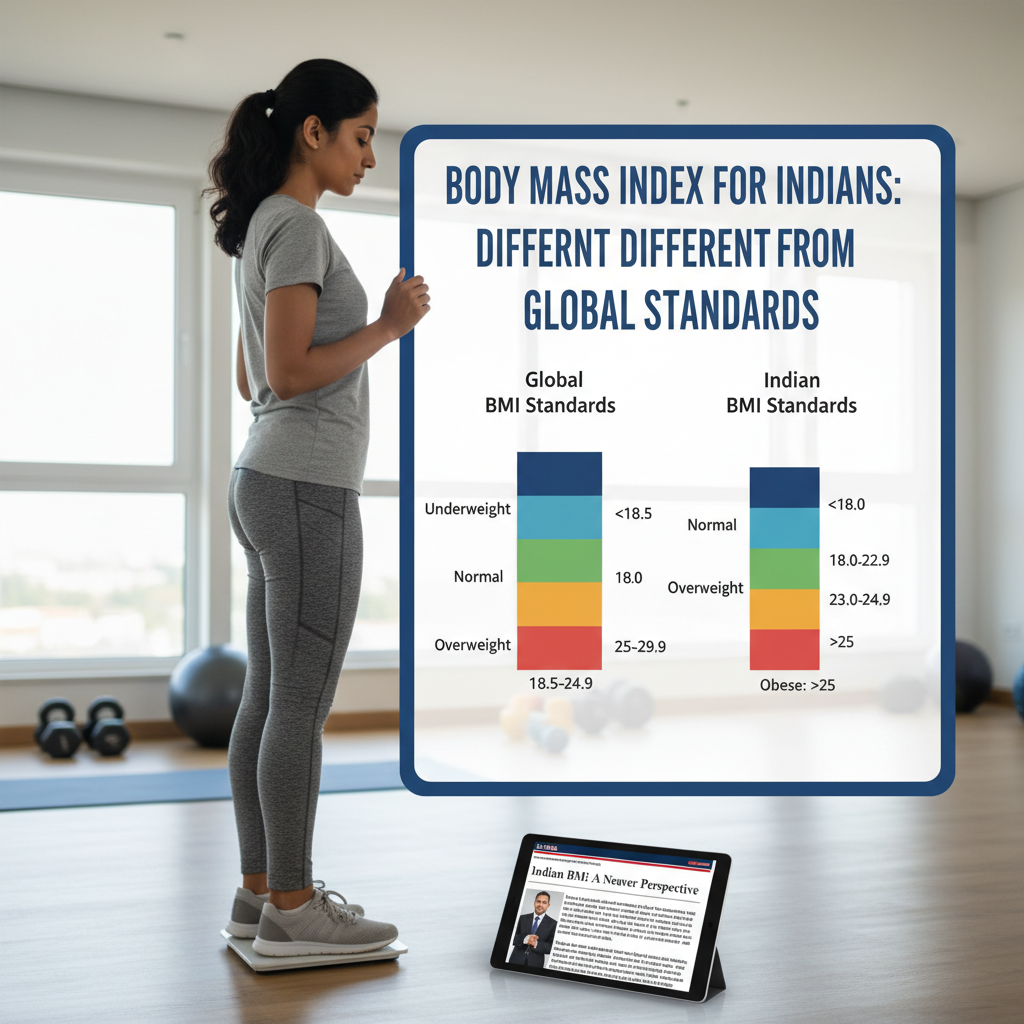
Understanding Why BMI for Indians is Different from Global Standards
For decades, the Body Mass Index (BMI) has been the universal yardstick for measuring whether a person is underweight, normal, overweight, or obese. However, as medical science evolved, researchers noticed a startling trend: people of South Asian descent, particularly Indians, were developing lifestyle diseases like Type 2 diabetes and hypertension at much lower BMI levels than their Western counterparts. This realization led to the critical understanding that bmi for indians different global standards are necessary to accurately reflect the metabolic health of the population.
The standard BMI categories established by the World Health Organization (WHO) define overweight as a BMI of 25 or more and obesity as 30 or more. But for an Indian individual, these numbers can be dangerously misleading. Because of a unique body composition often referred to as the ‘Asian Indian Phenotype,’ the risk for cardiovascular diseases begins to skyrocket even when an individual appears ‘thin’ by global standards. In this comprehensive guide, we will explore the biological, genetic, and environmental reasons why these standards differ and how you can accurately assess your health.
The Global Standard (WHO)
Underweight: Below 18.5
Normal: 18.5 – 24.9
Overweight: 25.0 – 29.9
Obese: 30.0 and above
The Indian Standard (Revised)
Underweight: Below 18.0
Normal: 18.0 – 22.9
Overweight: 23.0 – 24.9
Obese: 25.0 and above
The Science Behind the BMI for Indians Different Global Standards
The primary reason for the bmi for indians different global standards lies in the distribution of body fat. Indians tend to have a higher percentage of body fat and lower muscle mass compared to Caucasians of the same age and gender. Even more critically, Indians are more prone to ‘visceral adiposity’—the accumulation of fat around the internal organs in the abdominal area. This is often called the ‘Thin-Fat Indian’ syndrome.
Visceral fat is metabolically active and far more dangerous than subcutaneous fat (fat stored just under the skin). It releases inflammatory cytokines that lead to insulin resistance, which is the precursor to diabetes. Because this fat is concentrated in the belly, an Indian person might have a ‘normal’ global BMI but still possess a high risk for metabolic syndrome. This biological reality is why health authorities in India, supported by the World Health Organization, have lowered the thresholds for overweight and obesity for South Asians.
The Role of Genetics and Evolution
Genetic factors play a significant role in why bmi for indians different global standards are a clinical necessity. Some theories suggest that historical periods of famine in the Indian subcontinent led to the development of ‘thrifty genes.’ These genes are exceptionally efficient at storing energy as fat to survive periods of food scarcity. In the modern era of calorie-dense diets and sedentary lifestyles, this genetic advantage has become a disadvantage, leading to rapid fat accumulation even with moderate caloric intake.
Metabolic Risks and BMI for Indians Different Global Standards
When we ignore the fact that bmi for indians different global standards exist, we miss the window for early intervention. Clinical studies have shown that the risk of developing Type 2 diabetes is significantly higher for Indians at a BMI of 23 than it is for Europeans at the same level. In fact, an Indian with a BMI of 24 might have the same metabolic risk profile as a Caucasian with a BMI of 30.
This discrepancy is why the Indian Council of Medical Research (ICMR) and other national health bodies emphasize the 23 kg/m² cutoff for overweight. By identifying risks earlier, healthcare providers can encourage lifestyle changes—such as diet modification and increased physical activity—before chronic conditions become unmanageable. If you are curious about your current standing, using a specialized Indian BMI Calculator can provide a more accurate assessment of your health status based on these localized guidelines.
Diabetes Risk
Indians develop diabetes nearly a decade earlier than Western populations, often at a lower BMI, due to higher insulin resistance.
Cardiovascular Health
Heart disease risk increases sharply once BMI crosses 23 in Indians, necessitating earlier screenings and preventive care.
Hypertension
High blood pressure is closely linked to abdominal obesity, which is prevalent in Indians even within ‘normal’ BMI ranges.
Beyond BMI: The Importance of Waist Circumference
While understanding why bmi for indians different global standards are used is helpful, BMI itself has limitations. It does not distinguish between muscle and fat. For the Indian population, waist circumference is often a better predictor of health outcomes than BMI alone. Because of the tendency toward central obesity, measuring the waist provides a direct insight into visceral fat levels.
For Indian men, a waist circumference of more than 90 cm (approx. 35.5 inches) is considered a risk factor. For Indian women, the cutoff is even lower at 80 cm (approx. 31.5 inches). When combined with the revised Indian BMI standards, these measurements provide a powerful tool for self-assessment. A person might have a BMI of 22 (normal) but a waist circumference of 95 cm, indicating they are still at high risk for metabolic complications.
The Waist-to-Hip Ratio
Another metric that complements the bmi for indians different global standards is the waist-to-hip ratio. This measures the proportion of fat stored on your waist versus your hips and buttocks. A higher ratio indicates more abdominal fat. For Indians, keeping this ratio below 0.90 for men and 0.80 for women is generally recommended by health experts to minimize the risk of chronic diseases.
How to Manage Your Health Using Indian BMI Standards
Knowing that the bmi for indians different global standards apply to you is the first step toward a healthier life. Once you realize that the ‘buffer zone’ for weight gain is smaller for Indians, you can take proactive steps to maintain your health. Here are some actionable insights based on the revised guidelines:
- Prioritize Protein: Since Indians naturally have lower muscle mass, increasing lean protein intake (dal, paneer, eggs, lean meats) can help build muscle and improve metabolic rate.
- Reduce Refined Carbs: High consumption of white rice and refined flour (maida) contributes to abdominal fat. Switch to whole grains like millets, oats, and brown rice.
- Strength Training: To combat the ‘Thin-Fat’ phenotype, cardiovascular exercise is not enough. Incorporating resistance training at least twice a week helps build the muscle mass that Indians often lack.
- Regular Monitoring: Don’t wait for symptoms. Check your BMI and waist circumference regularly. If your BMI is over 23, consult a nutritionist or doctor for a metabolic screening.
Why Public Awareness is Crucial
The biggest challenge with bmi for indians different global standards is the lack of public awareness. Many people feel a false sense of security because their BMI is 24, thinking they are well within the ‘normal’ range of 18.5 to 25. In reality, they are already in the overweight category for their ethnicity and may be at risk for pre-diabetes. Public health campaigns and medical practitioners are increasingly working to standardize these Asian-specific cutoffs in clinics across the country.
According to research published in The Lancet, the burden of non-communicable diseases in India is rising rapidly. By acknowledging that our bodies process fat differently and adjusting our health benchmarks accordingly, we can take a significant step toward reversing this trend.
Actionable Step 1
Calculate your BMI using the Indian threshold (Normal is 18-22.9).
Actionable Step 2
Measure your waist circumference at the narrowest point.
Actionable Step 3
If BMI > 23, reduce daily sugar and refined carb intake by 20%.
Conclusion: A Localized Approach to Global Health
In conclusion, the bmi for indians different global standards are not just a minor adjustment; they are a vital clinical tool for the South Asian population. Our unique genetic makeup and body composition require us to be more vigilant about weight gain than other ethnic groups. By sticking to the revised ‘normal’ range of 18.0 to 22.9 and keeping a close eye on abdominal fat, we can significantly reduce the risk of life-altering diseases. Remember, health is not just about the number on the scale, but how that weight is distributed across your body. Stay informed, stay active, and use the right benchmarks for your specific biology.
FAQs
Indians have a unique body composition characterized by higher body fat and lower muscle mass compared to Western populations. This leads to metabolic diseases at lower weight levels, necessitating stricter BMI cutoffs.
For Indians, the healthy or ‘normal’ BMI range is 18.0 to 22.9 kg/m². Anything above 23 is considered overweight, and above 25 is classified as obese.
Both are important, but waist circumference is often a better indicator of health for Indians because it measures visceral (abdominal) fat, which is the primary driver of metabolic diseases in the South Asian phenotype.
You can use any calculator to get the numerical value, but you must interpret the result using the Indian standards (Overweight starts at 23) rather than the global standards (Overweight starts at 25).
No, it simply means our bodies have a different metabolic threshold. With the right diet (higher protein, lower refined carbs) and regular physical activity, Indians can maintain excellent health profiles.