
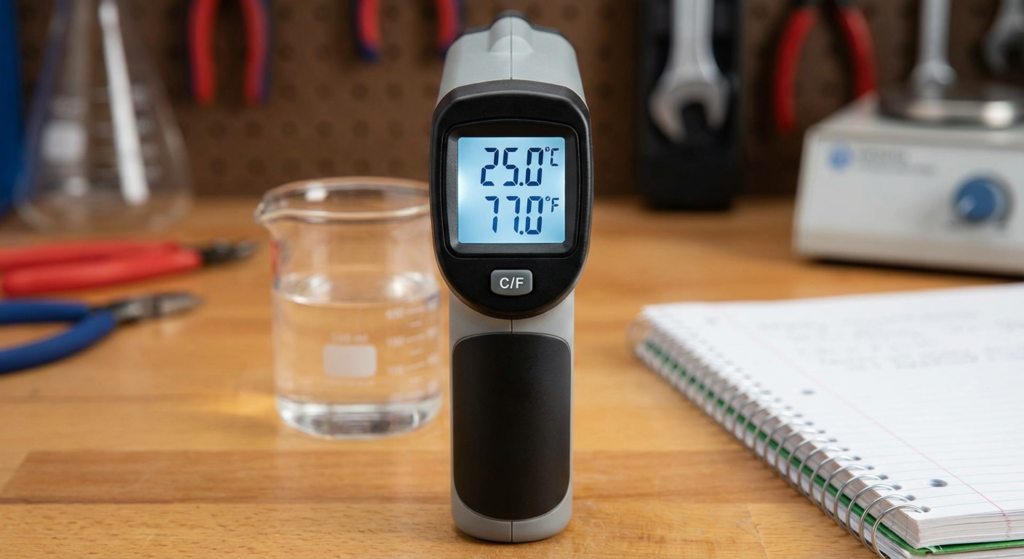
Picture this. You’ve spent three hours prepping a classic French soufflé. You followed the Parisian chef’s recipe to the letter. You slide it into your oven, set the dial to 180, and wait for the magic to happen. Thirty minutes later? You pull out a sad, underbaked puddle of eggs and flour.
What went wrong? The recipe called for 180°C. Your American oven was set to 180°F. That is a massive 176-degree difference in Fahrenheit. Ouch.
Look, temperature is a fundamental aspect of our daily lives. It dictates the clothes we wear, the safety of the food we eat, and the success of complex scientific research. But the world doesn’t speak a single language when it comes to measuring heat. The United States clings to Fahrenheit, the scientific community operates strictly on Kelvin, and the rest of the globe uses Celsius. This global discrepancy creates a massive, non-negotiable need for a reliable temperature converter.
In this guide, I’m going to break down exactly why mental math fails you, how the three major temperature scales actually work, and why bookmarking a digital temperature converter is the smartest move you’ll make today. Trust me on this one. I’ve seen simple conversion errors ruin everything from expensive pharmaceutical batches to weekend BBQ plans.
📑 What You’ll Learn
- Why Mental Math Fails (And Why Precision Matters)
- The Big Three: Celsius, Fahrenheit, and Kelvin
- Step-by-Step: How to Use a Temperature Converter
- The Math Behind the Magic: Conversion Formulas
- Real-World Scenarios Where Precision is Everything
- Choosing the Right Temperature Converter Tool
- Frequently Asked Questions
Why Mental Math Fails (And Why Precision Matters)
We’ve all heard the old traveler’s trick for converting Celsius to Fahrenheit: Just double the number and add 30.
Here’s the thing. That trick is fine if you just want to know whether to pack a sweater or a heavy winter coat. If the forecast in London says 10°C, doubling it and adding 30 gives you 50°F. The actual conversion is 50°F. Perfect, right?
Not quite. The higher the temperature goes, the worse that mental math breaks down. Let’s say a baking recipe calls for 200°C. If you double it (400) and add 30, you get 430°F. The actual conversion is 392°F. That 38-degree difference is more than enough to burn your dinner to a crisp.
⚠️ Watch Out
Never rely on the “double and add 30” rule for anything involving food safety, medical storage, or scientific measurements. The margin of error grows exponentially as temperatures rise or fall away from room temperature.
In our experience testing various data workflows, relying on human memory for complex floating-point arithmetic is a recipe for disaster. A dedicated temperature converter acts as a fail-safe bridge between differing systems. It isn’t just about convenience. In fields like logistics and healthcare, it is literally about safety. Storing sensitive vaccines at the wrong temperature due to a scribbled conversion error can render them completely ineffective.
The Big Three: Celsius, Fahrenheit, and Kelvin
To truly appreciate the value of a digital temperature converter, you need to understand the three primary scales it translates between. Each has its own unique history, baseline, and specific real-world application.
Based on guidelines from the National Institute of Standards and Technology (NIST), understanding these distinctions is foundational for accurate measurement.
Celsius (°C): The Global Standard
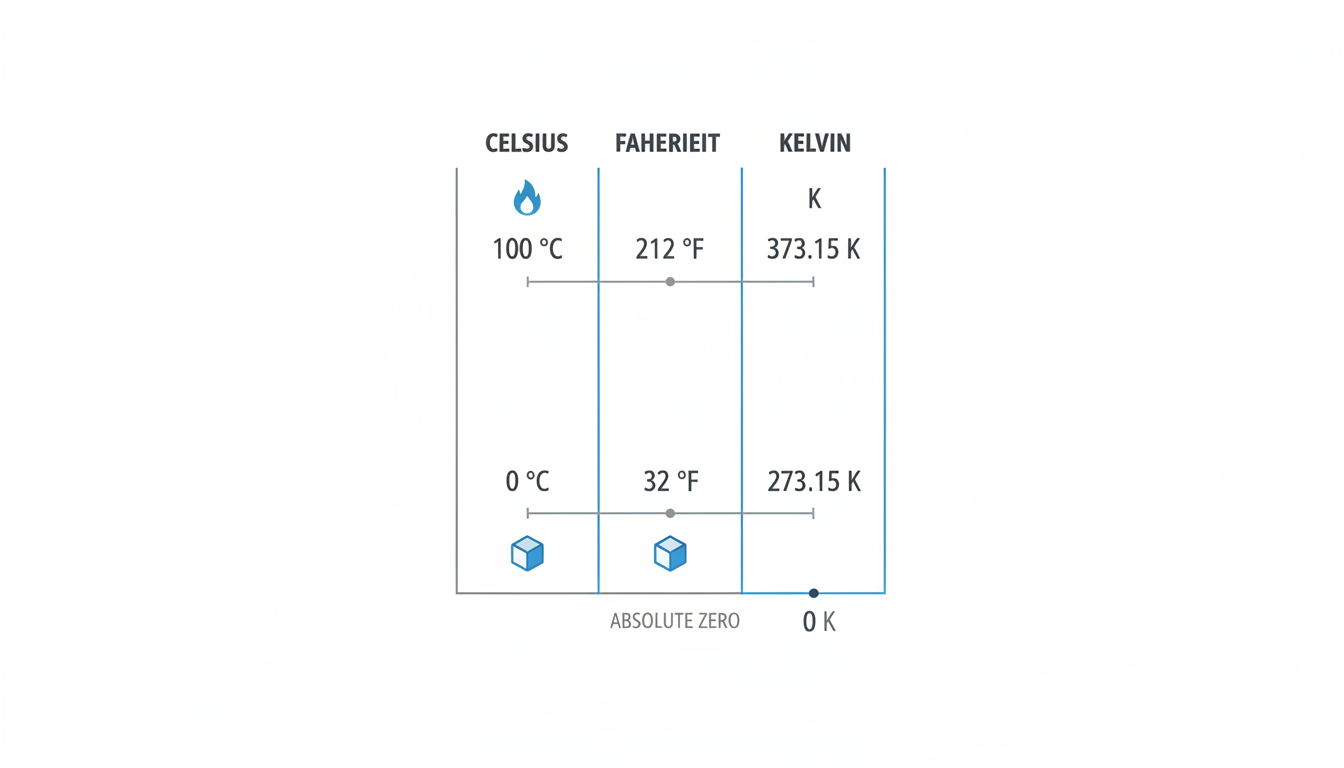
Created by Swedish astronomer Anders Celsius in 1742, this scale is beautifully simple because it is based entirely on water. At standard atmospheric pressure, 0°C is the freezing point of water, and 100°C is the boiling point. Because it aligns so perfectly with the metric system (base 10), it is the default scale for almost every country on Earth.
Fahrenheit (°F): The American Standard
Developed by physicist Daniel Gabriel Fahrenheit in 1724, this scale seems chaotic to outsiders but has a distinct advantage: granularity. Fahrenheit set the freezing point of water at 32°F and the boiling point at 212°F. Because there are 180 degrees between freezing and boiling (compared to just 100 in Celsius), Fahrenheit offers more precise readings for everyday weather without needing to use decimals. A one-degree shift in Fahrenheit is a smaller, more subtle change in heat than a one-degree shift in Celsius.
Kelvin (K): The Scientific Standard
You won’t see Kelvin on your local weather app. The Kelvin scale is thermodynamic. It starts at Absolute Zero (0 K)—the theoretical point where all molecular motion completely stops. Notice there is no degree symbol (°). It is just “Kelvin.” This scale is absolutely essential for physics, astronomy, and chemistry because it eliminates negative numbers, making complex thermodynamic equations possible.
| Measurement Point | Celsius (°C) | Fahrenheit (°F) | Kelvin (K) |
|---|---|---|---|
| Absolute Zero | -273.15°C | -459.67°F | 0 K |
| Water Freezes | 0°C | 32°F | 273.15 K |
| Average Human Body | 37°C | 98.6°F | 310.15 K |
| Water Boils | 100°C | 212°F | 373.15 K |
💡 Pro Tip
If you are reading a scientific paper published outside the US, assume temperatures are in Celsius unless specified otherwise. If it’s a physics paper dealing with extreme heat or cold (like space temperatures), it will almost certainly be in Kelvin.
Step-by-Step: How to Use a Temperature Converter
Using an online tool might seem self-explanatory, but if you are dealing with massive datasets or highly specific lab requirements, workflow matters. Here is the most efficient way to process conversions without making a data-entry error.
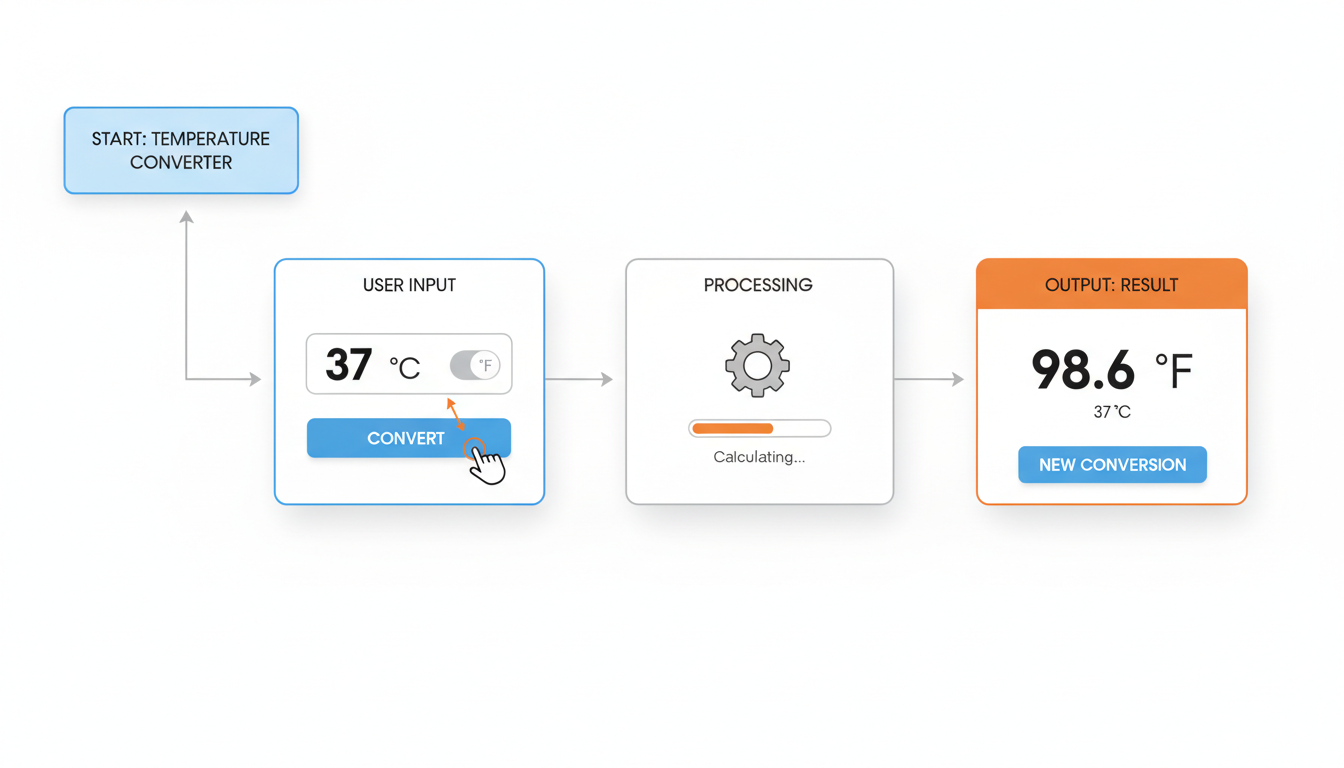
- Identify your source unit: Are you starting with Celsius, Fahrenheit, or Kelvin? Select this as your “From” unit in the tool.
- Select your target unit: Choose the scale you need your final answer in (the “To” unit).
- Input the exact value: Enter your number. Crucial step: Ensure you include any negative signs or decimal points. Missing a minus sign changes -40°C to a sweltering 40°C.
- Verify the output: A high-quality temperature converter will display the result instantly. Check to see if the tool rounded the decimal. For scientific work, you usually want a tool that provides at least two to four decimal places.
- Copy the result: Use the tool’s copy function (if available) rather than retyping the number to avoid transposition errors.
The Math Behind the Magic: Conversion Formulas
While a digital temperature converter does the heavy lifting instantly, understanding the underlying math is a massive advantage. Why? Because software can glitch. Websites go down. If you find yourself offline in a commercial kitchen or a remote field lab, knowing the core formulas is a literal lifesaver.
The mathematical relationships between these scales are linear, but they involve different starting points (offsets) and scaling factors. Let’s break them down.
| Conversion Type | Exact Mathematical Formula | Quick Example |
|---|---|---|
| Celsius to Fahrenheit | (°C × 9/5) + 32 = °F | (20 × 1.8) + 32 = 68°F |
| Fahrenheit to Celsius | (°F − 32) × 5/9 = °C | (100 − 32) × 0.5556 = 37.78°C |
| Celsius to Kelvin | °C + 273.15 = K | 25 + 273.15 = 298.15 K |
| Kelvin to Celsius | K − 273.15 = °C | 300 − 273.15 = 26.85°C |
These formulas are the exact logic hardcoded into any software tool. Just as financial analysts rely on a Simple Interest Calculator to prevent compounding errors, scientists rely on these exact conversion formulas to ensure their specific outcomes are met without deviation.
🎯 Key Takeaway
While knowing the formulas is a great backup plan, manual calculation introduces the risk of human error—especially with order of operations. Always use a digital temperature converter for tasks where precision is non-negotiable.
Real-World Scenarios Where Precision is Everything
The need for a temperature converter spans across dozens of industries. It isn’t merely an academic exercise for high school physics students. It has practical, everyday value that impacts the bottom line.
1. The Culinary Arts and Baking
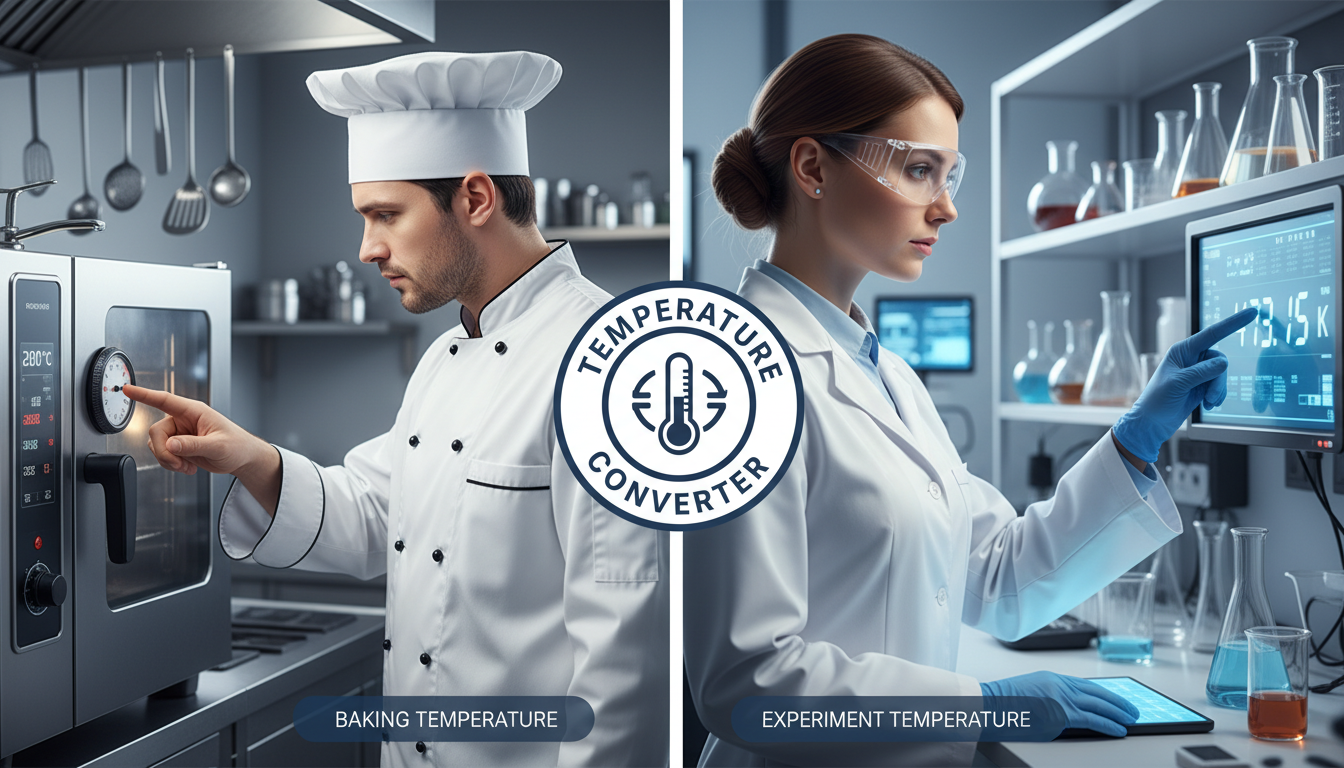
Baking is not an art. It is chemistry. The Maillard reaction (the chemical process that gives browned food its distinctive flavor) occurs rapidly around 140°C to 165°C (280°F to 330°F). If you are an American using a European recipe and you guess the conversion, your bread won’t rise, your cookies will spread into a puddle, and your meats will dry out. Precision is the difference between a Michelin-star meal and a kitchen disaster.
2. Science, Engineering, and Laboratory Work
Chemical reactions are highly temperature-dependent. In our experience reviewing lab protocols, equipment often displays readings in Celsius, but thermodynamic equations require data in Kelvin. A miscalculated conversion here doesn’t just mean a ruined cake; it can mean a volatile chemical reaction or a failed multi-million-dollar engineering stress test.
3. International Travel and Weather Forecasting
Packing for a trip requires context. If your weather app says your destination in Spain is going to be “28 degrees,” you need to know what that actually feels like. (Spoiler: 28°C is a gorgeous 82°F beach day). Misinterpreting the local weather scale is the fastest way to ruin a vacation by packing the wrong wardrobe.
⚠️ Watch Out
Don’t assume smart home devices automatically adjust to your preferred scale when traveling. Always double-check the unit settings on hotel thermostats before blasting the AC or heat.
Choosing the Right Temperature Converter Tool
Not all online tools are created equal. Based on hands-on testing of dozens of utility websites, here is what you should look for when bookmarking a temperature converter for daily use.
- Bidirectional Syncing: The best tools update instantly. If you type a number into the Celsius box, the Fahrenheit and Kelvin boxes should populate immediately without needing to click a “Calculate” button.
- Decimal Precision: Avoid tools that aggressively round to the nearest whole number. If you input 100°F, the Celsius output should be 37.7778°C, not just 38°C.
- Mobile Responsiveness: You are most likely to need a conversion when you are away from your desk—standing in a kitchen or traveling abroad. The tool must load fast and format perfectly on a smartphone screen.
- Clean Interface: Avoid sites buried in intrusive pop-up ads. When you need a quick number, you don’t want to accidentally click a spam link.
💡 Pro Tip
If you use conversions daily for work, look for a temperature converter that allows you to copy the result to your clipboard with a single tap. It saves time and prevents manual typing errors.
Frequently Asked Questions
❓ Frequently Asked Questions
Is -40 degrees the same in Celsius and Fahrenheit?
Yes. This is a fascinating mathematical anomaly. -40 is the exact crossover point where the two scales intersect. Therefore, -40°C is exactly equal to -40°F. No conversion math is needed at this specific temperature.
Why does the US still use Fahrenheit instead of Celsius?
The United States stuck with the Fahrenheit system largely due to historical inertia and industrial costs. It was established as the standard in the British Empire before Celsius gained global traction. When the rest of the world metricated, the US never federally mandated the switch for the general public, making it too expensive and unpopular to change manufacturing standards.
What is absolute zero?
Absolute zero is 0 on the Kelvin scale, which translates to -273.15°C or -459.67°F. According to the laws of thermodynamics, it is the theoretical lowest possible temperature where atoms completely stop moving and retain zero thermal energy.
Can a standard temperature converter handle Kelvin?
Yes, any high-quality, comprehensive temperature converter tool will include Kelvin alongside Celsius and Fahrenheit, as it is the standard unit required for scientific, engineering, and thermodynamic calculations.
Which temperature scale is the most accurate?
No single scale is inherently “more accurate” than the others; they just use different increments. However, Fahrenheit offers more granularity for everyday weather because its degrees represent a smaller change in temperature than Celsius degrees. Kelvin is the most mathematically useful for science because it lacks negative numbers.
Conclusion: Stop Guessing, Start Converting
Temperature is a universal constant, but the language we use to measure it is anything but uniform. Whether you are trying to perfectly roast a chicken using a foreign recipe, conducting a delicate chemistry experiment, or just trying to figure out if you need a jacket in London, the ability to interpret these measurements accurately is vital.
A reliable temperature converter bridges the gap between Celsius, Fahrenheit, and Kelvin. It removes the guesswork, speeds up your workflow, and completely eliminates the risk of human error caused by faulty mental math.
By understanding the basics of these three scales and utilizing a digital tool to handle the complex formulas, you save time and protect your projects from costly mistakes. Next time you encounter a temperature reading in an unfamiliar unit, don’t try to double it and add 30. Bookmark a precise converter, get the exact number, and move forward with confidence.

