
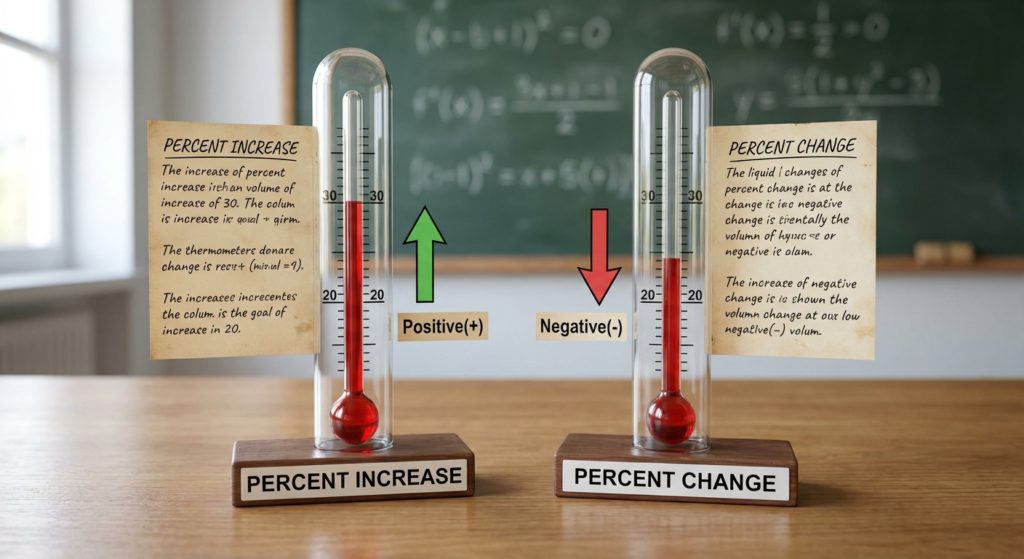
In the world of data analysis, finance, and everyday mathematics, terms like “growth,” “lift,” and “variation” are thrown around constantly. However, few concepts are as fundamental—and occasionally confusing—as the distinction between Percent Increase vs Change. Whether you are tracking the performance of a stock portfolio, analyzing website traffic, or simply trying to figure out how much the price of groceries has gone up, understanding the mechanics of percent change is essential.
Many people use the terms interchangeably, but mathematically and semantically, they hold distinct nuances. Percent change is the umbrella term that mathematically describes the relative difference between an old value and a new value. Percent increase is specifically a positive percent change. Grasping this concept allows you to communicate data accurately and make better-informed decisions. In this comprehensive guide, we will break down the formulas, the differences, and the real-world applications of calculating these figures.
What Exactly is Percent Change?
At its core, percent change is a mathematical concept used to express the difference between two values over time as a percentage of the original value. It provides context to numbers. For example, a $10 increase on a $20 item is massive, whereas a $10 increase on a $10,000 car is negligible. Percent change standardizes these shifts so we can compare apples to oranges.
When we talk about percent change, we are looking for the ratio of the change to the original amount. This calculation yields a result that can be either positive or negative. If the result is positive, it indicates an increase. If the result is negative, it indicates a decrease. Therefore, understanding percent change is the foundation for understanding both growth and decline in any statistical dataset.
The Variable
This represents the shift in value. It is strictly mathematical and does not imply direction until calculated.
The Context
Percent change provides relative context, allowing you to compare changes across different scales effectively.
The Outcome
The final percentage tells you the magnitude and direction (up or down) of the trend.
The Formula for Calculating Percent Change
To master the debate of Percent Increase vs Change, you must first master the universal formula. The beauty of the percent change formula is its simplicity. It remains consistent regardless of whether the numbers are going up or down. By sticking to this single method, you avoid the confusion often associated with trying to memorize different rules for increases and decreases.
The standard formula is:
Percent Change = ((New Value – Old Value) / Old Value) × 100
Let’s break this down:
- Subtract the Old Value from the New Value: This gives you the absolute change.
- Divide by the Old Value: This gives you the decimal representation of the change relative to the start.
- Multiply by 100: This converts the decimal into a readable percentage.
Handling Negative Numbers in Percent Change
One area where students and professionals alike stumble is when the result is negative. If you apply the formula and get -15%, what does that mean? It simply means the value has dropped by 15%. In the context of percent change, the negative sign is just a directional indicator. It transforms a generic “change” into a specific “decrease.” Conversely, a result of +15% transforms the change into an “increase.”
Percent Increase vs. Change: The Key Differences
While percent change is the broad category, “percent increase” is a specific subset. Understanding the distinction is vital for accurate reporting. If you report a “change” of 5%, it is ambiguous unless the context implies direction. If you report an “increase” of 5%, the direction is explicit.
Here is how they stack up against each other:
Percent Change
Definition: The extent to which a variable gains or loses intensity, magnitude, value, or extent.
Sign: Can be Positive (+) or Negative (-).
Usage: Used in scientific data, stock market volatility, and general statistics.
Percent Increase
Definition: A specific type of change where the new value is greater than the original value.
Sign: Always Positive (+).
Usage: Used in sales growth, salary raises, and inflation tracking.
When writing reports or analyzing data, use percent change when the direction is unknown or variable (e.g., “The stock experienced a high percent change today”). Use percent increase only when the trajectory is strictly upward.
Why Percent Change is Critical for Financial Literacy
Financial literacy relies heavily on your ability to interpret percentages. Whether you are looking at interest rates, investment returns, or tax adjustments, the raw numbers often hide the true story. For instance, an investment growing from $100 to $105 is a 5% return. However, if you are looking at credit cards, a small shift in interest rates can mean a huge difference in what you owe.
Consider the Annual Percentage Rate (APR) on loans. A shift from 3% to 4% might look like a small “1% difference” in absolute terms, but it is actually a 33% percent change in the interest you pay. To understand how these rates affect your long-term finances, using tools like an APR calculator can help you visualize the impact of these percentages over time.
Real-Life Examples of Percent Change in Economics
Economists love percent change. It is how we measure inflation (CPI) and Gross Domestic Product (GDP). If the price of bread goes from $2.00 to $2.20, that is a 10% increase. If it drops back to $2.00, that is roughly a 9.1% decrease (since the starting value was higher). This asymmetry is a classic example of why understanding the base value in percent change calculations is so important.
Applying Percent Change to Health and Fitness
Mathematics isn’t just for the boardroom; it is crucial for the gym as well. When tracking weight loss or strength gains, percent change offers a healthier perspective than raw pounds. Losing 5 pounds might not seem like much to someone weighing 250 pounds (a 2% change), but for someone weighing 120 pounds, it is a significant 4.1% change.
Furthermore, when managing diet, tracking the reduction in caloric intake is essentially a game of percentages. If you aim to reduce your intake by 15% to lose weight, you need to calculate your baseline first. Using a resource like a daily calorie calculator allows you to determine your starting point so you can accurately measure that percent change in your diet plan.
Common Mistakes When Calculating Percent Change
Even experts occasionally make errors when calculating percent change. Here are the most common pitfalls to avoid:
- Confusing Percentage Points with Percent Change: If a tax rate goes from 10% to 12%, it increased by 2 percentage points, but the percent change is actually 20%. This distinction is critical in political and financial reporting.
- Using the Wrong Denominator: You must always divide by the Old Value (the starting number). Dividing by the New Value will give you a completely different, and incorrect, metric known as margin or discount rate.
- Asymmetry of Percentages: A 50% loss requires a 100% gain to recover. If you start with $100 and lose 50%, you have $50. To get back to $100, you need to gain $50, which is 100% of your current $50 balance.
Percent Change vs. Absolute Change
Another layer of confusion arises between absolute change and percent change. Absolute change is simply the numerical difference (New – Old). While useful, it lacks scale.
For example, reliable sources like Investopedia highlight that investors prefer percentage change because it allows them to compare the performance of a $10 stock against a $1,000 stock. If both stocks gain $5 (absolute change), the $10 stock has skyrocketed by 50%, while the $1,000 stock has barely moved (0.5%). Prioritizing percent change reveals the true efficiency of the investment.
Absolute Change
Simple subtraction. Tells you “how much” but not “how significant.”
Percent Change
Ratio-based calculation. Tells you the significance relative to the starting point.
Conclusion
Understanding the nuances of Percent Increase vs Change is more than a math exercise; it is a critical skill for navigating modern life. Whether you are analyzing financial markets, tracking your fitness goals, or simply trying to understand the news, the ability to calculate and interpret percent change empowers you to see the true story behind the numbers.
Remember, “Change” is the directionless magnitude, while “Increase” and “Decrease” are the directional outcomes. By mastering the formula ((New – Old) / Old) * 100, you ensure that you never misinterpret data again. From interest rates to calorie counting, percentages are the universal language of comparison. Make sure you are speaking it fluently.
FAQs About Percent Change
Percent change compares an old value to a new value over time. Percent difference compares two different values (like the height of two different people) where neither is the “original” or “start” point, usually dividing the difference by the average of the two numbers.
Yes, absolutely. If a value more than doubles, the percent change will be greater than 100%. For example, going from 10 to 30 is a 200% increase.
Mathematically, you cannot calculate percent change from zero because you cannot divide by zero. In practical terms, the change is considered undefined or infinite, as moving from nothing to something represents an unmeasurable relative jump.
Yes. A negative percent change is mathematically identical to a percent decrease. The negative sign simply indicates the downward direction of the value.
It normalizes data, allowing for comparisons between datasets of different scales. As noted by the Bureau of Labor Statistics, indices like the CPI rely entirely on percent change to track inflation and economic health.

