
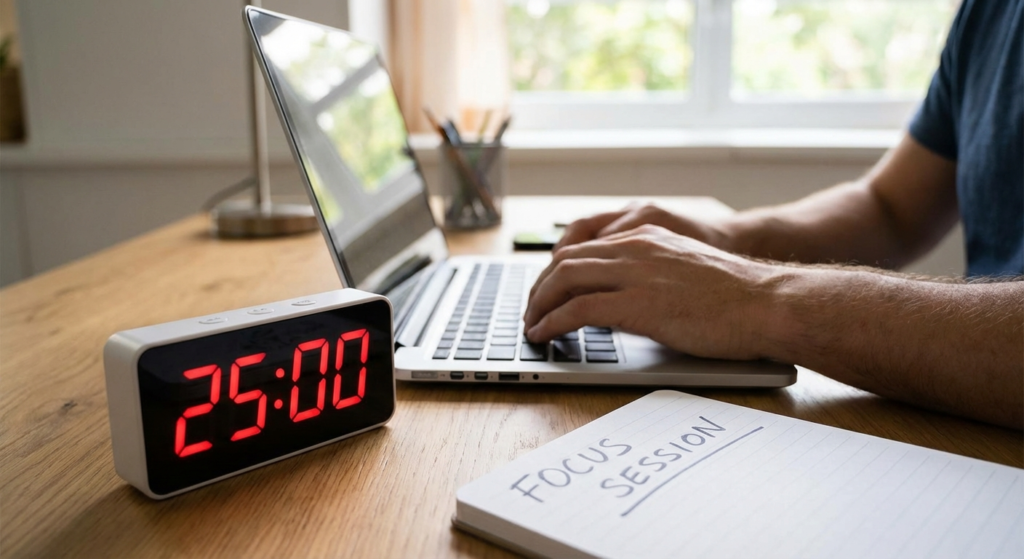
In an age defined by digital distractions, maintaining a deep state of concentration feels like a superpower. We are constantly bombarded by notifications, emails, and the allure of social media, all of which fragment our attention span. This is where the humble yet powerful focus timer enters the picture. It is not just a ticking clock; it is a psychological anchor that grounds your mind, enabling you to work with intent and purpose.
Whether you are a student preparing for exams, a freelancer juggling multiple clients, or an entrepreneur trying to maximize efficiency, a focus timer is the tool that bridges the gap between intention and action. By compartmentalizing time into manageable chunks, you can transform an overwhelming mountain of work into a series of climbable hills. In this comprehensive guide, we will explore the mechanics, benefits, and advanced strategies of using a focus timer to reclaim your day.
The Science: Why a Focus Timer Works
To understand the efficacy of a focus timer, we must look at the psychology of motivation and attention. The human brain is not wired for prolonged, unbroken focus on abstract tasks. Evolutionarily, we are designed to scan our environment for changes. When we force ourselves to sit for hours without a break, cognitive fatigue sets in, leading to diminishing returns.
Using a focus timer leverages a concept known as Parkinson’s Law, which states that “work expands to fill the time available for its completion.” When you have all day to finish a report, it will take all day. However, when you set a timer for 25 or 50 minutes, you create an artificial urgency. This urgency sharpens your focus, forces you to prioritize essential tasks, and eliminates procrastination.
The Role of Ultradian Rhythms
Our bodies operate on biological cycles called ultradian rhythms. Research suggests that the human brain can only sustain high-intensity focus for about 90 to 120 minutes before it needs a rest. A focus timer helps you align your work schedule with these biological peaks and valleys. Instead of fighting against your natural energy dips, you plan your breaks around them, ensuring that when you are working, you are operating at peak capacity.
3 Proven Focus Timer Techniques
Not all timing strategies are created equal. Depending on your work style and the nature of your tasks, different methods may yield better results. Here is a breakdown of the most effective methodologies.
The Pomodoro Technique
Developed by Francesco Cirillo, this is the most famous method. It involves setting a focus timer for 25 minutes of work, followed by a 5-minute break. After four cycles, you take a longer break of 15-30 minutes. It is ideal for churning through repetitive or administrative tasks.
The 52/17 Rule
Based on a study of the most productive employees, this method suggests working for 52 minutes and then breaking for 17 minutes. This ratio typically aligns well with natural energy levels and is excellent for deep work sessions requiring cognitive load.
Flowtime Technique
Unlike rigid structures, Flowtime allows you to set a stopwatch rather than a countdown. You work until you feel your focus slipping, then record the time and take a break proportional to the work duration. This is perfect for creatives who don’t want a timer interrupting their flow state.
Benefits of Integrating a Focus Timer into Your Routine
Adopting a focus timer is not merely about getting more done; it is about working healthier. The benefits extend beyond simple output metrics and contribute to overall mental well-being.
1. Prevention of Burnout
Burnout often stems from a lack of boundaries. When work bleeds into leisure time, the brain never truly decompresses. By strictly adhering to the breaks dictated by your focus timer, you ensure that your mind gets the rest it requires. This sustainable pace allows you to maintain consistency over weeks and months, rather than sprinting for a few days and crashing.
2. Elimination of Single-Tasking
Multitasking is a myth; what we actually do is task-switching, which carries a heavy cognitive cost. Every time you switch context, you lose time re-orienting. A focus timer enforces single-tasking. During the active interval, you are committed to one specific objective. This laser focus significantly improves the quality of your output.
3. Gamification of Productivity
Tracking how many “intervals” or “pomodoros” you complete in a day adds a layer of gamification to your work. Seeing your numbers go up triggers a dopamine release, motivating you to stick to the task at hand. For business owners, analyzing these metrics is crucial. For instance, understanding how much time is spent on specific tasks can help in other areas, such as calculating what is a good profit margin for ecommerce business by accurately factoring in labor hours.
How to Set Up Your Focus Timer Environment
Merely buying a timer or downloading an app is insufficient. You must cultivate an environment that supports the tool. Here is a step-by-step guide to setting up a distraction-free zone.
- Clear the Clutter: Physical clutter often leads to mental clutter. A clean desk invites focus.
- Digital Hygiene: Before starting your focus timer, close irrelevant browser tabs. Put your phone on “Do Not Disturb” mode or move it to another room.
- Define the Task: Never start the timer without a clear goal. Vague intentions like “work on project” lead to wandering minds. Be specific: “Draft the introduction for the quarterly report.”
- Respect the Bell: When the timer rings, stop. Even if you are in the middle of a sentence. This discipline trains your brain to respect the boundaries of work and rest.
Digital Apps vs. Physical Focus Timers
The market is flooded with tools designed to help you track time. The choice between a digital app and a physical device depends on your personal triggers for distraction.
Physical Timers: Devices like hourglasses, kitchen timers, or specialized productivity cubes are excellent because they do not require you to look at a screen. Using your phone to set a timer often leads to checking notifications “quickly,” which derails the entire session. A physical object on your desk serves as a constant visual reminder of your commitment.
Digital Apps: Software solutions offer advanced tracking and analytics. They can block other websites while the focus timer is running and generate reports on your productivity trends. If you work primarily on a computer, browser extensions can be highly effective.
Advanced Strategies for Power Users
Once you have mastered the basics, you can overlay advanced strategies to further enhance the effectiveness of your focus timer.
Task Batching
Group similar tasks together and assign them to a specific block of time. For example, dedicate two 25-minute cycles solely to answering emails and Slack messages. This prevents communication tasks from interrupting your deep work blocks throughout the day.
The Interruption Log
Internal distractions are just as dangerous as external ones. You might suddenly remember you need to buy milk or pay a bill. Instead of acting on it immediately, keep a notepad nearby. When a distracting thought arises while the focus timer is running, write it down and immediately return to work. Address the list during your break.
Overcoming Resistance to the Timer
It is common to feel resistance when first using a focus timer. You might feel confined or stressed by the ticking clock. This is usually a symptom of trying to do too much at once. If 25 minutes feels too long, start with 10 or 15 minutes. The goal is to build the habit of focused attention, not to hit a specific number immediately.
Additionally, ensure your breaks are genuinely restorative. Scrolling through social media during a 5-minute break does not rest the brain; it floods it with more information. Instead, stand up, stretch, look out a window, or engage in a quick, unrelated activity. Some people find quick mental resets helpful, similar to how one might engage in a quick round of a bingo card game during a longer break to completely detach from work logic, though physical movement is generally preferred.
Conclusion
The focus timer is more than a productivity hack; it is a philosophy of valuing your time. By respecting the limits of your attention and alternating between intense focus and genuine rest, you can achieve more in less time while reducing stress. Whether you opt for a mechanical kitchen timer or a sophisticated app, the key lies in consistency. Start small, experiment with different intervals, and discover the rhythm that unlocks your potential. In a world fighting for your attention, the focus timer is your shield and your sword.
Frequently Asked Questions
While the standard Pomodoro technique suggests 25 minutes, the “best” duration is subjective. Some people prefer 50 minutes of work followed by a 10-minute break. Experiment to find what matches your attention span.
Yes, but be cautious. Phones are portals to distraction. If you use your phone, ensure it is in “Do Not Disturb” mode or use an app that blocks other applications while the timer is running.
Avoid screens. Stand up, stretch, drink water, or do breathing exercises. The goal is to give your eyes and brain a rest from digital stimuli.
Absolutely. While some creatives fear it kills spontaneity, a timer actually provides a container for creativity, preventing perfectionism and procrastination. The Flowtime technique is often best for this.
Most users report adapting within a week or two. It requires discipline initially, but soon the sound of the timer starting becomes a trigger for instant focus.
Read Also:
- 7 Game-Changing Strategies Using a QR Code Generator in 2025
- 10 Ways to Master the Use of Dice Roller Tools (2024 Guide)
- The 50x70cm Framing Secret for 2026
- Watch Hurawatch Offline? Your 2026 Guide
- 8 to 4: Your 2026 Work Hours Solved
- Stop Content Theft in 2026
- The Ultimate 2024 Guide: How to Convert Hands to Ft Accurately
- 12 Expert Tips to Master Any Online Converter Tool for Maximum Efficiency – Visual Story

