
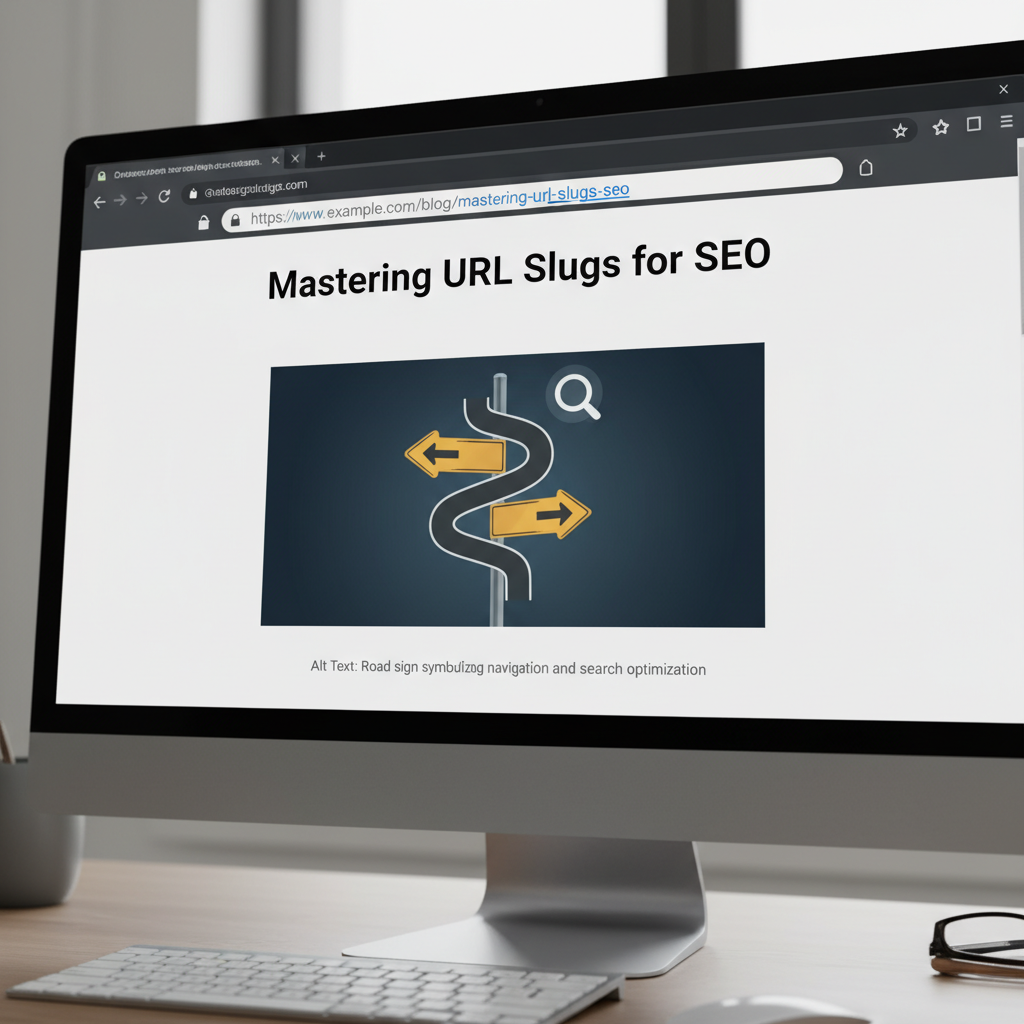
The Anatomy of a Perfect URL Slug: Why Generation Tools Are Essential
In the vast landscape of search engine optimization, every detail counts. While we often obsess over content length, keyword density, and backlinks, one fundamental element frequently gets overlooked: the URL slug. The slug is the specific part of your URL that identifies a piece of content, appearing immediately after your domain name (e.g., yoursite.com/this-is-the-slug).
A well-crafted slug doesn’t just look tidy; it communicates relevance to both the user and the search engine crawler. If you are managing a large site or producing content rapidly, manually optimizing every slug can be tedious and prone to error. This is where the power of an seo friendly url slug generator comes into play, transforming messy titles into concise, optimized web addresses.
Understanding how to leverage these tools is crucial for maximizing your site’s ranking potential and improving user experience. This comprehensive guide will dissect the essential characteristics of an SEO-friendly slug and show you exactly how to use a specialized generator to achieve structural perfection across your website.
What Exactly is a URL Slug and Why Does it Matter for SEO?
The URL slug is the customizable portion of the Uniform Resource Locator (URL). It provides immediate context about the content of the page. Unlike the full URL, which includes protocols and domains, the slug is specifically designed for human readability and search engine interpretation.
The Role of Slugs in Search Engine Optimization
Search engines like Google use the URL structure as a primary signal for understanding page topicality. When the slug contains relevant keywords, it reinforces the content’s focus, making it easier for algorithms to categorize and rank the page for specific queries. A clean, keyword-rich slug can contribute significantly to better visibility in the SERPs.
Furthermore, slugs impact the Click-Through Rate (CTR). When a user sees a clear, descriptive slug in the search results, they are more likely to trust the link and click on it compared to a URL filled with random numbers or stop words. Clarity equals authority.
SEO Benefit: Keyword Reinforcement
A slug containing the primary keyword acts as another signal to search engines, strengthening the page’s relevance for target queries.
UX Benefit: Improved Navigability
Users can instantly understand the page content just by glancing at the URL, enhancing site architecture perception and trust.
Technical Benefit: Easier Indexing
Simple, predictable URL structures allow search engine bots to crawl and index your site more efficiently.
7 Essential Characteristics of an SEO Friendly URL Slug
Creating an effective slug isn’t just about dropping in a keyword; it requires adherence to specific structural rules. Ignoring these rules can lead to poor user experience, broken internal linking, and missed ranking opportunities. These characteristics are precisely what a high-quality seo friendly url slug generator is designed to implement automatically.
- Conciseness: Keep slugs as short as possible while retaining meaning. Shorter slugs are easier to read and share.
- Keyword Focus: Always include the primary keyword, ideally near the beginning of the slug.
- Use Hyphens for Separation: Google prefers hyphens (dashes) to separate words (
-). Avoid underscores (_) or spaces. - Lowercase Only: Use lowercase characters exclusively. Mixed-case URLs can cause issues with server handling and duplicate content recognition.
- Eliminate Stop Words: Remove common, low-value words like “a,” “the,” “and,” “in,” unless their removal drastically changes the meaning.
- Avoid Dates and Numbers (If Possible): If your content is evergreen, avoid dates (e.g.,
/guide-2024/). This prevents needing 301 redirects when updating the content next year. - Be Permanent: Once a slug is published and indexed, try never to change it. If you must change it, implement a 301 redirect immediately.
The Power of the Primary Keyword in Your Slug
Integrating your primary keyword is perhaps the most critical component of slug optimization. While keyword stuffing is penalized in content bodies, using the core term in the URL slug is strongly recommended by SEO professionals. For example, if your article is about “2025 Post Office FD Interest Rates,” the ideal slug is /post-office-fd-interest-rates-2025/, not /read-about-money-and-savings-here/.
As industry expert Rand Fishkin once noted, “A clean, concise, keyword-rich URL is a ranking factor, and it’s also a usability factor.” This underscores the dual benefit of thoughtful slug design.
Mastering the Art of Slug Creation: Manual vs. seo friendly url slug generator
When generating content, platforms like WordPress or Shopify automatically create a slug based on the H1 title. However, these default slugs are often imperfect—they include stop words, are excessively long, and may contain unnecessary special characters.
While manual editing gives you absolute control, it is time-consuming. A dedicated seo friendly url slug generator automates the adherence to all the best practices listed above, ensuring consistency and saving valuable editorial time.
Manual Slug Creation
- Pros: Full control over exact keyword placement and nuance.
- Cons: Highly time-consuming; high risk of human error (e.g., using underscores or leaving stop words); difficult to maintain consistency across a large site.
Using an SEO Friendly URL Slug Generator
- Pros: Instantaneous cleanup; automatic removal of stop words and special characters; enforces lowercase and hyphen separation; ensures consistency.
- Cons: May sometimes remove contextually important words if the title is very long and complex. Requires minor review.
If you are looking for efficiency and error reduction, adopting an automated tool is the clear choice. You can instantly convert a verbose title like “The ultimate and comprehensive guide on how to calculate your Basal Metabolic Rate and estimate your daily caloric needs” into a perfect slug like /basal-metabolic-rate-calculate-daily-calories-guide/.
Step-by-Step Guide to Using an Effective seo friendly url slug generator
Using a generator tool is incredibly simple, yet the impact on your site’s structure is profound. These tools follow sophisticated logic to sanitize and optimize your input text.
1. Input the Content Title or Key Phrase
Start by pasting the exact headline (H1) of your article or the primary topic sentence into the generator. It is crucial to use the full title, as the tool will intelligently analyze the keywords within that text.
2. Automatic Cleaning and Standardization
The core function of a reliable seo friendly url slug generator is to perform instantaneous cleanup. The generator automatically executes the following steps:
- Converts all letters to lowercase.
- Replaces spaces and special characters with hyphens.
- Removes common stop words (e.g., is, are, of, the).
- Eliminates punctuation marks (commas, apostrophes, colons).
If you need to test the efficiency of such a tool, you can check out a reliable Text to slug Generator designed for SEO purposes.
3. Review and Finalize (The Human Check)
While the generator does 99% of the work, always perform a quick review. Ensure the resulting slug is still meaningful and contains the most important keywords. Sometimes, if the generator is too aggressive, you might need to manually re-insert a critical bridging word that was incorrectly identified as a stop word, although this is rare with advanced tools.
Example Transformation:
Original Title: “5 Proven Meta Tag Errors Destroying Your CTR (A Comprehensive Analysis)”
Generator Output Slug: 5-proven-meta-tag-errors-destroying-ctr-comprehensive-analysis
Recommended Optimized Slug: 5-proven-meta-tag-errors-destroying-ctr (Removing “comprehensive-analysis” for brevity, as the core message is already captured).
Common Pitfalls to Avoid When Generating Slugs
Even with the best tools, users can still make mistakes when implementing slugs across their CMS. Awareness of these common errors is key to maintaining a healthy site structure.
- Over-Optimization (Keyword Stuffing): Do not force keywords into the slug if they do not logically fit the content. A slug should be descriptive, not just a list of keywords separated by hyphens.
- Non-ASCII Characters: Slugs should primarily use letters, numbers, and hyphens. Avoid using characters outside the standard ASCII set, as these can be URL-encoded into long, ugly strings (e.g.,
%C3%A9), which is bad for UX. - Duplication: Ensure every slug is unique. If two pages have the same content, choose the one you want to rank and implement canonicalization or use a 301 redirect for the duplicate version.
Advanced Tips for Maintaining SEO Health Across All Your URL Slugs
Maintaining a large website requires vigilance regarding URL structure. Even after using an excellent seo friendly url slug generator, ongoing maintenance is necessary to prevent structural decay.
1. Handling Slug Changes with 301 Redirects
The cardinal rule of SEO is: never change an indexed URL without implementing a 301 permanent redirect. If you decide that an old slug, such as /old-article-topic-2019/ needs to be updated to /new-optimized-topic/, the old address must point to the new one permanently. Failing to do this results in a 404 error, losing link equity and frustrating users.
2. Canonicalization for Similar Content
If you have products or content pages that are very similar (e.g., a guide on “SIP Calculator” and “Monthly SIP Calculator”), you might end up with similar slugs. In such cases, use the canonical tag (rel="canonical") to tell search engines which version is the master copy. This prevents potential duplicate content penalties while allowing both slugs to exist.
According to Google Search Central’s guidelines on URL structure, simple and logical URLs are easier for both users and search engines to process, reinforcing the need for automated optimization. Google recommends using simple directory structures that are easy to remember.
Feature 1: Bulk Processing
A premium slug generator should handle bulk inputs, allowing you to optimize multiple post titles simultaneously, crucial for migrating or launching large sites.
Feature 2: Custom Stop Word List
The best tools allow customization, letting you define specific industry-related words that should or should not be excluded from the resulting slug.
Feature 3: Automatic Length Limitation
To prevent excessively long URLs, the tool should offer an option to truncate the slug after a specified character count (e.g., 50-70 characters).
3. Integrating Slugs with Site Architecture
The slug often reflects the site hierarchy. A good structure uses folders (directories) to group related content, which is often visible in the URL. For instance, /category/post-slug/ is clearer than /post-slug/ alone. Ensuring your generator respects and integrates properly with your site’s directory structure is vital for semantic SEO.
As confirmed by various studies on on-page SEO factors, URL structure remains a foundational element of technical optimization. Moz emphasizes the importance of keeping URLs descriptive and concise for maximum search engine effectiveness. Following best practices for URL structure can significantly enhance your site’s overall authority.
Conclusion
The URL slug is the silent ambassador of your content. Investing time in perfecting this small detail yields significant returns in SEO and user experience. Whether you manage a small blog or an enterprise-level platform, integrating an efficient seo friendly url slug generator into your publishing workflow is no longer optional—it is a necessity for achieving consistency, minimizing errors, and ensuring every piece of content is instantly understandable by both users and search engines. By adhering to the principles of conciseness, keyword inclusion, and proper formatting, you lay a solid foundation for long-term ranking success.
FAQs
While there is no strict limit, best practice suggests keeping the slug concise, ideally between 3 to 5 words, or less than 60 characters. Shorter slugs are easier for users to remember, share, and comprehend at a glance in the search results.
Generally, avoid dates or numbers (like years or specific statistics) unless the content is time-sensitive and will never be updated (e.g., historical reports). For evergreen content, using dates forces you to implement 301 redirects every time you update the year, which can dilute link equity over time. A good seo friendly url slug generator often strips these automatically.
Hyphens (-) are strongly preferred by Google and are the industry standard for word separation in URLs. Underscores (_) are generally interpreted as joining two words together, diminishing the keyword separation signal. A quality generator will always use hyphens.
If you change a slug and do not implement a 301 permanent redirect from the old URL to the new one, you will lose all the link equity and ranking associated with the original address, resulting in 404 errors. Always use a 301 redirect immediately after changing an indexed slug to preserve SEO value.
Using an SEO friendly URL slug generator ensures that the technical structure of your URLs adheres to best practices, which is a key foundational element for SEO. While it doesn’t guarantee top rankings on its own (quality content and backlinks are also essential), it eliminates structural errors that could otherwise hinder your performance and improves user trust and CTR.
Read Also:
- The Ultimate Guide to Compress JPEG to 50KB Online Without Losing Quality
- The Ultimate Guide to Crafting SEO Friendly URL Slugs: Choosing the Right Generator
- Leap Year Facts: Understanding the Science and History – And Determining If 2026 Is a Leap Year
- Unlock Hidden Views: The Ultimate Guide to Using a Free YouTube Tag Generator for Views
- Ultimate GST Calculation Guide: Mastering the GST Calculation Formula India with Examples
- The Ultimate Guide to Using a Color Palette Generator for Stunning Designs
- 7 Proven Strategies to Build Wealth Using an Investment Calculator
- 7 Expert Ways to Use a Backlink Checker for SEO Dominance in 2025
- 10 Ways a URL Shortener Transforms Your Digital Strategy
- Hz to Watts: The 2026 Tech Myth Busted
- 12 Smart Strategies for the Use of Username Generator Tools in 2024 – Visual Story

