
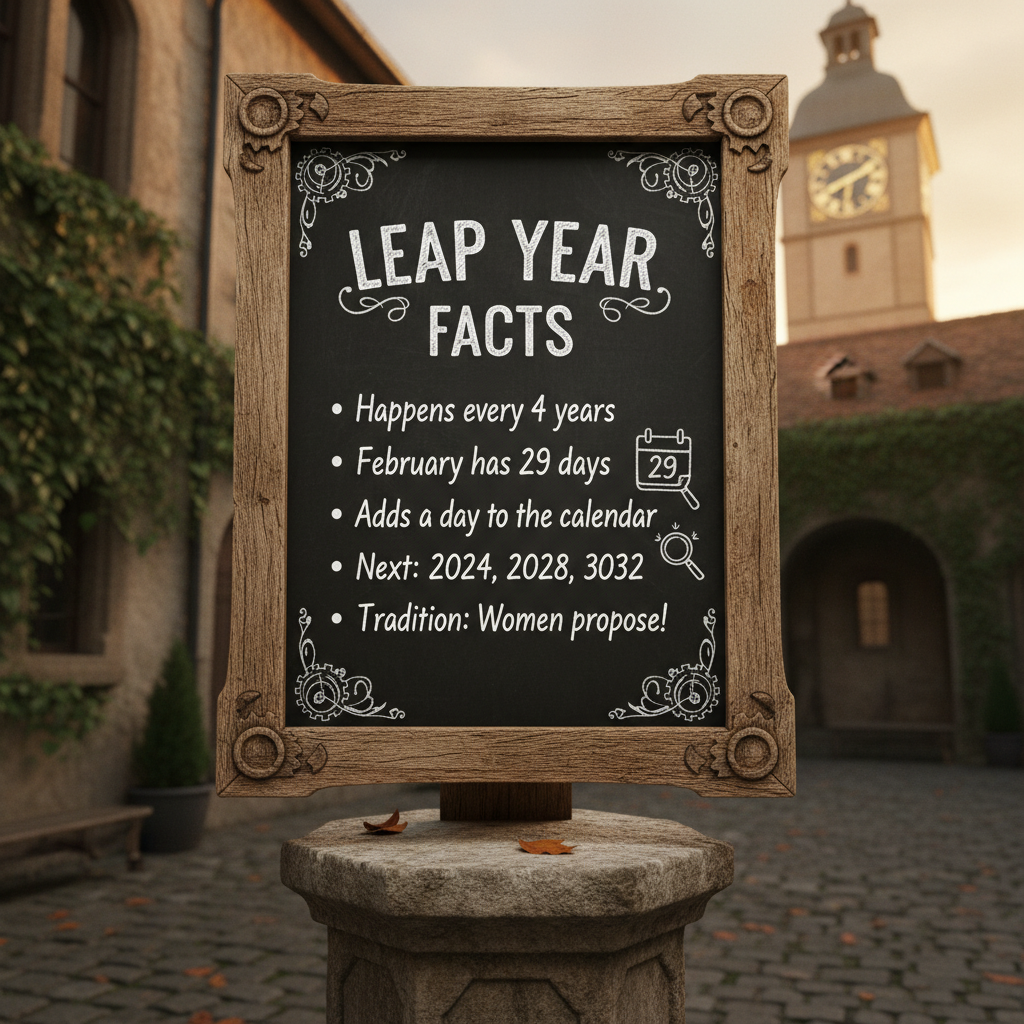
The Crucial Role of the Leap Year in Timekeeping
Time, as we experience it on Earth, is governed by the meticulous dance between our planet and the Sun. If you’ve ever wondered why we occasionally insert an extra day into February, you are grappling with one of humanity’s most enduring astronomical challenges: synchronizing the calendar year with the actual solar year. The concept of the leap year is vital for maintaining seasonal alignment, preventing our calendars from drifting over centuries.
The urgency to understand this mechanism often peaks around non-leap years. For instance, a common question asked by those planning future events is: is 2026 a leap year? To answer this, we must first master the strict rules that govern when February 29th makes its rare appearance. The short answer is no, 2026 does not qualify, but the reasons why are complex and steeped in history.
This comprehensive guide explores the deep-seated science, the historical fixes, and the fascinating cultural traditions that revolve around the insertion of the extra day, ensuring you understand exactly how our modern calendar works.
The Astronomical Necessity: Why We Need the Extra Day
The underlying reason for the leap year is that the Earth does not take exactly 365 days to orbit the Sun. Instead, the actual time it takes to complete one solar orbit—known as the tropical year—is approximately 365 days, 5 hours, 48 minutes, and 45 seconds. This slight difference of nearly six hours might seem trivial, but accumulating it over time causes major problems.
If we ignored these extra hours, every four years, our calendar would fall behind the actual solar events by roughly 24 hours (a full day). Over just 100 years, the calendar would be off by about 25 days. Eventually, this drift would mean that major seasonal markers, like the winter solstice or the start of spring, would occur much earlier in the calendar year than expected, making agricultural planning and religious observance impossible to standardize.
The Julian Fix and the Gregorian Refinement
The first standardized attempt to fix this issue was by Julius Caesar in 45 BCE, introducing the Julian calendar. This system simply added an extra day every four years. While a massive improvement, it was still slightly inaccurate, overcompensating by about 11 minutes per year.
By the 16th century, the accumulated error of the Julian calendar meant that the calendar was misaligned by 10 days relative to astronomical events. Pope Gregory XIII rectified this in 1582 with the introduction of the Gregorian calendar, which added two exceptions to the simple “every four years” rule. This system is the one we use today, and it is crucial for determining is 2026 a leap year or not.
Rule 1: The Primary Rule
A year is a leap year if it is divisible by 4. This covers most cases, ensuring the six-hour accumulation is addressed every four years.
Rule 2: The Century Exception
If a year is divisible by 100, it is NOT a leap year, even if it is divisible by 4. This fixes the slight overcompensation from the Julian system (e.g., 1700, 1800, 1900 were not leap years).
Rule 3: The Century Exception Exception
If a year is divisible by 400, it IS a leap year. This ensures the calendar remains tightly synchronized (e.g., 1600 and 2000 were leap years).
Applying the Rules: Is 2026 a Leap Year?
To definitively answer the question “is 2026 a leap year?” we simply need to apply the primary rule of divisibility by four. Leap years generally occur in years like 2020, 2024, 2028, and so on.
Let’s test 2026 against the criteria:
- Is 2026 divisible by 4? No. (2026 / 4 = 506.5)
- Since it fails the primary test, we don’t need to check the century exceptions.
Conclusion: 2026 is a common year, consisting of 365 days. The next leap year following the most recent one (2024) will be 2028. Understanding why 2026 is not a leap year is key to appreciating the precision of the Gregorian calendar. The system ensures that we only add the extra day when the accumulated time discrepancy warrants it.
The Impact of Missing a Leap Year
While 2026 is just a regular year, imagine the chaos if we suddenly decided to skip a necessary leap year, such as 2028. The consequences, though not immediately apparent, would ripple through global systems.
Agricultural Misalignment
Seasonal markers, crucial for farming and harvesting cycles, would gradually shift. What we call ‘summer’ on the calendar would increasingly occur earlier than the actual peak solar insulation.
Religious Observances
Many major religious holidays, particularly those tied to equinoxes and solstices (like Easter or Passover), rely heavily on accurate calendar synchronization. Skipping a leap year would throw these calculations into error.
Navigational & Scientific Error
Modern satellite navigation, astronomical observations, and precise scientific experiments rely on extremely accurate timekeeping. Even minor calendar drifts can introduce cumulative errors in these sensitive fields.
Fascinating Leap Year Facts and Cultural Traditions
The rarity of February 29th has led to a host of unique cultural beliefs, superstitions, and traditions around the world. These facts add a layer of human interest to what is otherwise a cold, mathematical necessity.
The Tradition of Women Proposing
One of the most famous traditions associated with the leap day is the reversal of gender roles in marriage proposals. Often called “Bachelor’s Day” or “Ladies’ Privilege,” this tradition supposedly originated in 5th-century Ireland, attributed to St. Bridget complaining to St. Patrick about women having to wait too long for a proposal.
While historically rooted more in folklore and social satire than in codified law, the tradition gained popularity in Europe and the US, where the leap day became the one acceptable day for a woman to propose marriage without social stigma. Some countries, like Scotland, even imposed fines on men who refused a leap day proposal!
The Phenomenon of Leap Day Birthdays (Leaplings)
Individuals born on February 29th – known colloquially as “leaplings” or “leapers” – are a rare breed. The odds of being born on this specific day are roughly 1 in 1,461. This creates a unique scheduling dilemma for celebrating birthdays.
Many leaplings celebrate their birthday either on February 28th or March 1st in common years. However, officially, they only celebrate their “actual” birthday once every four years. For those interested in precisely tracking the time elapsed since their birth, especially if you were born on February 29th, calculating your age accurately requires specialized tools. You might want to use an Age Calculator to determine your exact age in days, months, and years.
This phenomenon highlights the strange intersection of legal and biological time. Although a leapling may legally turn 18 or 21 on a common year, they have only celebrated a handful of actual birthdays.
The Precision of the Tropical Year and Why 2026 is Not a Leap Year
The Gregorian calendar is not perfect, but it is incredibly precise. The system results in an average year length of 365.2425 days. Given that the true tropical year is 365.2422 days, the Gregorian calendar only introduces an error of about 0.0003 days per year. This equates to being off by just one day every 3,333 years. This remarkable accuracy is why the question of whether is 2026 a leap year can be answered with such certainty – the calendar system is highly predictable.
Why the Divisibility Rules Are So Important
If we only followed the simple “divisible by 4” rule, we would be adding slightly too much time. The century rule (skipping the leap day in years divisible by 100, like 1900) removes three extra days every 400 years. The exception to that rule (adding the day back in years divisible by 400, like 2000) ensures we don’t remove too many. This balancing act is what keeps the calendar tied to the seasons.
As astronomer and writer Carl Sagan once noted regarding the cosmos, “The calendar is a kind of map of the universe, a way to keep track of where we are in the grand cycle of things.” Maintaining this map requires the meticulous application of these rules, confirming that 2025, 2026, and 2027 are all common years.
The complexity of reconciling Earth’s rotation with its orbit means that timekeeping is a continuous effort. For those interested in the astronomical basis of time, understanding the difference between the sidereal year and the tropical year provides deeper context. The tropical year, upon which the leap year is based, measures the time between successive spring equinoxes, crucial for seasonal stability. For more detailed insights into the astronomical definitions that govern our calendar, the National Institute of Standards and Technology (NIST) provides excellent resources on the history and definition of time standards. You can explore the complexities of timekeeping here.
Calculating Future Leap Years Beyond 2026
Since we have established that is 2026 a leap year is answered with a definitive “no,” let’s look ahead. Predicting future leap years is straightforward using the Gregorian rules.
The next sequence of leap years includes:
- 2028 (Divisible by 4)
- 2032 (Divisible by 4)
- 2036 (Divisible by 4)
- 2040 (Divisible by 4)
The next time the century rule will come into play is the year 2100. Since 2100 is divisible by 100 but not by 400, 2100 will NOT be a leap year, breaking the traditional four-year cycle.
Why February?
It often seems odd that the extra day is tacked onto February, the shortest month. This tradition dates back to the Roman calendar. Originally, March was the first month of the year, and February was the last. When Julius Caesar reformed the calendar, the extra day was simply inserted where the original extra month (intercalary month) used to be, at the very end of the calendar year, which was February.
The calendar’s history reflects centuries of adjustments and corrections designed to align human chronology with cosmic reality. The Gregorian reform, detailed extensively in historical documents, stands as one of the most successful scientific interventions into daily life. For those interested in the primary source material regarding the calendar reform, documents outlining Pope Gregory XIII’s instructions are often held in major historical archives, such as those digitized by the Library of Congress, detailing the shift from the Julian to the Gregorian system.
Conclusion: The Value of the Extra Day
The leap year is far more than just an arbitrary extra day; it is a profound testament to mathematical accuracy and astronomical observation. While is 2026 a leap year is easily answered – no, it is not – understanding the mechanism behind this decision illuminates how deeply intertwined our concept of time is with the movements of the cosmos. The precise placement of the leap day ensures that our seasons remain reliable, our timekeeping accurate, and our calendar synchronized for centuries to come.
FAQs
This tradition dates back to the ancient Roman calendar. When the calendar was reformed by Julius Caesar, February was the last month of the year. When the intercalary day was added, it was placed at the end of the year, which was February, a practice that continued even after the calendar year officially started in January.
Leap years generally occur every four years. However, due to the Gregorian calendar rules, a leap year is skipped three times every 400 years (in years divisible by 100 but not by 400). This means the cycle is not perfectly predictable based solely on the “divisible by four” rule over very long timescales.
Since 2026 is a common year, the next subsequent leap year after 2024 will be 2028. This year is divisible by 4 and does not fall under any of the century exceptions (it is neither divisible by 100 nor 400).
A Leapling (or Leaper) is a person born on February 29th. Because their actual birth date appears on the calendar only once every four years, they often celebrate their birthday on either February 28th or March 1st during common years.
If we stopped observing leap years, the calendar would drift significantly out of sync with the astronomical seasons. Our calendar year would start approximately 5 hours, 49 minutes earlier each year relative to the tropical year. Within about 100 years, the calendar would be off by 25 days, causing summer to officially begin in what we currently consider late spring.
Read Also:
- Optimizing Your Gains: Using a Daily Protein Intake for Muscle Growth Calculator
- The Ultimate Guide to Easily Make Bar Graph Online Free: Choosing the Best Creator Tools
- The Ultimate Guide to Tracking the USD to INR Currency Converter Live Rate
- Achieving a Good Profit Margin for Ecommerce Business: Strategies for Maximum Profitability
- Optimizing Hypertrophy: Using a Daily Protein Intake for Muscle Growth Calculator Effectively
- 10 Proven Ways a Habit Tracker Can Revolutionize Your Productivity in 2025
- 7 Powerful Ways a Grammar Checker Transforms Your Writing Success
- 50x70cm to Inches: The Ultimate 2026 Conversion & Framing Guide
- Your 2026 Secret to Faster Laps
- Supercharge Your Links in 2026
- Linear Foot Secrets for 2026 Projects