
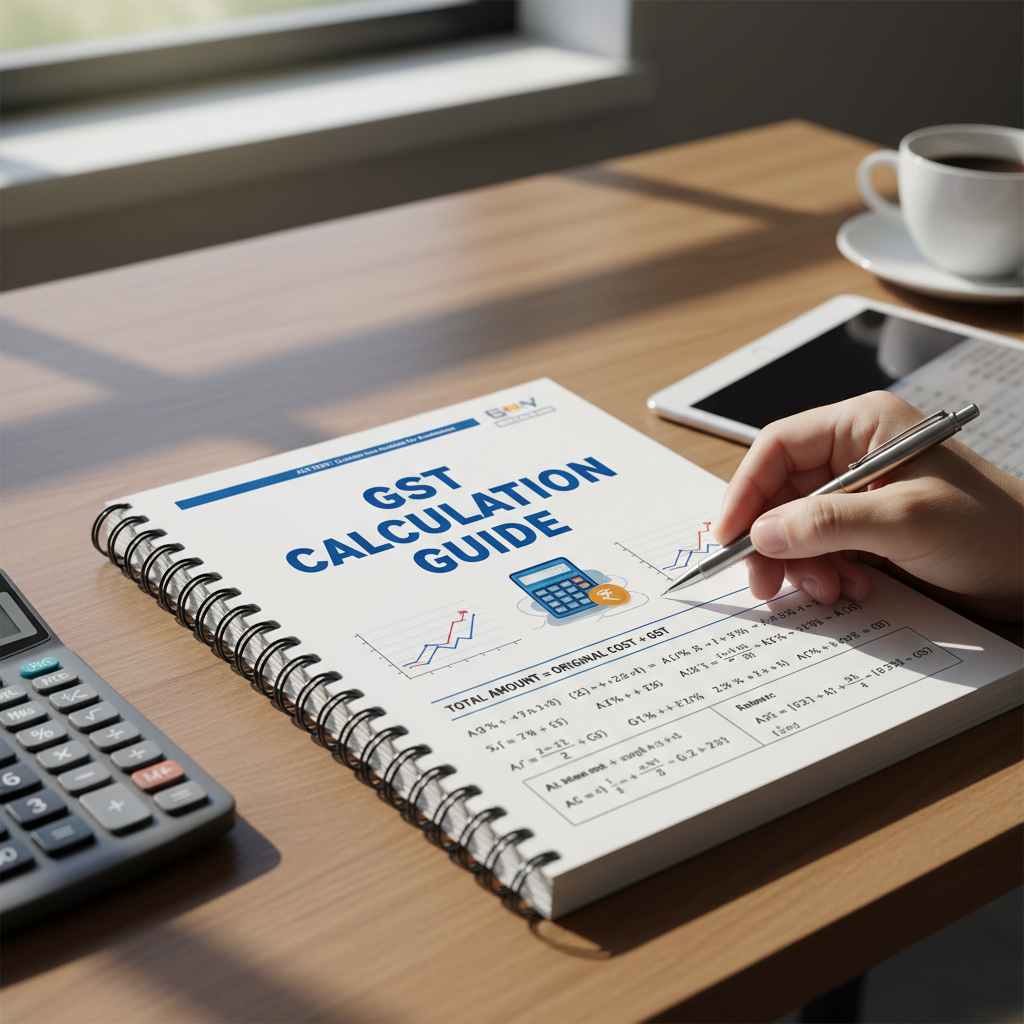
Decoding GST: Why Mastering the GST Calculation Formula India with Examples is Crucial
The Goods and Services Tax (GST) revolutionized India’s indirect tax structure, consolidating numerous central and state levies into a single, comprehensive tax. While the concept aims for simplicity, the actual application and calculation often pose challenges for businesses, especially SMEs and newcomers. Accurate financial reporting and compliance hinge entirely on understanding the precise gst calculation formula india with examples.
This comprehensive guide breaks down the complex mechanics of GST calculation. We will walk you through the core formulas, illustrate them with practical scenarios, explain the vital role of Input Tax Credit (ITC), and provide actionable steps to ensure your business remains compliant and maximizes tax efficiency. By the end of this article, you will have a clear, actionable roadmap for handling all your GST obligations.
Understanding the Foundation: Components and Rates of GST
Before diving into the mathematics, it is essential to recognize the different components of GST and the applicable tax slabs. GST is levied based on whether the transaction is intra-state (within the same state) or inter-state (between different states or union territories).
The Four Pillars of GST
- CGST (Central GST): Tax levied by the Central Government on intra-state supply.
- SGST (State GST): Tax levied by the State Government on intra-state supply.
- IGST (Integrated GST): Tax levied by the Central Government on inter-state supply and imports. IGST is the sum of CGST and SGST.
- UTGST (Union Territory GST): Replaces SGST in Union Territories without legislatures (e.g., Andaman & Nicobar Islands, Chandigarh).
Current Standard GST Slabs (India)
The GST Council determines the rates based on the classification of goods and services. Most essential items fall into the lower categories, while luxury goods attract the highest rate.
- 0% (Nil Rate): Essential food items, books, certain raw materials.
- 5%: Household necessities, basic services, packaged food items.
- 12%: Processed food, apparel above certain price points, common services.
- 18%: Standard rate for most goods and services, including IT services, financial services, and capital goods.
- 28%: Luxury goods, sin goods (tobacco, aerated drinks), and specific automobiles.
Key Takeaway on Jurisdiction
If you sell goods worth Rs 10,000 within Maharashtra at an 18% rate, the tax is split: 9% CGST (Rs 900) and 9% SGST (Rs 900). If you sell the same goods from Maharashtra to Gujarat, the tax is 18% IGST (Rs 1,800), which goes entirely to the Central Government, later apportioned to the consuming state.
Applying the Core GST Calculation Formula India with Examples
There are two primary scenarios for GST calculation: calculating the tax amount when it is added to the base price, and calculating the base price when the GST amount is already included (reverse calculation).
Formula 1: Calculating GST Amount (Tax Added)
This is the most common calculation where the supplier determines the tax to be charged over the cost of the goods or services.
GST Amount = (Original Cost × GST Rate) / 100
Total Invoice Value = Original Cost + GST Amount
Example 1: Intra-State GST Calculation (18% Rate)
A vendor in Karnataka sells services to a client also in Karnataka. The base price of the service is Rs 50,000, and the applicable GST rate is 18%.
- Determine Rates: Since it’s intra-state, the rate is split: CGST = 9% and SGST = 9%.
- Calculate CGST: (50,000 × 9) / 100 = Rs 4,500
- Calculate SGST: (50,000 × 9) / 100 = Rs 4,500
- Total GST Amount: Rs 4,500 + Rs 4,500 = Rs 9,000
- Total Invoice Value: Rs 50,000 (Base) + Rs 9,000 (GST) = Rs 59,000
Formula 2: Reverse GST Calculation (Tax Included)
Sometimes, a price is quoted as “all-inclusive,” and the business needs to determine how much of that price represents the GST component to ensure accurate reporting and Input Tax Credit claims. This requires a reverse application of the gst calculation formula india with examples.
GST Amount = Total Value × [GST Rate / (100 + GST Rate)]
Taxable Value (Base Price) = Total Value – GST Amount
Example 2: Reverse Calculation (28% Rate)
An automobile part is sold for an all-inclusive price of Rs 1,28,000, and the applicable GST rate is 28% (IGST for simplicity).
- Calculate GST Amount: 1,28,000 × [28 / (100 + 28)]
- Calculation: 1,28,000 × (28 / 128) = 1,28,000 × 0.21875 = Rs 28,000
- Calculate Taxable Value: 1,28,000 (Total) – Rs 28,000 (GST) = Rs 1,00,000 (Base Price)
This reverse calculation is vital for ensuring that the tax component is properly isolated for compliance purposes. To handle these complex calculations quickly and accurately, leveraging an online tool is essential. We recommend using a dedicated GST Calculator.
The Backbone of GST: Mastering the Input Tax Credit (ITC) Mechanism
The core philosophy of GST is to eliminate the cascading effect of taxes (tax on tax). This is achieved through the Input Tax Credit (ITC) mechanism. ITC allows a registered business to claim credit for the GST paid on the purchase of goods or services used in the course or furtherance of its business.
How ITC Impacts Your Final Tax Liability
Your actual GST liability (the amount you pay to the government) is not the total GST collected from customers; rather, it is the net difference between the output GST (collected) and the input GST (paid).
Net GST Payable = Output Tax Liability – Eligible Input Tax Credit
Step-by-Step ITC Flow
- Purchase: Pay GST (Input Tax) to your supplier.
- Sale: Collect GST (Output Tax) from your customer.
- Claim: Deduct the Input Tax paid from the Output Tax collected.
- Pay: Remit the balance (Net GST Payable) to the government.
The Matching Principle
ITC claims are subject to the matching principle, meaning the input tax claimed must match the tax reported by your supplier in their GSTR-1 filing, reflected in your GSTR-2B. This ensures transparency and prevents fraudulent claims.
Credit Utilization Hierarchy
The GST law mandates a specific order for utilizing ITC:
- IGST credit must first be used to offset IGST liability, then CGST, and finally SGST/UTGST.
- CGST credit can only offset CGST or IGST liability.
- SGST/UTGST credit can only offset SGST/UTGST or IGST liability.
Tax consultants often emphasize that proper documentation is paramount for maximizing ITC claims. “Failing to secure proper, compliant invoices is the single biggest cause of lost ITC for SMEs,” notes a leading tax expert. Ensuring all your documentation, including invoices, is clear and compliant is crucial, much like optimizing digital assets for visibility, as discussed in our guide on Meta Tag Analyzer.
A Detailed Guide to Using the GST Calculation Formula India with Examples (PK 3)
Implementing the GST calculation correctly involves more than just plugging numbers into a formula; it requires systematic pre-analysis and classification.
Step 1: Classification and HSN/SAC Code Identification
Every good or service in India is assigned a unique code:
- HSN (Harmonized System of Nomenclature): Used for goods.
- SAC (Services Accounting Code): Used for services.
The HSN/SAC code determines the precise GST rate applicable. Misclassification is a common compliance error that leads to incorrect tax remittance.
Step 2: Determining the Nature of Supply (Intra vs. Inter-State)
The location of the supplier and the place of supply (POS) dictate whether CGST/SGST or IGST is applicable. The POS rules are complex, particularly for services, and must be correctly identified before applying the gst calculation formula india with examples.
Step 3: Applying the Appropriate Formula
Once the rate and supply type are confirmed, apply the relevant formula (Tax Added or Tax Included) established earlier. If the transaction involves discounts, the GST is calculated on the value after the discount, provided the discount is recorded on the invoice.
Example 3: Net GST Payable Calculation
A business in Mumbai (Maharashtra) has the following transactions in a month:
- Output Tax Liability: GST Collected (CGST: Rs 15,000, SGST: Rs 15,000)
- Input Tax Credit: GST Paid (CGST: Rs 8,000, SGST: Rs 8,000)
- CGST Payable: Output CGST (15,000) – Input CGST (8,000) = Rs 7,000
- SGST Payable: Output SGST (15,000) – Input SGST (8,000) = Rs 7,000
- Total Net Liability: Rs 14,000
This systematic approach ensures that the total tax burden is accurately accounted for, minimizing risk during audits.
Compliance and Common Errors in GST Calculations (PK 4)
While the basic calculation is straightforward, complex scenarios like exempt supplies, reverse charge mechanisms (RCM), and composite supplies often lead to calculation errors.
Mistake 1: Incorrect Rate Application
Applying the wrong GST rate due to misclassification of goods (e.g., confusing 12% vs. 18% HSN codes). This can lead to short payment of tax and subsequent penalties.
Mistake 2: Failing to Account for RCM
In RCM scenarios, the recipient, not the supplier, is liable to pay GST. Failing to calculate and remit RCM liability is a major compliance risk.
Mistake 3: Errors in Place of Supply (POS)
Mistaking an inter-state supply for an intra-state supply (or vice versa) leads to paying the wrong tax head (IGST instead of CGST/SGST). This tax is considered non-existent until rectified.
For the most current and official rate notifications, taxpayers should always refer to the Central Board of Indirect Taxes and Customs (CBIC) official portal, which serves as the ultimate source of truth for compliance (CBIC Official Site). Understanding the broader economic implications of GST compliance is key for business strategy, as regularly analyzed by major financial institutions and publications (The Economic Times).
Conclusion: Simplify Your GST Compliance
Mastering the gst calculation formula india with examples is non-negotiable for business success and regulatory adherence. Whether you are calculating the forward charge for a standard sale or performing the reverse calculation to determine the taxable value, accuracy is paramount. By diligently applying the formulas, correctly identifying HSN/SAC codes, and efficiently managing your Input Tax Credit, you can navigate the complexities of GST with confidence and ensure robust financial health. Consistent use of reliable tools and adherence to the prescribed calculation methods will streamline your monthly compliance process significantly.
FAQs
The basic formula is: GST Amount = (Base Price × GST Rate) / 100. The Total Invoice Value is then Base Price + GST Amount. If the rate is 18%, and the base price is Rs 100, the GST is Rs 18, and the total value is Rs 118.
For inter-state (outside the state) transactions, only Integrated GST (IGST) is applicable. The IGST rate is the combined rate of CGST and SGST (e.g., if the intra-state rate is 9% CGST + 9% SGST, the IGST rate is 18%). The calculation uses the same formula but substitutes the combined rate.
ITC is the credit a business receives for the GST paid on purchases used for business operations. It reduces the final tax liability. The calculation is: Net GST Payable = GST collected from customers (Output Tax) minus GST paid on inputs (Input Tax Credit).
No. While most business inputs are eligible, there are specific block credits under Section 17(5) of the CGST Act. Examples include motor vehicles for personal use, certain construction services, and food and beverages (unless used for further supply).
GST added (Forward Charge) calculates the tax on a known base price. GST included (Reverse Calculation) determines the tax component and the base price when only the total, all-inclusive selling price is known. The reverse calculation formula is crucial for isolating the taxable value when a single inclusive price is advertised.
Read Also:
- Mastering Exchange Rates: The Definitive Guide to Using a USD to INR Currency Converter Live
- The Ultimate Guide to Crafting SEO Friendly URL Slugs: Choosing the Right Generator
- The Ultimate Guide to Accurately Check Website Page Load Speed Google Metrics and Boost Performance
- The Ultimate Guide to Compress JPEG to 50KB Online Without Losing Quality
- Mastering the Math: How to Accurately Calculate Age in Years, Months, and Days
- Stop Being Broke: Your 2026 Budget Plan
- Yandex Image Search: The 2026 Pro Guide