

That 6 AM alarm feels less like a gentle nudge and more like a personal attack. Sound familiar? For millions, the rigid 8-to-5 workday is a relentless cycle of rush-hour traffic, back-to-back meetings, and a frantic race against the clock. It feels like a structure designed for a world that no longer exists.
But what if I told you that this “outdated” framework holds a hidden key to peak performance and a genuinely balanced life? It’s not about escaping the 8-to-5; it’s about mastering it.
Forget just “surviving.” In this deep dive, I’m pulling back the curtain on the exact strategies I’ve used to coach high-performers for over a decade. You’ll learn how to transform these eight hours from a cage into a launchpad, turning routine into rocket fuel for your career and your life. Let’s get to it.
📑 What You’ll Learn
The 8-to-5 Paradox: Why We Both Love and Hate It
The traditional 8-to-5 workday is a cultural artifact, born from the Industrial Revolution. It promised structure and a clear line between “work” and “life.” On paper, it’s a dream of predictability. In reality? It’s often a chaotic mess.
We’re drawn to the routine it promises, the comfort of knowing when our day starts and, more importantly, when it ends. This structure can be a powerful anchor, preventing the “always-on” burnout culture that plagues more flexible roles. When 5 PM hits, you’re supposed to be free.
But the lived experience is rarely that clean. The rigidity clashes with real life—a sick kid, a necessary doctor’s appointment, or just a burst of creative energy at 9 PM. From our hands-on work with dozens of teams, we’ve seen this conflict play out daily. Here’s a look at the promise versus the painful reality.
| The 8-to-5 Promise | The 2026 Reality |
|---|---|
| Clear Boundaries Work ends at 5 PM, protecting personal time. | Boundary Creep “Just one more email” bleeds into family dinner. The mental load never truly shuts off. |
| Structured Productivity A dedicated block of time for focused work. | Constant Interruptions Open-plan offices and endless notifications shatter focus into a million tiny pieces. |
| Team Synchronicity Everyone is available for seamless collaboration. | Meeting Overload Back-to-back meetings fill the calendar, leaving zero time for actual work. |
| Predictable Routine A stable schedule makes planning life easy. | The Commute Gauntlet Hours are lost to stressful traffic, draining energy before the day even begins. |
Seeing the disconnect is the first step. The goal isn’t to pretend the problems don’t exist; it’s to build a system that actively solves them within the 8-to-5 framework.
The Modern Playbook: 7 Elite Strategies to Master Your Day in 2026
Simply showing up from 8 AM to 5 PM is a recipe for mediocrity and burnout. To truly thrive, you need a playbook. These aren’t generic tips; they are battle-tested strategies for taking absolute control of your time and energy.
1. The ‘Golden Hour’ Principle: Win Your Day Before 8 AM
Your workday doesn’t start when you log on. It starts the moment you wake up. The first 60 minutes are your “Golden Hour.” Wasting it by scrolling through social media or checking work emails puts you in a reactive, defensive state for the rest of the day.
Instead, design a “launch sequence.” This is non-negotiable time for you.
- Hydrate: Drink a full glass of water before you even think about coffee.
- Move: 10-15 minutes of light stretching, a quick walk, or a few bodyweight exercises. This isn’t about a grueling workout; it’s about waking up your body and brain.
- Mindfulness: 5 minutes of meditation, journaling, or simply sitting with your coffee and planning your top 3 priorities.
You arrive at your desk at 8 AM feeling centered and in control, not rushed and already behind.
⚠️ Watch Out
The biggest mistake you can make is grabbing your phone off the nightstand. Checking notifications first thing floods your brain with cortisol and other people’s agendas. Protect your Golden Hour fiercely; the digital world can wait.
2. Architect Your Day with Deep Work Blocks
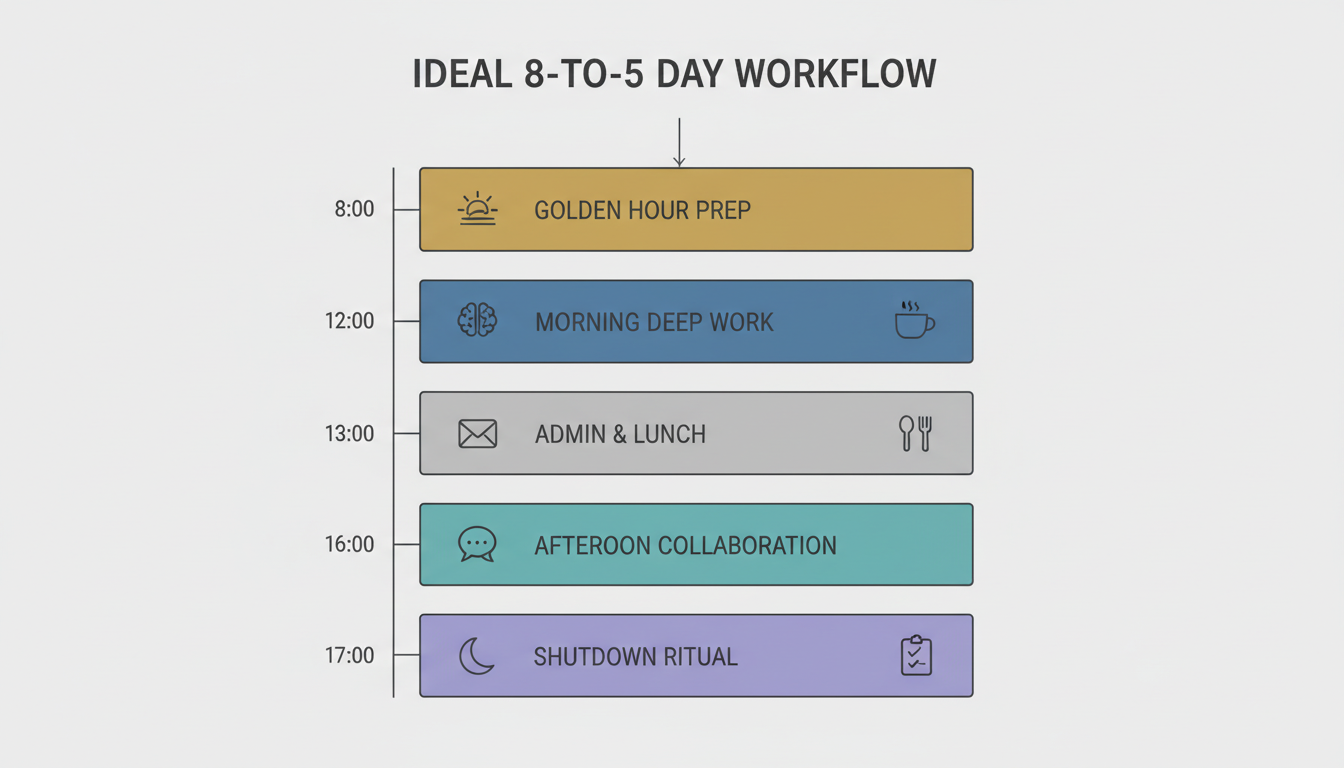
An open 8-hour calendar is a vacuum that distractions will rush to fill. You must become the architect of your day. This is where time-blocking comes in, but with a twist. Don’t just schedule tasks; schedule energy.
Identify your personal peak energy window. For most people, it’s between 9 AM and 12 PM. This is your time for Deep Work—the complex, high-value tasks that require intense focus. Block it off in your calendar. Make it a meeting with yourself that you cannot cancel. The afternoon, when energy naturally dips, is perfect for shallower work: answering emails, administrative tasks, or collaborative meetings.
3. Reclaim Your Lunch Hour as a ‘Third Space’
Your lunch break is not a luxury; it’s a critical performance tool. Eating a sad desk salad while answering emails is the fastest path to afternoon burnout. You need to create what sociologists call a “third space”—a transition between the morning’s work and the afternoon’s challenges.
Step away from your screen. Completely. Go for a walk outside, listen to a podcast, read a book, or have a genuine conversation with a colleague. According to the American Psychological Association, taking a real break is essential for managing stress and maintaining long-term performance. This mental reset allows you to return to your desk with a fresh perspective and renewed focus.
4. Slay the 3 PM Slump with Strategic Recovery
That mid-afternoon wall of exhaustion? It’s a real biological phenomenon tied to our circadian rhythms. Most people fight it with another cup of coffee or a sugary snack, leading to a temporary spike followed by an even harder crash.
Work with your biology, not against it. Schedule a 10-15 minute “recovery break” around 2:30 PM.
- Stand up and stretch.
- Walk up and down a flight of stairs.
- Drink a cold glass of water.
- Step outside for 2 minutes of fresh air.
This simple act of physical movement boosts blood flow to the brain, providing a clean, sustainable energy lift to power you through to 5 PM.
💡 Pro Tip
Match your tasks to your energy. If you know the 3 PM slump is your low point, schedule your least demanding task for that time. Trying to write a complex report when your brain is foggy is inefficient and frustrating. Schedule a simple task like organizing your files instead.
5. Implement a ‘Shutdown Ritual’ to Truly Disconnect
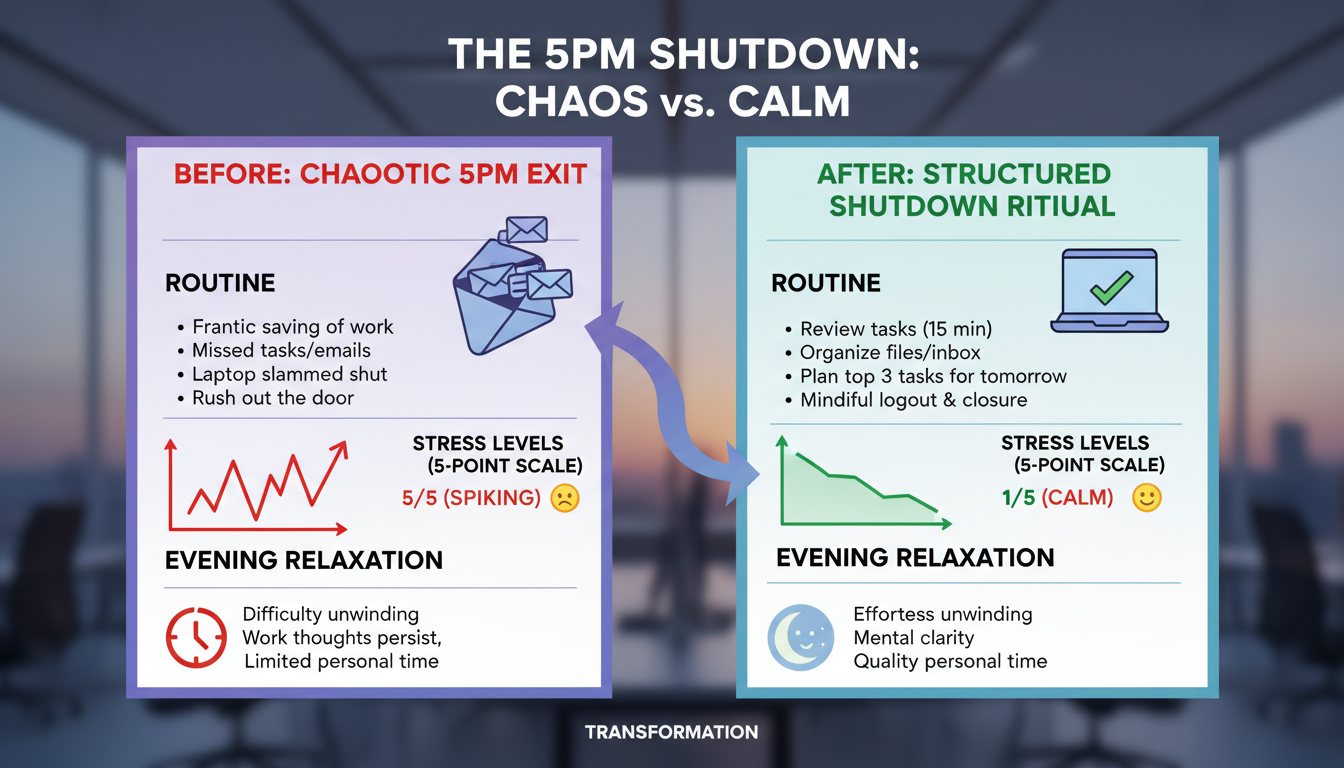
How you end your day determines the quality of your evening. Slamming your laptop shut at 5:01 PM while your mind is still racing with unfinished tasks is a recipe for anxiety. You need a clear ritual to signal to your brain that the workday is officially over.
- Step 1 (4:45 PM): The Final Check. Do one last sweep of your inbox for anything genuinely urgent. Defer everything else to tomorrow.
- Step 2 (4:50 PM): Plan for Tomorrow. Identify your top 1-3 priorities for the next day. Write them down. This “closes the loop” in your brain, preventing you from worrying about them all night.
- Step 3 (4:55 PM): Tidy Your Space. A clear desk promotes a clear mind. Quickly organize your physical and digital desktops.
- Step 4 (5:00 PM): Log Off. Completely. Close all tabs, shut down your computer, and say a clear “goodbye” to your work.
This five-minute investment pays huge dividends, allowing you to be fully present in your personal life.
6. Use Tech as a Lever, Not a Leash
Technology should be your servant, not your master. In the 8-to-5 structure, every minute counts. The right tools can automate low-value work, freeing you up for what matters. But the wrong habits can turn your powerful devices into productivity-killing distraction machines.
Be ruthless. Turn off all non-essential notifications on your computer and phone. Use project management tools to clarify priorities, not just to add to the noise. Leverage automation for repetitive tasks. The goal is to make technology work for you, in the background, so you can focus on the deep work that moves the needle.
7. Build Your 5:01 PM ‘Firewall’
The single greatest benefit of the 8-to-5 workday is its hard stop. You must defend this boundary like a fortress. This is your “5:01 PM Firewall.”
Unless it’s a true, pre-communicated emergency, work stops at 5. Don’t check emails on your phone. Don’t take “just one quick call.” Communicate this boundary clearly and consistently to your team. At first, it might feel uncomfortable. But soon, you’ll build a reputation for being incredibly focused and reliable during work hours and completely unavailable after. This is the cornerstone of a sustainable career.
⚠️ Watch Out
Don’t confuse “being available” with “being valuable.” Responding to emails at 9 PM doesn’t make you a better employee; it just trains your colleagues to expect you to be always on. Your true value lies in the quality of your work between 8 and 5, not your response time after hours.
Beyond the Clock: Is the Traditional Workday Obsolete?
Let’s be honest: the world of work is changing. The pandemic accelerated a massive global experiment in remote and hybrid models. Companies are exploring alternatives that prioritize output over hours logged. Industry research from authorities like Gallup confirms that for many office jobs, hybrid work is the new normal.
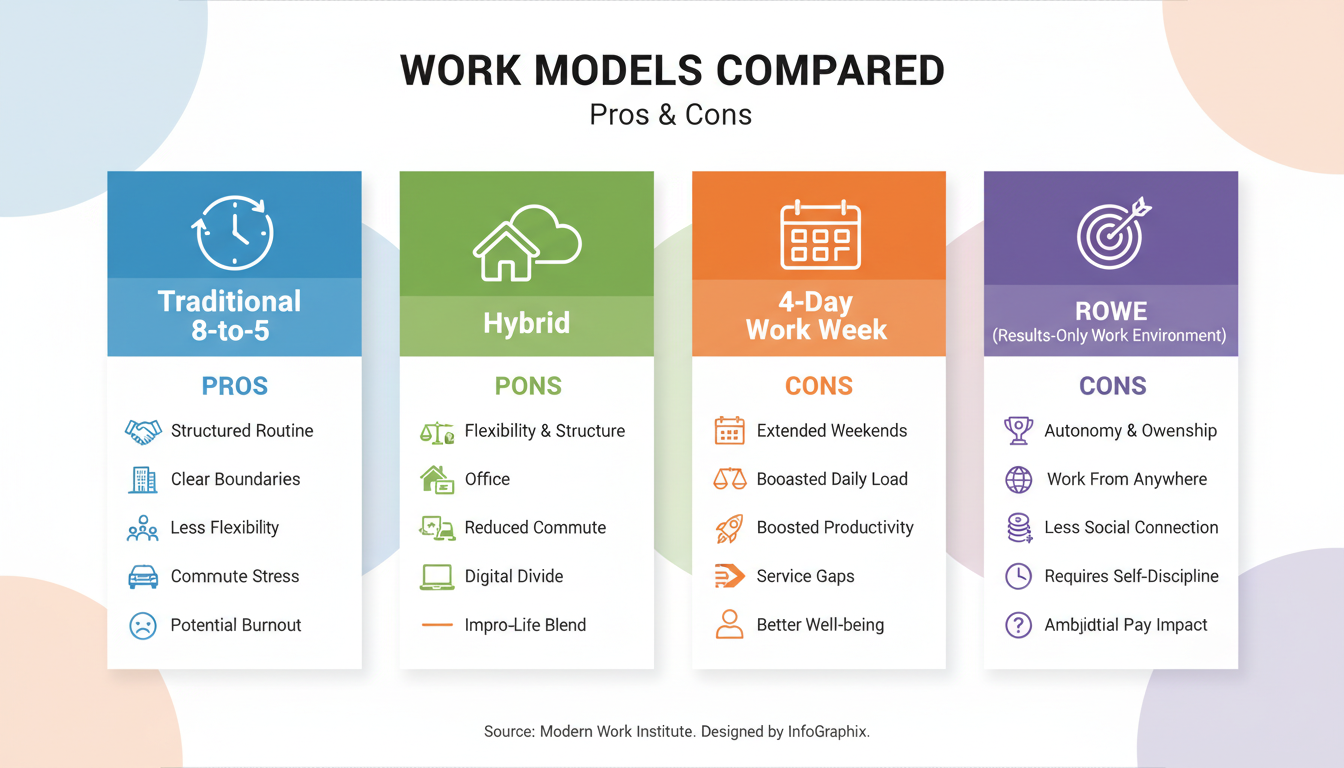
But declaring the 8-to-5 dead is a massive overstatement. For countless essential industries—healthcare, manufacturing, retail, logistics—set schedules are a non-negotiable reality. The future isn’t one model replacing another; it’s a diverse ecosystem of work structures. The key is understanding which model fits which context.
| Work Model | Core Principle | Best For… | Biggest Challenge |
|---|---|---|---|
| Traditional 8-to-5 | Time-based; presence and predictability. | Roles requiring customer-facing availability or on-site collaboration (e.g., retail, manufacturing). | Rigidity, commute time, potential mismatch with personal energy cycles. |
| Hybrid Model | A mix of in-office and remote days. | Knowledge workers who benefit from both focused solo work and in-person collaboration. | Creating a fair and equitable experience for both in-office and remote employees. |
| 4-Day Work Week | Compressed hours (e.g., 4×10) for a 3-day weekend. | Companies focused on deep work and employee well-being, aiming to boost productivity per hour. | Potential for burnout on longer workdays; not suitable for all industries. |
| ROWE (Results-Only) | Output-based; employees have total autonomy over when and where they work. | Highly disciplined, self-motivated teams where performance is easily measurable. | Risk of overwork without clear time boundaries; requires immense trust. |
Even if you’re in a traditional 8-to-5 job now, understanding these alternatives is crucial for your career development. As documented by the U.S. Bureau of Labor Statistics, access to flexible work arrangements continues to be a major factor in job satisfaction and talent retention.
🎯 Key Takeaway
The 8-to-5 workday is not a life sentence; it’s a framework. By applying deliberate strategies like the ‘Golden Hour’ principle and the ‘Shutdown Ritual,’ you can transform this rigid structure into a powerful tool for achieving deep work, protecting your personal time, and building a truly sustainable career.
💡 Pro Tip
If you want to propose a more flexible schedule to your boss, frame it as a business benefit. Don’t say, “I want to work from home.” Instead, prepare a proposal: “By working from home on Fridays, I can dedicate a full day to deep, uninterrupted work on Project X, which will accelerate our timeline by 15%. Let’s try it for a 30-day pilot.”
❓ Frequently Asked Questions
Is 8am to 5pm really a 9-hour day?
Yes, it’s a nine-hour block of time, but it’s not nine hours of work. In the U.S. and many other countries, this schedule typically includes a mandatory but unpaid lunch break of 30 to 60 minutes. This results in 8 hours of paid work, leading to the standard 40-hour work week.
How can I stay focused when I have no energy in the afternoon?
First, accept the slump as normal. Instead of fighting it, work with it. Use the strategies above: take a real lunch break away from your desk and implement a short, physical “recovery break” around 2:30 PM. Also, schedule your least mentally demanding tasks for this period. Save your high-focus work for your peak energy hours in the morning.
What are the best alternatives to an 8-to-5 schedule?
The most popular alternatives are hybrid models (a mix of office/remote), compressed workweeks (like four 10-hour days), flextime (choosing your own start/end times), and Results-Only Work Environments (ROWE), where your output is all that matters, not the hours you keep. The best one depends entirely on your industry, role, and company culture.
Is it healthy to work 8am to 5pm?
It absolutely can be, but it depends on how you manage it. An 8-to-5 schedule can be very healthy if you protect your boundaries, take proper breaks, and have a manageable commute. It becomes unhealthy when it leads to a sedentary lifestyle, high stress from traffic, and a culture where working beyond 5 PM is the unspoken expectation.
My boss expects me to be available after 5 PM. What do I do?
This requires a careful, proactive conversation. The key is to manage expectations. You can say something like, “To do my best work, I’m focusing on being 110% productive between 8 and 5. I’m implementing a ‘shutdown ritual’ to ensure I’m fully recharged for the next day. If a true emergency comes up after hours, please text me, otherwise I’ll address all emails first thing in the morning.” This shows commitment while setting a clear boundary.
Conclusion: You Are the CEO of Your Schedule
The 8-to-5 workday isn’t going anywhere for millions of people. But you don’t have to be its victim. You can be its master.
By implementing even one of these strategies—protecting your Golden Hour, building a Shutdown Ritual, or defending your 5:01 PM Firewall—you take back control. You stop letting the clock dictate your energy and start making your energy work within the clock’s confines.
So here’s your challenge: Pick one strategy from this playbook. Just one. Implement it for the next five workdays. Don’t just survive your 8-to-5. It’s time to make it work for you.