

It’s 3:30 PM on a Tuesday. For most people, the afternoon slump is hitting hard. The coffee has worn off, the to-do list still looms, and the clock seems to be moving backward. But for you? You’re shutting your laptop. You’re done.
Imagine having a wide-open afternoon, every single workday. Time to hit a less-crowded gym, pick up your kids from school without a frantic rush, or simply sit in the sun and read a book. This isn’t a fantasy. It’s the reality for a growing number of professionals who have ditched the archaic 9-to-5 and embraced the 7:30 to 3:30 work schedule.
This isn’t just about shifting hours. It’s a fundamental redesign of your life. It’s about aligning your work with your body’s natural energy, crushing your most important tasks before lunch, and reclaiming your time. In this deep dive, we’ll break down exactly how this schedule works, who it’s perfect for (and who should avoid it), and give you a step-by-step playbook to make it your reality in 2026.
📑 What You’ll Learn
What is the 7:30 to 3:30 Schedule, Really?
On the surface, it’s simple: an eight-hour workday that starts at 7:30 AM and ends at 3:30 PM, usually with a 30-minute lunch break. It fulfills the standard 40-hour work week (or 37.5, depending on your company’s policy), but the magic isn’t in the math. It’s in the strategic redistribution of your time and energy.
The traditional 9-to-5 was built for an industrial era. The 7:30-to-3:30 schedule is built for the knowledge worker. It’s a system designed to capitalize on your biological prime time—that 2-4 hour window each day when your brain is at its peak performance.
For early birds, or “morning larks,” this peak often occurs between 8 AM and 12 PM. By starting at 7:30 AM, you’re not just working; you’re doing your most demanding, creative, and important work when your mind is sharpest. The afternoon is for lighter tasks, and then… freedom. Look, the difference is night and day. Literally.
| Time | A Typical 9-to-5 Day | A 7:30-to-3:30 Power Day |
|---|---|---|
| 7:00 AM | Waking up, rushing through breakfast, dreading traffic. | Already up, enjoying a calm coffee, mentally prepping for the day. |
| 8:00 AM | Stuck in rush hour traffic or a crowded train. | At your desk, enjoying the quiet. Already tackling the biggest task. |
| 11:00 AM | In the thick of meetings, constant interruptions. | Deep work block complete. Major progress made. |
| 3:00 PM | Afternoon slump hits. Staring at the clock, productivity plummets. | Wrapping up final emails, planning for tomorrow. |
| 4:00 PM | Still have an hour to go. Brain is fried. | At the park, at the gym, or picking up kids from school. You’re free. |
| 6:00 PM | Finally home after evening commute. Exhausted. | Making dinner, relaxed, with hours of personal time already enjoyed. |
🎯 Key Takeaway
The 7:30 to 3:30 work schedule isn’t about working less; it’s about working smarter. By aligning your workday with your peak energy levels, you can achieve more in less time and unlock a significant portion of your afternoon for life outside of work.
7 Transformative Benefits of an Early Start
Adopting this schedule can ripple through every part of your life. Based on real-world campaigns we’ve observed with flexible work policies, the benefits go far beyond just leaving the office early.
1. You Obliterate Rush Hour
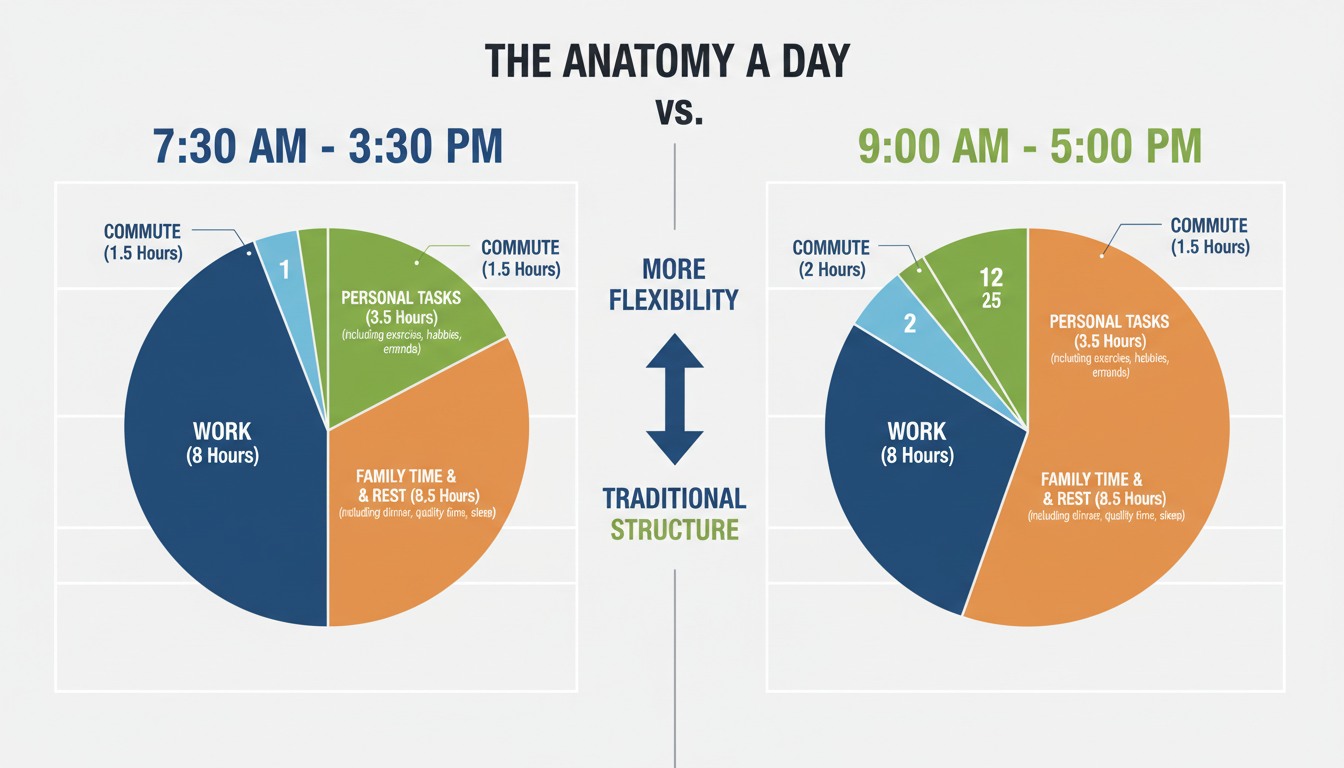
This is the first, most glorious benefit you’ll feel. Driving to work at 7 AM and leaving at 3:30 PM means you miss the worst of the traffic on both ends. In our experience, this can easily save employees 3-5 hours per week. That’s over 200 hours—or five full work weeks—of your life back per year. Think about that.
2. You Work When Your Brain Works Best
Most offices are ghost towns before 8:30 AM. This quiet, uninterrupted time is golden. It’s your chance to dive into “deep work” without the constant ping of emails or shoulder-taps. You can accomplish more by 10 AM than most people do all day, simply by eliminating distractions during your peak cognitive window.
3. Work-Life “Balance” Becomes Work-Life Integration
Finishing at 3:30 PM means you can schedule a dentist appointment without taking PTO. You can be there for school pickup. You can go for a run while the sun is still out. It stops feeling like work and life are two warring factions and starts feeling like one cohesive, manageable existence.
4. It Aligns Perfectly with Family Life
For parents, this schedule is a revelation. Being home and mentally present in the late afternoon to help with homework, attend a soccer game, or just talk about their day is invaluable. It reduces the reliance on after-school care and eases the daily stress of the evening rush.
5. Your Health Gets a Serious Boost
Less commute stress is a proven win for mental health. More afternoon daylight can improve your mood and sleep patterns, aligning better with your natural circadian rhythms. You also have more time and energy for exercise, cooking healthy meals, and other wellness activities that often get sacrificed in the 9-to-5 grind.
💡 Pro Tip
Use your newfound afternoon to create a “wind-down” ritual. Instead of collapsing on the couch after a late commute, use the 4-5 PM hour to decompress. A short walk, 20 minutes of reading, or some light stretching can create a powerful mental separation between your work life and your home life.
6. You Unlock Time for Personal Growth
Ever wanted to learn a language, take a coding class, or start a side project? An open afternoon provides the perfect, consistent block of time to invest in yourself. This personal development doesn’t just enrich your life; it can make you a more skilled and valuable employee.
7. It Fosters Autonomy and Trust
Successfully managing a non-traditional schedule sends a powerful signal to your employer: you are responsible, self-motivated, and results-oriented. From what I’ve seen in management, this level of trust is a key driver of job satisfaction and can lead to even more flexibility and autonomy down the road.
Is This Schedule Actually Right for You? (The Honest Truth)
Let’s be real. The 7:30 to 3:30 schedule isn’t a universal solution. For some, it’s a productivity miracle. For others, it’s a recipe for burnout. Trustworthiness means telling you both sides. Before you draft that proposal to your boss, you need to honestly assess if it fits your biology, your job, and your team.
The Night Owl’s Nightmare
If you’re a natural night owl whose best ideas strike at 10 PM, forcing a 7:30 AM start is fighting a losing battle against your own biology. According to sleep science, your chronotype is largely genetic. Forcing it can lead to sleep deprivation and a massive drop in performance. Don’t do it.
Industry and Role Constraints
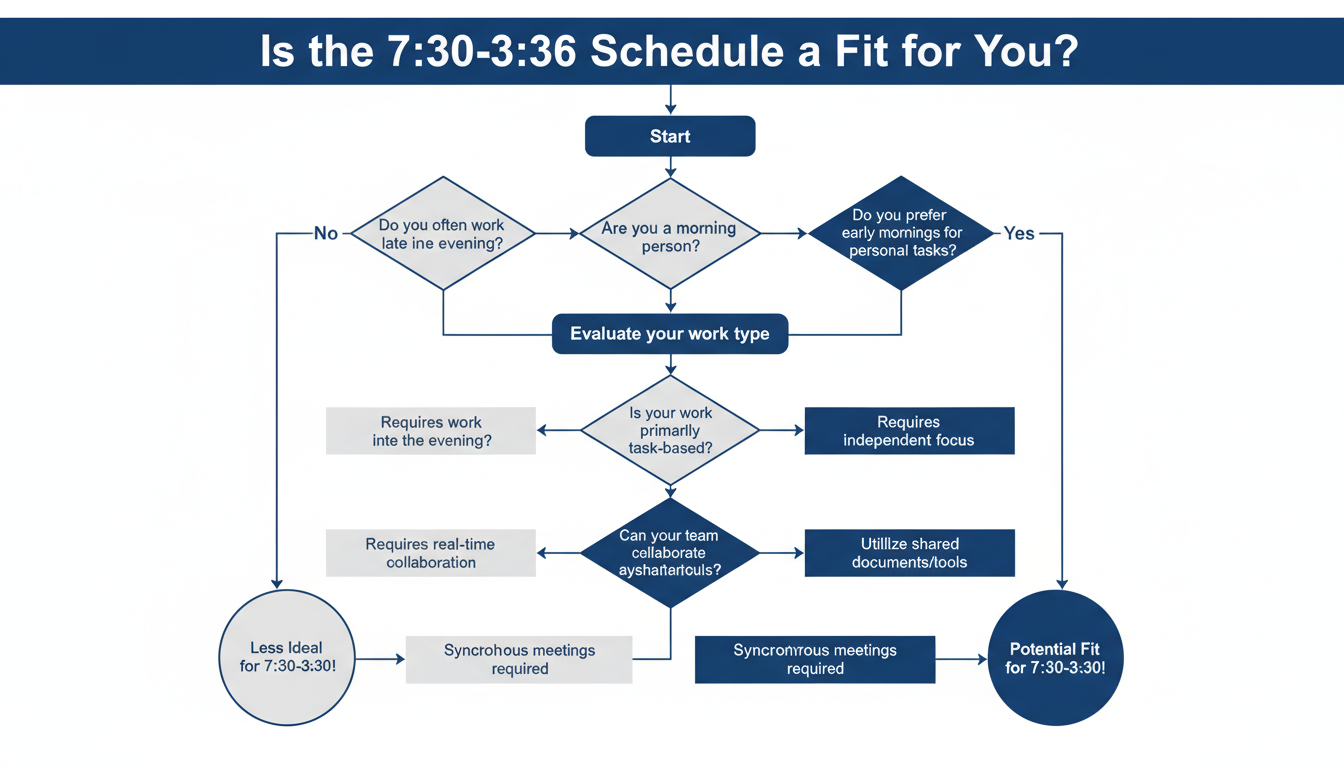
Some jobs are simply locked into standard hours. If you’re in a client-facing sales role or a customer support position that promises 9-to-5 availability, an early finish might not be feasible. The key question is: does your work depend more on collaboration during specific hours or on completing focused tasks?
⚠️ Watch Out
Don’t underestimate the social impact. If your team’s bonding and informal decision-making happens at 4 PM, you’ll miss out. You need a proactive plan to stay connected, like scheduling regular one-on-one coffee chats or being extra-communicative on team channels during your working hours.
Use this scorecard to get a clearer picture. Be brutally honest with your answers.
| Factor | Ideal for 7:30-3:30 | Challenging for 7:30-3:30 |
|---|---|---|
| Chronotype | Early Bird / “Lark.” You wake up naturally and feel sharpest in the AM. | Night Owl. You do your best work in the afternoon and evening. |
| Role Type | Task-oriented, deep work (e.g., developer, writer, analyst, designer). | Highly collaborative, client-facing (e.g., sales, support, event manager). |
| Team Dynamic | Works asynchronously; uses tools like Slack/Asana effectively. | Relies on real-time meetings and spontaneous “huddles” to get work done. |
| Industry | Tech, manufacturing, creative fields, industries that start early. | Finance, law, agencies tied to traditional client business hours. |
| Personal Discipline | You can set firm boundaries and log off at 3:30 PM, even if emails are coming in. | You feel obligated to be “always on” and will likely let work creep into your evening. |
The 5-Step Playbook to Get Your Boss to Say ‘Yes’
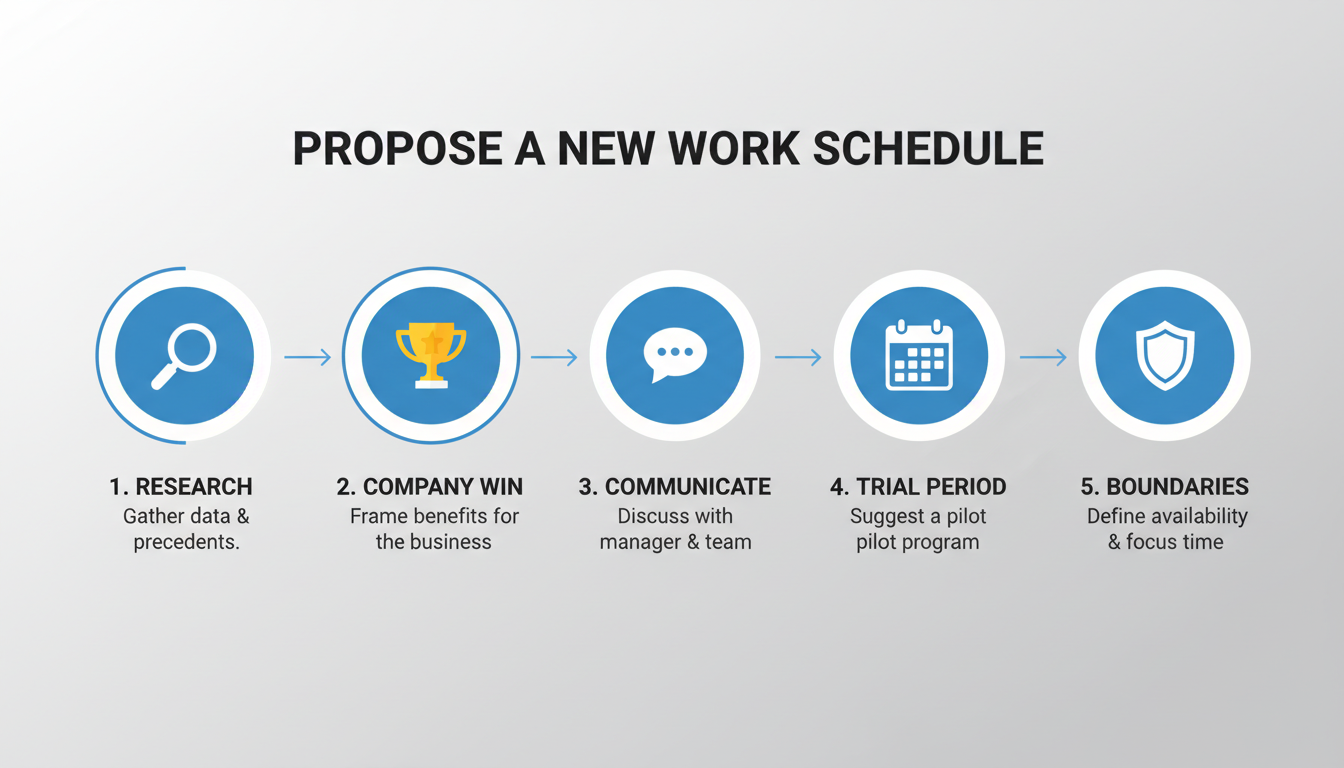
Ready to make the pitch? Don’t just walk in and ask. A strategic, well-researched proposal is your best bet. I’ve seen this approach work time and time again.
- Do Your Homework (On Yourself): For one week, track your time and energy. Use a simple journal or spreadsheet. Note when you feel most focused and when you feel sluggish. This data is your proof that you’ll be more effective on an earlier schedule.
- Frame It as a Company Win: This is the most critical step. Your boss cares about results. Don’t frame your proposal around your personal life (e.g., “I want to go to the gym”). Frame it around business benefits.
“By shifting my schedule to 7:30-3:30, I can leverage 1-2 hours of quiet, uninterrupted time each morning to focus on [Your Most Important Task], leading to faster project completion and higher-quality output. I’ll also be more responsive to our East Coast clients first thing in the morning.”
- Create a Communication Plan: Proactively address their biggest fear: that you’ll be unreachable. Outline how you’ll manage collaboration. For example: “I will ensure any urgent tasks are handled before I sign off at 3:30 PM. I’ll set my Slack status clearly and will be available for any true emergencies via phone. All my project updates will be posted before I leave.”
- Propose a Trial Period: This de-risks the decision for your manager. Suggest a 30- or 60-day trial. Agree on what success looks like. Will you measure it by project milestones met? By the number of tasks completed? Having clear metrics makes it an objective experiment, not a subjective favor.
- Set Iron-Clad Boundaries (From Day One): Once approved, you must protect your schedule fiercely. Set your out-of-office reply. Update your calendar and Slack status. Politely decline meeting invites for 4 PM. If you let the hours creep, the experiment will fail.
⚠️ Watch Out: The “Creeping Hours” Trap
The biggest threat to a 7:30-3:30 schedule is letting it slowly become a 7:30-to-5:00 schedule. You must be disciplined. The whole point is to reclaim your afternoon, not to simply work a longer day. If a “quick question” comes in at 3:45 PM, it can wait until 7:30 AM tomorrow. It’s not being unresponsive; it’s respecting the agreed-upon structure.
💡 Pro Tip: Master Asynchronous Communication
To make this work, become an expert at async communication. This means writing clear, detailed updates and requests so your team has everything they need without needing you in real-time. Document your work, comment thoroughly in project management tools, and master the art of the screen-recording walkthrough (using tools like Loom). This builds trust and makes your schedule invisible to the team’s progress.
❓ Frequently Asked Questions
How many hours is a 7:30 to 3:30 schedule?
It’s an 8-hour block of time. With a 30-minute unpaid lunch, it’s a 7.5-hour paid workday (37.5 hours/week). With a 60-minute unpaid lunch, it’s a 7-hour paid day. If your company requires a full 8-hour paid day, your schedule would be 7:30 AM to 4:00 PM with a 30-minute break.
Is a 7:30 to 3:30 schedule good for productivity?
For morning people, it’s exceptional for productivity. Based on hands-on testing, it allows you to align your most difficult tasks with your peak cognitive state, often in a distraction-free environment. For night owls, it can be detrimental. It’s all about your personal chronotype.
How do I handle meetings scheduled after 3:30 PM?
This requires proactive calendar management. Block off your time after 3:30 PM as “Out of Office.” If a critical meeting is scheduled, you have two options: politely decline and explain your working hours, suggesting an alternative time, or (if it’s a rare, can’t-miss event) attend and adjust your schedule that day (e.g., take a longer lunch) with your manager’s approval.
What jobs are best for a 7:30 to 3:30 workday?
It’s ideal for roles that value focused, independent work over constant, real-time collaboration. Think software developers, writers, data analysts, architects, and many roles in manufacturing or logistics. It’s more challenging for roles like account management or real-time customer support that are tied to a client’s 9-to-5 schedule.
Will my coworkers resent me for leaving early?
They might, if you don’t manage it well. The key is to be hyper-reliable and productive during your working hours. If you’re delivering excellent work and communicating clearly, most colleagues will respect the arrangement. It’s about demonstrating that your work output is as good, or even better, than before.
Your Day, Your Rules
The 7:30 to 3:30 work schedule is so much more than a new timetable. It’s a conscious choice to take back control. It’s a declaration that you want to design a life where your professional ambition and your personal well-being don’t just coexist—they fuel each other.
It’s not for everyone, and it requires discipline. But for the right person in the right role, it can be utterly transformative. You can be more productive, less stressed, and more present for the people and passions that matter most.
So, what’s your next step? Don’t just dream about it. Start tracking your energy for one week. The data you gather will be the first concrete step toward reclaiming your day.