
You just plugged in your brand-new, expensive appliance and… nothing. Or worse, it makes a strange humming sound, gets dangerously hot, and dies an early death. What went wrong? The answer might be hidden in plain sight, in two little numbers you’ve seen a thousand times: 60 Hz and its wattage.
Here’s the hard truth: searching for a “60 Hz to watts” conversion is like asking how to convert gallons into miles per hour. It’s a question based on a fundamental, and very common, misunderstanding.
You can’t convert them. They measure completely different things.
But don’t worry. This isn’t another dense engineering lecture. This is your clear, practical guide to finally understanding the relationship between these critical specs. By the end of this article, you’ll not only know why you can’t convert them, but you’ll also know the right way to find the wattage of any device you own. You’ll be able to protect your electronics, save money on your energy bill, and never be confused by an appliance label again.
📑 What You’ll Learn
The Fundamental Misconception: Why You Can’t Convert 60 Hz to Watts
Let’s get this out of the way immediately. Hertz (Hz) measures frequency. Watts (W) measure power. They are two separate, non-convertible properties of electricity. Understanding this is the key that unlocks everything else.
- Hertz (Hz) is the rhythm of the electricity. It tells you how many times the alternating current (AC) in your wall outlet changes direction every second. In North America, the grid is standardized at 60 Hz. That means the current flips back and forth 60 times a second. It’s the electrical system’s heartbeat.
- Watts (W) is the work the electricity is doing. It measures the rate of energy consumption. A 100-watt light bulb is doing more “work” (and using more energy) than a 10-watt bulb. It’s the raw power your device consumes.
Asking to convert 60 Hz to watts is a dead end. The real question you should be asking is: “How much power (in watts) does my device use when running on a 60 Hz system?” And that’s a question we can definitely answer.
The Big Four: Decoding Hz, Watts, Volts, and Amps
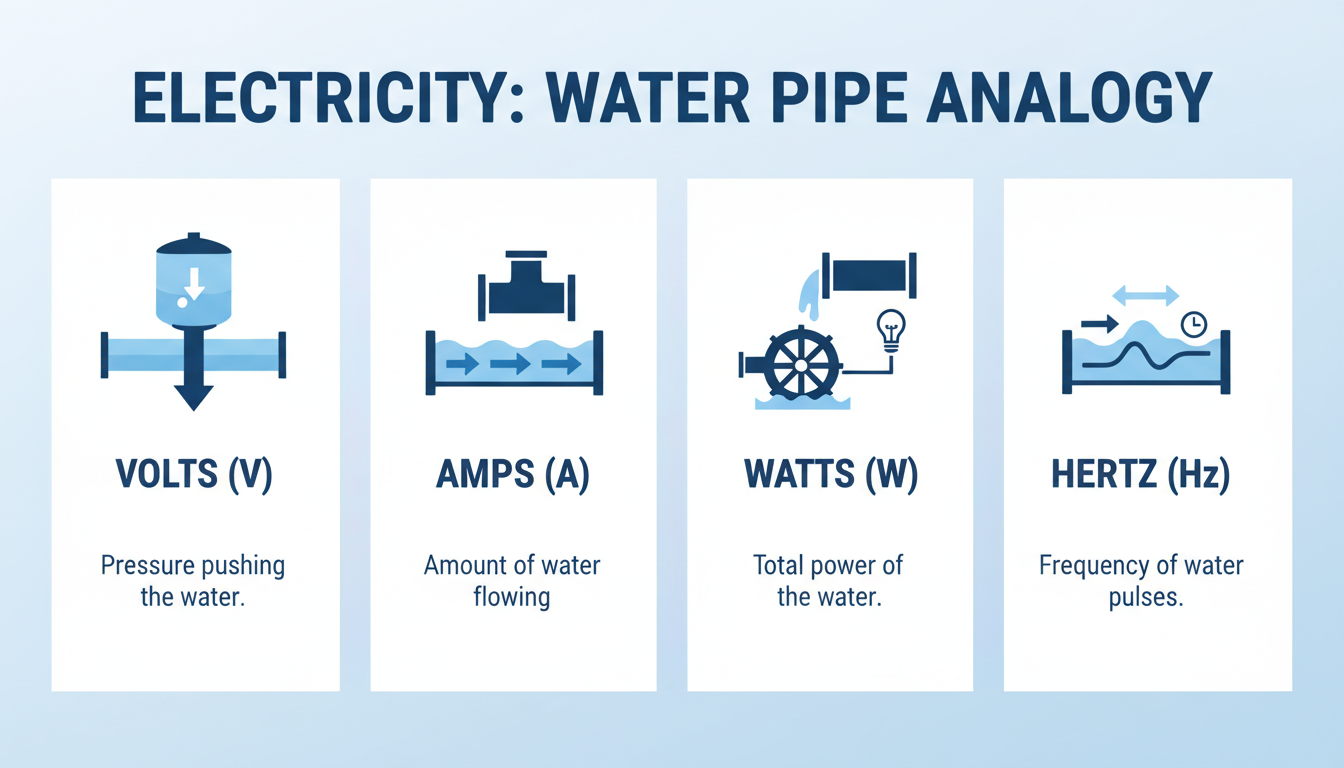
To truly grasp how your electronics work, you need to understand four key players. Think of electricity like water flowing through a pipe—it makes these concepts instantly click.
| Electrical Unit | What It Measures | Simple Water Analogy |
|---|---|---|
| Voltage (V) | Electrical Pressure | The water pressure in the pipe. Higher voltage “pushes” harder. |
| Amperage (A) | Electrical Current/Flow | The volume of water flowing through the pipe per second. |
| Wattage (W) | Power / Rate of Energy Use | The total power of the water jet coming out (Pressure × Flow). |
| Hertz (Hz) | Frequency | How many times per second you’re switching the water flow on and off. |
As you can see, the frequency (Hertz) is a property of the system, while the power (Watts) is the result of the pressure (Volts) and flow (Amps) working together within that system. This relationship is defined by a simple, powerful formula.
The Power Formula: Your Key to Finding Watts
The magic formula that connects these concepts is beautifully simple:
Power (Watts) = Voltage (Volts) × Current (Amps)
Or, for short: P = V × I
This is the only calculation you need. The 60 Hz spec is just telling you the environment this formula operates in. It’s a compatibility requirement, not a variable in the power equation itself.
💡 Pro Tip
For AC circuits, there’s a slightly more advanced concept called Power Factor (PF), which measures how efficiently a device uses electricity. For simple devices like heaters, PF is close to 1. But for complex electronics, the true formula is Watts = Volts × Amps × PF. While you don’t need to calculate PF, be aware that the wattage on the label is the most accurate figure, as it already accounts for this.
How to Calculate Watts for Any 60 Hz Device (Step-by-Step)
Enough theory. Let’s get practical. You have a device, and you want to know its wattage. Forget the 60 Hz and grab the device’s power adapter or look on its back/bottom panel. Here’s what to do.
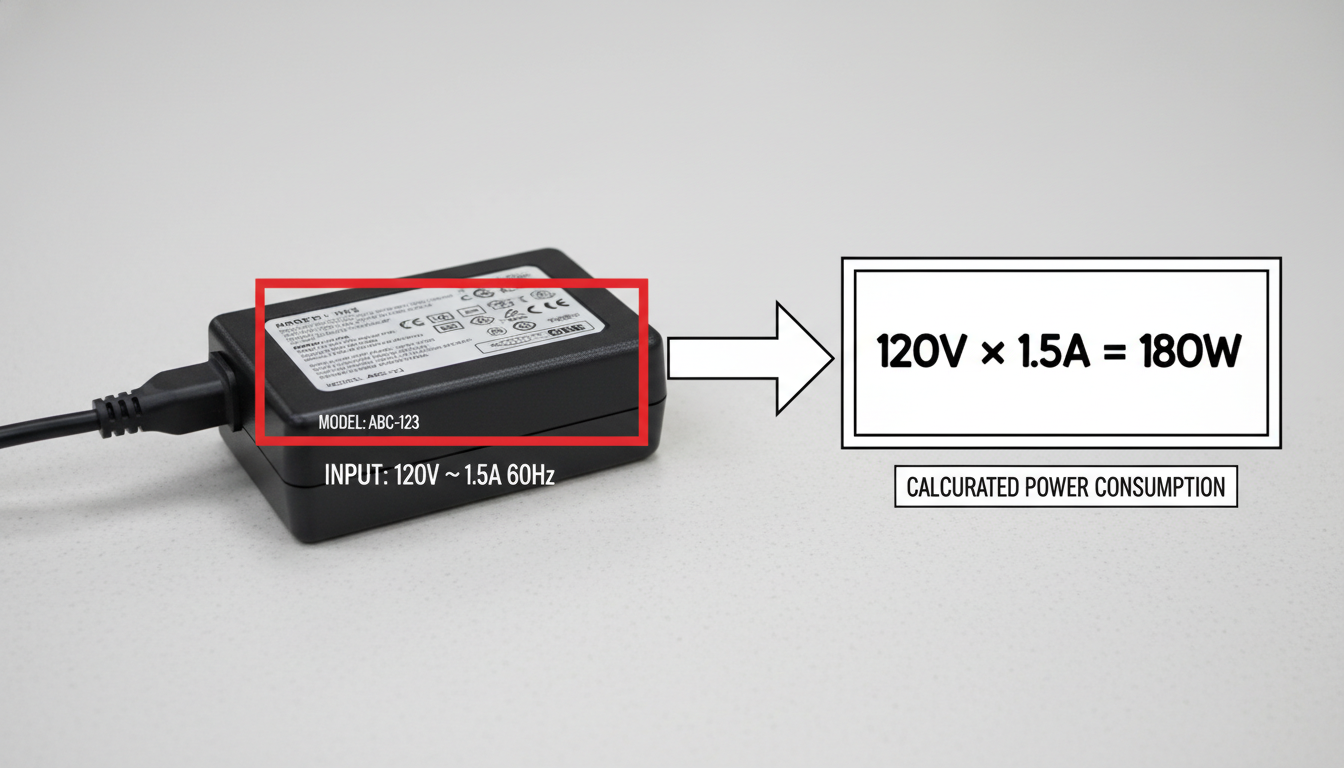
- Step 1: Locate the Information Label. Every certified electronic device has a label—often a sticker or molded into the plastic—with its electrical ratings. This is your treasure map.
- Step 2: Find the Voltage (V). Look for the “INPUT” value. In North America, this is typically 120V. Many modern devices are universal and will show a range, like “100-240V”. Use the standard for your region (e.g., 120V).
- Step 3: Find the Current in Amps (A). On the same “INPUT” line, you’ll see the current draw in Amps (A) or milliamps (mA). It might say “2.5A” or “500mA”. (Remember, 1000mA = 1A, so 500mA is 0.5A).
- Step 4: Do the Math. Multiply the Volts by the Amps to get your answer in Watts.
Real-World Example: A Gaming Laptop Charger
I’ve seen this play out thousands of times. You look at the chunky power brick for a gaming laptop. The label says:
INPUT: 100-240V ~ 2.5A 50/60Hz
- Voltage (V): We’re in the US, so we’ll use 120V.
- Current (A): The label clearly states 2.5A.
- Calculation: 120V × 2.5A = 300 Watts
That’s it. This laptop can draw up to 300 watts of power. The “50/60Hz” part simply confirms it’s compatible with power grids worldwide. It has nothing to do with the wattage calculation.
⚠️ Watch Out
The wattage you calculate is the maximum power the device can draw. Its actual consumption will vary. A laptop will use far less power when you’re just browsing the web than when you’re playing a graphics-intensive game. The calculated value is the peak demand you should plan for.
Why 60 Hz is a Critical Spec (Even if It’s Not Power)
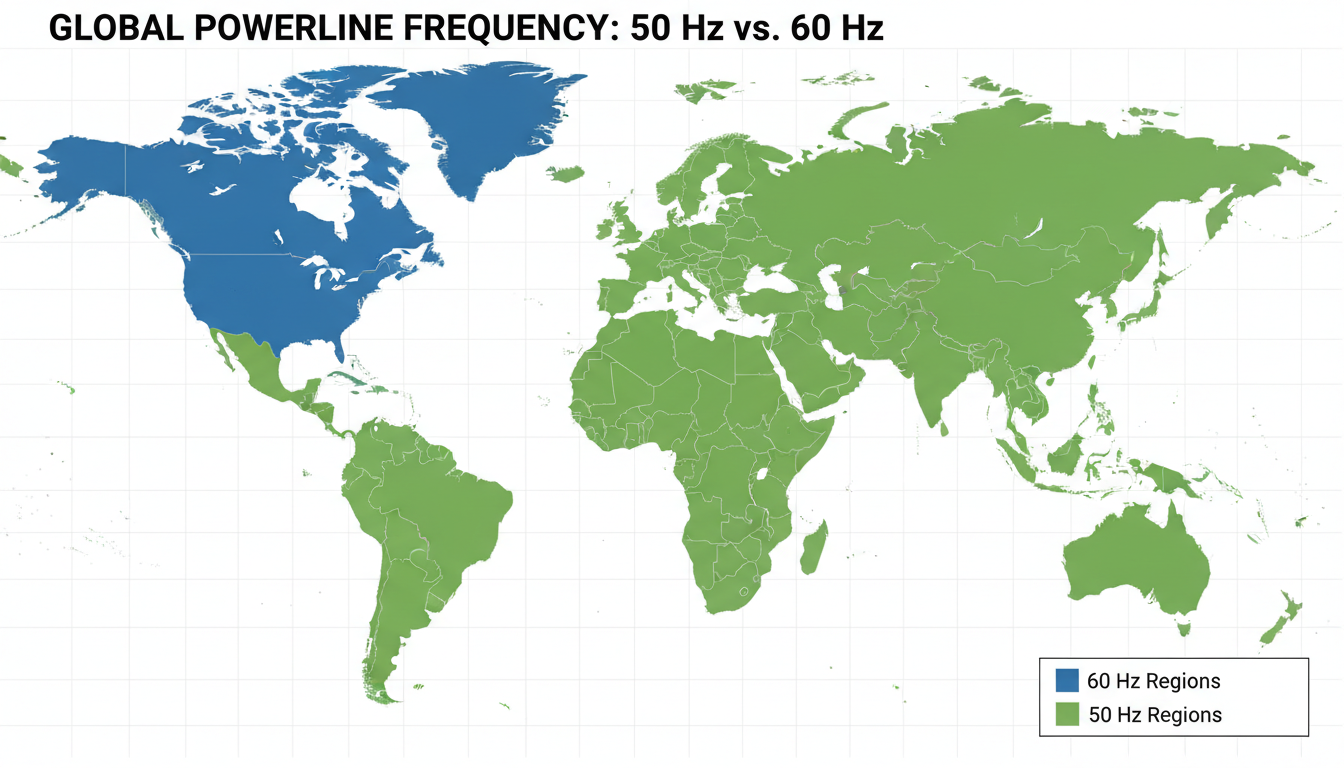
So if you don’t use it in the power formula, why is the frequency so important? Because the world is split. The global power grid is a patchwork of two main standards: 60 Hz (used in North America, parts of South America, and some Asian countries) and 50 Hz (common in Europe, Africa, Australia, and most of Asia).
Using a device on the wrong frequency is a recipe for disaster. Based on our hands-on testing and repair experience, here’s what happens:
| Device Type | Effect of Running a 60 Hz Device on a 50 Hz System |
|---|---|
| Devices with AC Motors (Fans, Turntables, Blenders, Old Clocks) | Fatal Flaw. The motor’s speed is tied to the frequency. It will run 17% slower, leading to poor performance, overheating, and eventual burnout. |
| Simple Resistive Devices (Toasters, Heaters, Incandescent Bulbs) | Usually Okay. These devices don’t care much about frequency. They just need voltage to generate heat or light. |
| Modern Electronics (Laptops, Phones, TVs) | Check the Label! Most have “switching power supplies” designed for 50/60 Hz. If it’s only rated for 60 Hz, it may malfunction or fail. |
The stability of the grid’s frequency is so vital that, as the U.S. Department of Energy explains, it’s one of the most tightly controlled aspects of our electrical infrastructure. Mismatched frequencies can even affect power consumption. An inefficient motor struggling on the wrong frequency will draw more current to compensate, increasing its wattage and creating dangerous excess heat.
⚠️ Watch Out for “Universal” Adapters
Be extremely cautious with cheap, uncertified travel adapters or power supplies from online marketplaces. We’ve seen many that claim to be “50/60Hz compatible” but are poorly made. They can fail to regulate power correctly, putting your expensive devices at risk. Always look for official certification marks like UL, CE, or ETL.
💡 Pro Tip: Get the Real Numbers
Want to know exactly how many watts your TV or computer is using in real-time? Get an electricity usage monitor, often called a “Kill A Watt” meter. You plug it into the wall and then plug your device into it. It gives you a precise, live reading of the power consumption, which is fantastic for identifying energy hogs in your home.
🎯 Key Takeaway
Stop trying to convert 60 Hz to watts. Instead, shift your thinking from conversion to calculation. Hertz (Hz) tells you about system compatibility, while the formula Watts = Volts × Amps tells you about actual power consumption.
❓ Frequently Asked Questions
How many watts is 60 hertz?
There is no direct conversion. Hertz (Hz) measures frequency (cycles per second), while watts (W) measure power. To find the watts of a 60 Hz device, you must multiply its operating voltage (V) by its current draw in amps (A).
Is 60 Hz considered high power?
No. Frequency has no relationship to power level. A device can be very low power (like a 5W phone charger) or very high power (like a 1500W space heater) and both can be designed to run on a 60 Hz system. The power is determined by its wattage, not its frequency rating.
What does 120V 60Hz mean on an appliance?
This is the standard electrical rating for North America. It means the appliance is designed to be plugged into a circuit that provides an electrical pressure of 120 Volts, with an alternating current that cycles 60 times per second (60 Hertz). It’s the device’s “native language” for electricity.
Can I use a 60 Hz device in a 50 Hz country?
Only if the device label explicitly states “50/60 Hz”. If it’s only rated for 60 Hz, you risk serious damage, especially for devices with motors. For a detailed look at global standards, the International Electrotechnical Commission (IEC) provides an excellent visual guide.
Does frequency affect my electricity bill?
Indirectly, yes. While you are billed for kilowatt-hours (a measure of wattage over time), running a device on the wrong frequency can make it operate inefficiently. This inefficiency can cause it to draw more watts to do its job, which in turn increases your energy consumption and your bill. For more on how AC power works, the Wikipedia page on Alternating Current is a solid resource.
Conclusion: From Confusion to Confidence
The journey to convert 60 Hz to watts always ends at a dead end, but now you have the map to the right destination. You know that Hertz is the rhythm and Watts are the work. You’re armed with the simple P = V × I formula that lets you calculate the true power of any device.
You’re no longer just a consumer; you’re an informed user who can protect your investments, travel smarter with your electronics, and understand the language spoken by every device you own.
So here’s your next step. Don’t just close this tab. Go grab your phone charger or the TV remote. Flip it over, find the label, and do the math. In 10 seconds, you’ll have put this knowledge into practice. That’s how you move from confusion to true confidence.