
📑 What You’ll Learn
Picture this: You’ve just unboxed a stunning limited-edition print from a European artist. You waited three weeks for shipping. You drive to your local craft store, confident you’ll grab a standard frame off the shelf. But when you get there, nothing fits. The 18×24 is too small. The 24×36 is massive. You’re stuck in measurement limbo.
Welcome to the world of 50x70cm.
If you’re scratching your head trying to figure out the 50x70cm to inches conversion, you aren’t alone. In 2026, with the global art market more connected than ever, this metric dimension has become a staple in American homes—often without us realizing it until we try to frame it. Whether you’re an interior designer, a digital artist, or just someone trying to hang a poster without wrinkles, precision is non-negotiable.
Here is the thing: rounding up doesn’t work here. A quarter-inch mistake ruins the look. In this guide, we’re cutting through the fluff to give you the exact numbers, the framing hacks pros use, and the technical specs you need.
🎯 Key Takeaway
50x70cm converts to approximately 19.7 x 27.6 inches. Do not attempt to squeeze this size into a standard US 20×28 inch frame without checking the rebate depth, as it often results in buckled artwork. The safest bet is a dedicated 50x70cm frame or a larger frame with a custom mat.
The Exact Conversion: 50x70cm to Inches
Let’s get the math out of the way so we can focus on the application. The international conversion standard is fixed: 1 inch equals exactly 2.54 centimeters. When we run the numbers for 50x70cm, we get a result that isn’t quite as clean as we’d like.
The Calculation:
- Width: 50 cm ÷ 2.54 = 19.685 inches
- Height: 70 cm ÷ 2.54 = 27.559 inches
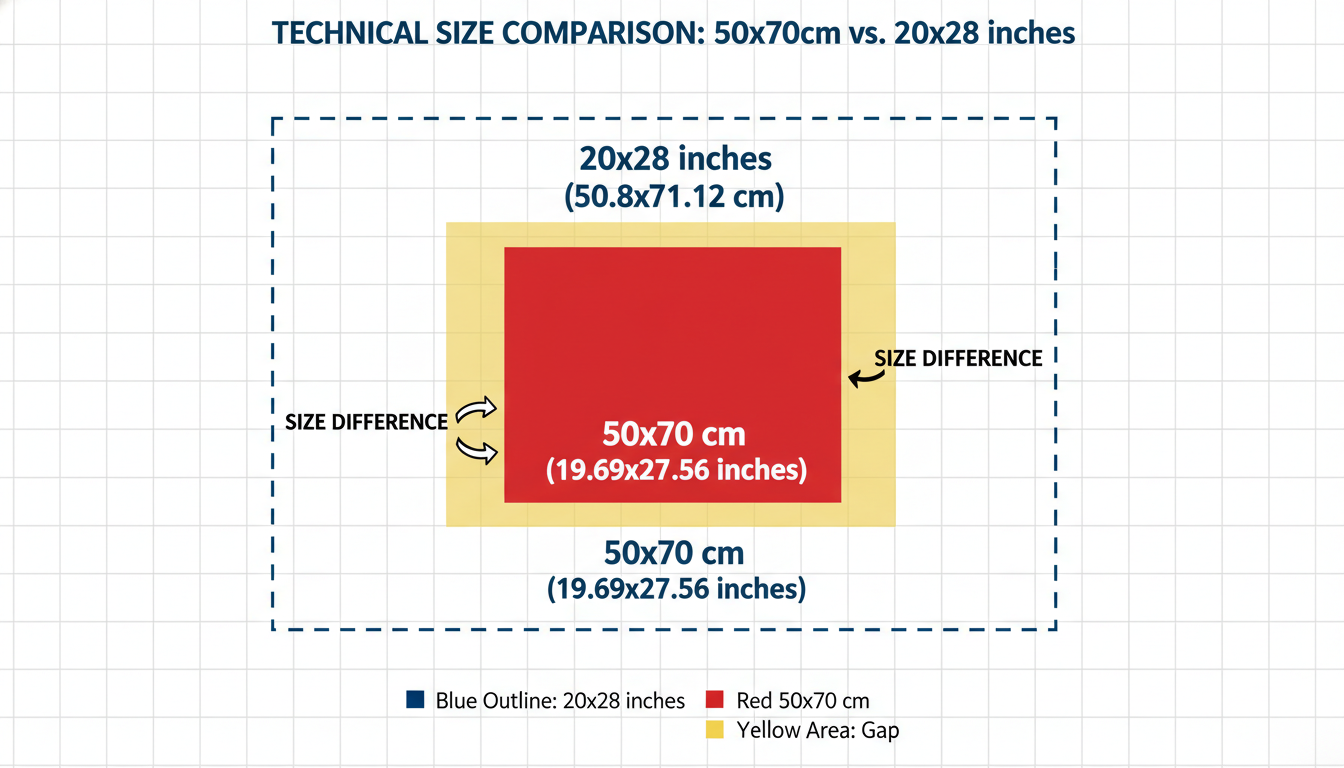
In the industry, we call this “The Metric Gap.” That missing 0.3 inches on the width and 0.4 inches on the height is where most DIY framers get into trouble. If you buy a frame labeled “20×28 inches,” you might assume it fits. But depending on the manufacturer’s tolerance, your print might slide around, revealing the backing board.
Conversion Cheat Sheet
To help you visualize how this size stacks up against standards you might know, here is a breakdown of the data.
| Measurement System | Dimensions (Width x Height) | Notes |
|---|---|---|
| Metric (Exact) | 500mm x 700mm | The precise manufacturing size. |
| Imperial (Exact) | 19.685″ x 27.559″ | Used for high-precision cutting. |
| Retail Labeling | 19 ¾” x 27 ½” | Commonly seen on packaging. |
| US “Equivalent” | 20″ x 28″ | Warning: This is 0.3″ wider and 0.4″ taller than the print. |
The “IKEA Effect” & Global Standards
Why is this specific size so ubiquitous? You can thank the International Organization for Standardization (ISO) and, frankly, IKEA.
In Europe and most of the world, paper sizes follow the B-series standard. The 50x70cm format is essentially the B2 paper size (which is technically 500mm x 707mm, but often trimmed to 700mm for commercial framing). Because European retailers dominate the affordable home decor market, they export these metric frames to the US.
According to the National Institute of Standards and Technology (NIST), the US is one of the few remaining countries primarily using the imperial system. This creates a friction point for consumers. You buy a print from a London-based Etsy seller (Metric) and try to frame it with a Target frame (Imperial). It’s a square peg in a round hole situation.
💡 Pro Tip
When shopping for frames online in the US, search specifically for “50x70cm frame” rather than converting to inches. Major retailers like Amazon, Walmart, and IKEA now list the metric size as a distinct category to avoid customer returns due to poor fit.
Framing Guide: Solving the Gap Problem
I’ve framed hundreds of prints in this size, and I’ve seen every mistake in the book. If you have a 50x70cm print, you have three viable paths to get it on the wall looking professional.
Option 1: The Direct Fit (Easiest)
The path of least resistance is to buy a frame manufactured in centimeters. IKEA’s Ribba, Lomviken, and Strömby lines are native 50x70cm frames. They fit perfectly. No tape, no sliding, no trimming.
Option 2: The Custom Mat (Most Professional)
This is my personal favorite method. It makes affordable posters look like high-end gallery art. You buy a larger, standard US frame—typically 24×36 inches—and order a custom mat board.
The Workflow:
- Buy a 24×36 inch frame (widely available).
- Order a mat board with an outer size of 24×36 inches.
- Request the inner window opening to be 19.5 x 27.4 inches.
⚠️ Watch Out
Don’t cut the window to the exact print size! You need to overlap the artwork by about 1/8th of an inch (3-4mm) on all sides to hold it in place behind the mat. If you cut the window exactly 19.7 x 27.6, the print will fall through.
Option 3: The Float Mount (Modern Aesthetic)
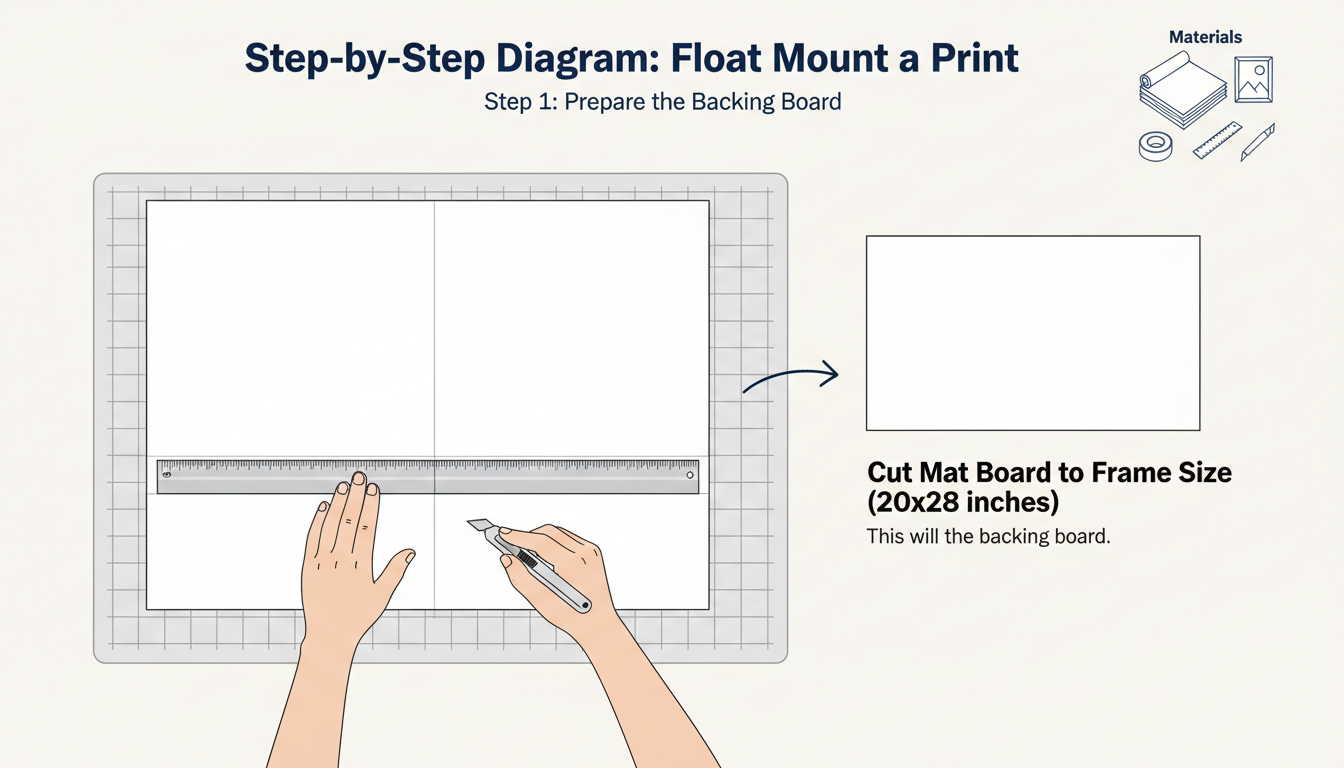
If you have a frame that is slightly too big (like a 20×28 inch frame) and you don’t want to use a mat, you can “float” the print. This involves mounting the print on top of a backing board so the edges are visible.
Since the 20×28 frame is larger than the 50x70cm print, floating it centers the artwork and leaves a deliberate, stylish gap around the edges, revealing the backing board color. It turns the size mismatch into a design feature.
Pixel Perfect: Printing at 50x70cm
Are you a photographer or digital artist? If you are preparing a file for print, the physical dimensions are only half the battle. You need the right resolution. A blurry print at this size is immediately noticeable.
To achieve a crisp, gallery-quality result, you need to aim for 300 DPI (Dots Per Inch). Here is how the 50x70cm to inches conversion translates into pixels.
| Quality Level | DPI | Pixel Dimensions (W x H) | Best Use Case |
|---|---|---|---|
| Draft / Billboard | 150 DPI | 2,953 x 4,134 px | Viewing from distance (5+ ft away). |
| Standard Print | 240 DPI | 4,724 x 6,614 px | Good for matte posters. |
| Fine Art / Gallery | 300 DPI | 5,906 x 8,268 px | High-detail photography & giclée. |
If you are working in Adobe Photoshop or Illustrator, set your canvas to 500mm x 700mm at 300 PPI right from the start. Upscaling a small image later usually results in pixelation or artifacts.
For more on international paper standards and printing formats, the ISO 216 standard outlines the mathematical logic behind these aspect ratios, which ensures that scaling artwork up or down retains the same proportions.
Beyond Art: Pillows & Luggage
While we mostly talk about frames, the 50x70cm dimension pops up in two other specific areas of life: bedding and travel.
The “Euro Sham” Pillow
In the US, a standard pillow is roughly 20×26 inches. However, if you buy bedding from luxury Italian or French brands (like Frette or Sferra), their “Standard” is often 50x70cm.
Does it fit? Yes, mostly. A US Standard pillow (20×26) will fit inside a 50x70cm case, but it might be a little loose on the width. A US Queen pillow (20×30) will be a very tight squeeze and might make the pillow feel hard.
Carry-On Luggage Limits
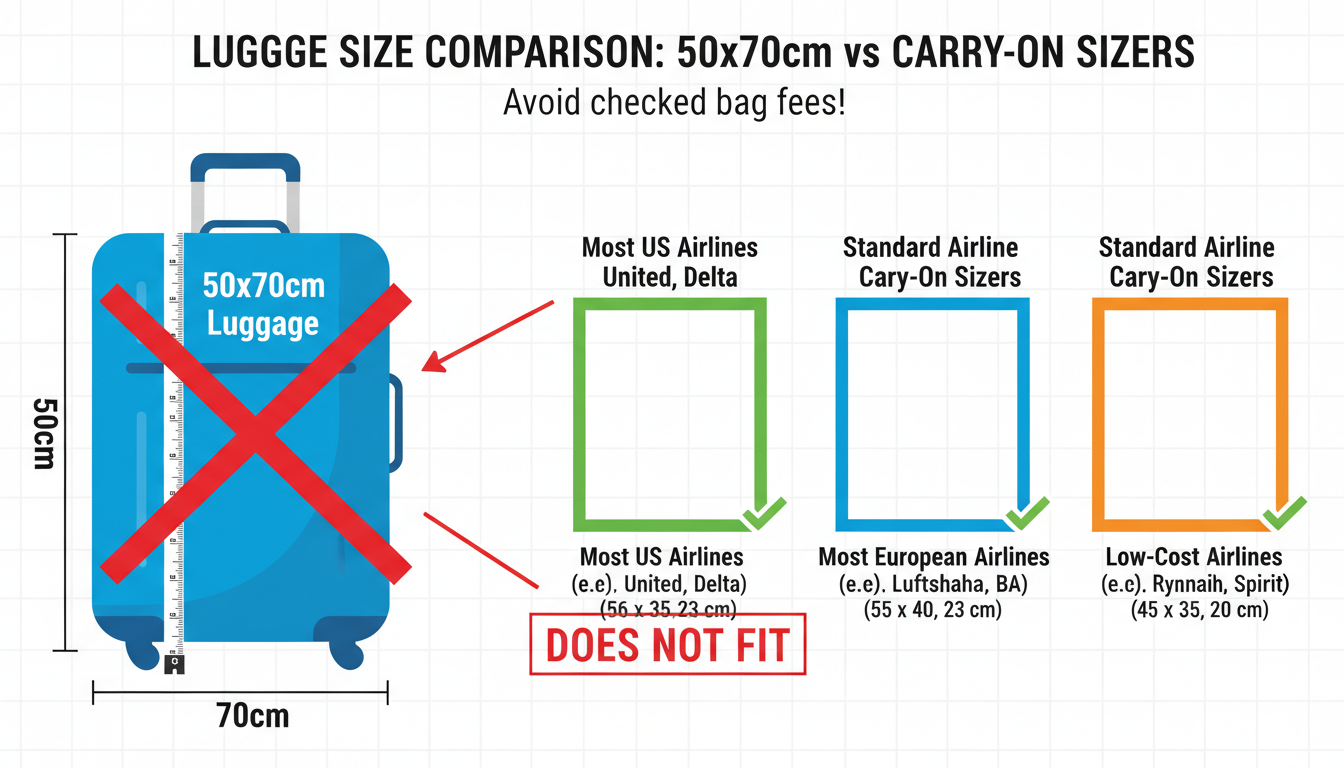
Travelers often ask if a 50x70cm bag is carry-on compliant.
The verdict: No. Most international airlines cap carry-on height at 55cm (approx 21.5 inches). A 70cm bag (27.5 inches) is strictly a checked bag size. It’s a medium-to-large suitcase, perfect for a week-long trip, but don’t try to bring it in the cabin.
Conclusion
Understanding the 50x70cm to inches conversion is about more than just swapping numbers; it’s about ensuring your home decor looks intentional and professional. Remember, 19.7 x 27.6 inches is your magic number.
Don’t settle for “close enough” with a 20×28 frame unless you are prepared to float mount or mat the artwork. The best approach is always to match the frame origin to the print origin—metric with metric. It saves you time, money, and the headache of a wrinkled poster.
Ready to start hanging? Grab your tape measure, check your frame rebate, and get that gallery wall started.
❓ Frequently Asked Questions
Is 50x70cm the same as 18×24 inches?
No. 50x70cm (19.7″ x 27.6″) is significantly larger than 18×24 inches. If you try to put an 18×24 print in a 50×70 frame, you will have large gaps. If you try the reverse, you would need to cut nearly 2 inches off your artwork width and 3.5 inches off the height.
What is the closest US standard frame size to 50x70cm?
The closest standard US size is 20×28 inches. However, this frame is slightly larger than the print (about 0.3″ wider and 0.4″ taller). You will likely need a backing board that matches the print color to hide the gaps.
Can I print a 50x70cm file at Walmart or Walgreens?
Usually, no. Most US drugstores print in standard imperial sizes (16×20, 20×30, 24×36). You will likely need to crop your image to 20×30 inches or find a specialized professional print shop that handles custom or metric sizes.
How many pixels is 50x70cm at 300 DPI?
For high-quality printing, a 50x70cm file should be approximately 5,906 x 8,268 pixels. This ensures sharp details and no pixelation when viewed up close.
Is 50x70cm a standard pillow size?
Yes, but primarily in Europe and Australia. In the US, it is very close to a “Standard” pillow (20×26 inches), but slightly longer. It is often referred to as a “Queen” size in some European markets.